
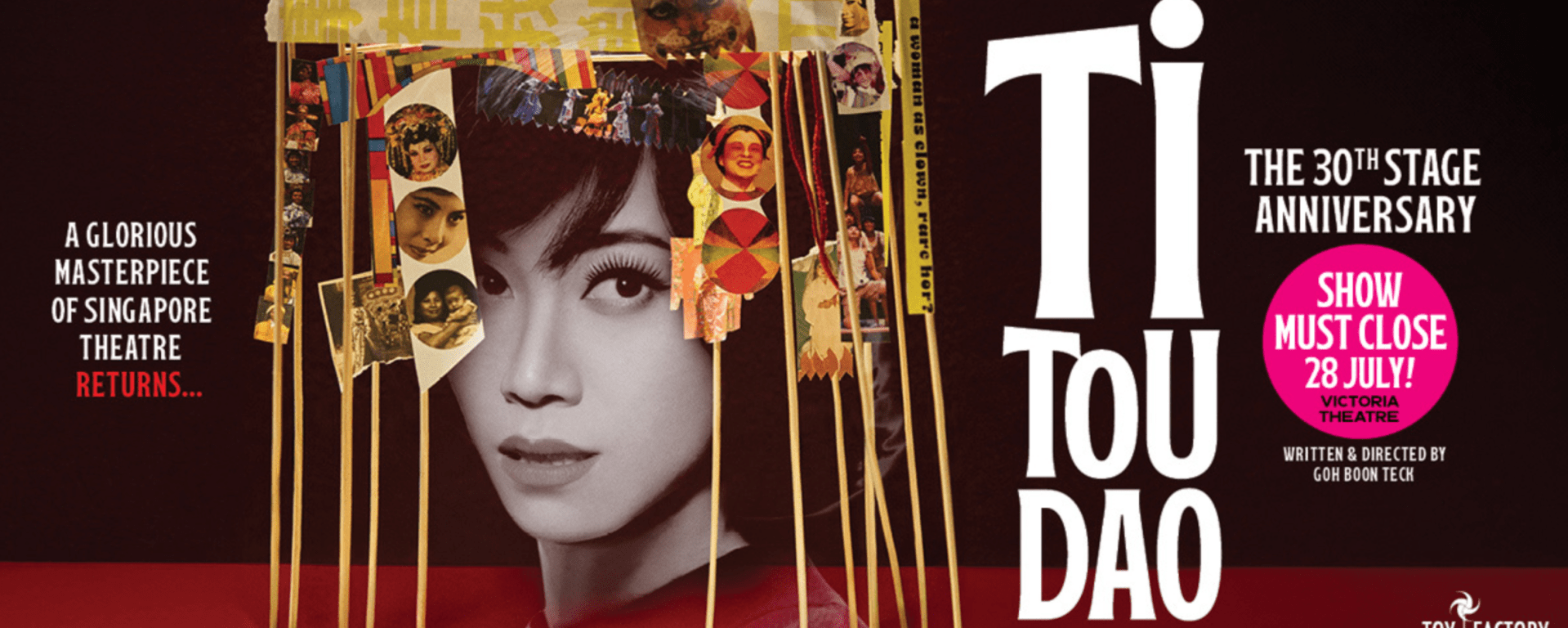
The story of Titoudao was first brought to light in 1994, when Toy Factory artistic director Goh Boon Teck wrote the iconic play and premiered it at the Jubilee Hall at the Raffles Hotel. In the three decades since, the play, which is based off the true life story of Singaporean Wayang star Madam Oon Ah Chiam, has been restaged multiple times, and even received a television adaptation in 2020. Now, it’s set to return to the stage once again, as it celebrates its 30th anniversary with a brand new staging at the Victoria Theatre this week.
What’s perhaps also incredibly special about this play, is how writer/director Goh Boon Teck is related to it – Madam Oon is, after all, his own mother, and through the staging of this play over and over, continues to tell of her struggles, of this petite lady with big dreams, fighting against despairing personal states of poverty, gender inequality and shadowed marital vexations. Yet through it all, she takes these hardships and challenges in life by the horns, and finds something powerful and universally resonant in how she can realise her dreams and find her place in the world, all while paralleling pivotal events in Singapore’s history to showcase how our lives have been transformed over the course of 5 decades.
This time around, Boon Teck will be directing a brand new cast, and reimagine the staging yet again for this 2024 production, with actress Tan Rui Shan (with a star turn in Toy Factory’s Kwa Geok Choo) in the lead as Madam Oon. As the team prepares to bring the epic biography to life once again, we spoke to both Boon Teck and Rui Shan, as they shared about the significance of the play 30 years on, and their creative process. Read the interview in full below:

Bakchormeeboy: How do you feel Titoudao continues to encapsulate and represent what Toy Factory stands for as a theatre company, whether in terms of its storytelling or style?
Goh Boon Teck: Titoudao embodies the essence of Toy Factory’s mission to create authentic, meaningful, and culturally rich theatrical experiences.
Bakchormeeboy: How has Titoudao been reimagined for this 30th anniversary staging, and what was the inspiration behind the new visuals and style, especially when it comes to evoking the mood and era?
Goh Boon Teck: For this production, our goal is to evoke the warm and candid atmosphere of a temple festival. Unlike our previous productions, we chose to construct an actual wayang stage on the main stage of Victoria Theatre — essentially, a stage on a stage. Additionally, I have personally hand-drawn eight wayang sceneries that will be featured throughout the show, adding a unique and artistic touch to this staging.

Bakchormeeboy: Let’s talk about what went into the casting – what were the main considerations, especially when casting lead Rui Shan?
Rui Shan: Actually, it’s only my second time working with Boon Teck, and he cast me without me even auditioning, and simply asked me if I wanted to play the lead role in Titoudao!
Goh Boon Teck: Rui Shan is hardworking and a thinking actress, brillant in delivering monologues (we saw her in Kwa Geok Choo) I feel safe handling this role over to her. She also sparkles on stage, enjoys entertaining people, loves to joke and play comedic roles, not to mention she is very passionate in acting and singing, similar to my mother.

Bakchormeeboy: Ruishan, how different is this role from the others you’ve played so far? Did you ever catch any earlier productions of the show? What has the research, rehearsal and preparation process been like?
Rui Shan: It’s been very different from the other roles I’ve played because there’s a very clear reference and homage to Hokkien wayang performance, alongside having to use specific dialects and languages in the play. Besides my role as Kwa Geok Choo, I’ve also rarely gotten a chance to play older characters, and in this play, I’ll be playing her across a whole range of ages, from the age of 5 to her 50s.
As for the preparation process, there was a deliberate choice to avoid watching any earlier productions or the TV series, because we wanted to be able to come up with our own version instead of being influenced by them. We only watched them after we finally did a full run, and saw how different we managed to make it then. Meanwhile, we also did intensive learning of wayang with workshops in May, to better digest and practice how to do it, before rehearsals began in June. I felt that we had enough time to get comfortable with the world, and to really digest and embody these elements.
We also talked to our teach and live percussionist a lot about what it was like to experience all that, because wayang show are now so limited, and we actually got a chance to see a show that Boon Teck arranged for us to watch, and we got to rehearse with some wayang actors as well, these professionals who’ve been doing it for so long, and we really got to understand their process and understand what it was like to perform it.

Bakchormeeboy: How has directing Titoudao changed over the years? As a personal story, how much emotion do you put into the rehearsal process, or do you put on a director’s hat and choose to look at the work from a more objective point of view?
Goh Boon Teck: The script does not change much from each production, there are usually just minor edits to make it more relatable to our current audiences each year. There are also new changes to the costumes and set.
At the same time, Titoudao is undeniably close to my heart, and it’s impossible to detach completely from the emotions involved. However, as a director, I strive to balance my personal connection with an objective perspective. This dual approach ensures that the story is told with authenticity and emotional depth while maintaining a clear, professional vision that benefits the entire production. I guide the cast through both the emotional landscapes of their characters and the technical aspects of their performances, aiming to create a harmonious and impactful final piece.

Bakchormeeboy: Rui Shan, over the years, we’ve watched you grow and make a name for yourself in the local theatre scene, especially as a choreographer and as a performer. Where do you see yourself now, and what are your goals as an artist in Singapore?
Rui Shan: These days, I think I’m in a comfortable place, where I’ve gained a lot more clarity in knowing what are the things I enjoy doing, and what I’m good at. I think I’m just very lucky and grateful to have all these opportunities to grow, with these people taking a chance on me. In future, I hope I can pass that on and give similar opportunities for younger artists to have the space to practice and perform and learn and grow, and most of all, to create more original works and tell Singaporean stories. That’s what I do want to continue exploring, and what attracted me to Toy Factory in the first place – to dig deep into one’s culture and roots, and I really admire how Boon Teck has so much drive and intention to do that in his art.

Bakchormeeboy: How aware do you think the average Singaporean is about Titoudao, especially since it’s been staged four times now, and even has a TV adaptation?
Goh Boon Teck: I believe that Titoudao has gained significant recognition among Singaporeans over the years. Its multiple stagings and the TV adaptation have helped to solidify its presence in the cultural landscape. While not everyone may have seen the play, many are likely aware of its existence and its importance as a piece of local theatre. The TV adaptation, in particular, has broadened its reach, making the story accessible to a wider audience and introducing Titoudao to those who may not typically attend theatre productions.
Bakchormeeboy: Why do you feel that this is a show that has been able to remain so relevant even today, 30 years on, and how do you hope audience members respond to the show?
Goh Boon Teck: Titoudao remains relevant today because it addresses universal themes such as resilience, cultural identity, and the human spirit’s ability to overcome adversity. These themes resonate with audiences across generations. The story’s authenticity and emotional depth continue to captivate viewers, making it a timeless piece. I hope that audience members leave the show feeling inspired and connected to the cultural heritage it portrays. I also hope they appreciate the strength and resilience of the characters, seeing reflections of their own lives and challenges within the narrative.

Bakchormeeboy: What have been the greatest learning points for both of you from working on this production of Titoudao so far?
Rui Shan: My greatest learning point has been from how Boon Teck is so good at seeing what each cast of Titoudao has brought to the table. Even though he’s done it maybe six times now, each production is vastly different and he acknowledges and is able to use each cast’s strengths to work on the show. That’s what true collaboration is in artmaking, where we make each production our own based on our own ability and strength. Going forward, I hope to be able to do something similar in my own collaborative processes in future. And working in Titoudao, it made me realise how little I don’t know about my own roots or even my own family and cultural background, where I don’t even ask my own parents or grandparents about the past. I’m holding that curiosity now, and want to learn more about it, and be more appreciative of this history, heritage and culture that has all led and shaped me to be who I am today.
Goh Boon Teck: Working on Titoudao has been an enriching and transformative experience for both of us. One of the greatest learning points has been the importance of understanding and respecting the cultural and historical context of the story we are telling. Delving into the traditions of Wayang and the personal history behind Titoudao has given us a deeper appreciation for the art form and its significance.
Additionally, collaborating with a diverse and talented cast and crew has highlighted the power of teamwork and collective creativity. We’ve learned the value of adaptability and openness, as every rehearsal and performance brings new insights and challenges. Ultimately, this production has reinforced the idea that theatre is not just about the final performance but also about the journey, the learning, and the connections made along the way.
Photo Credit: Toy Factory Productions
Titoudao plays from 5th to 28th July 2024 at Victoria Theatre. Tickets available from SISTIC
 Bakchormeeboy