
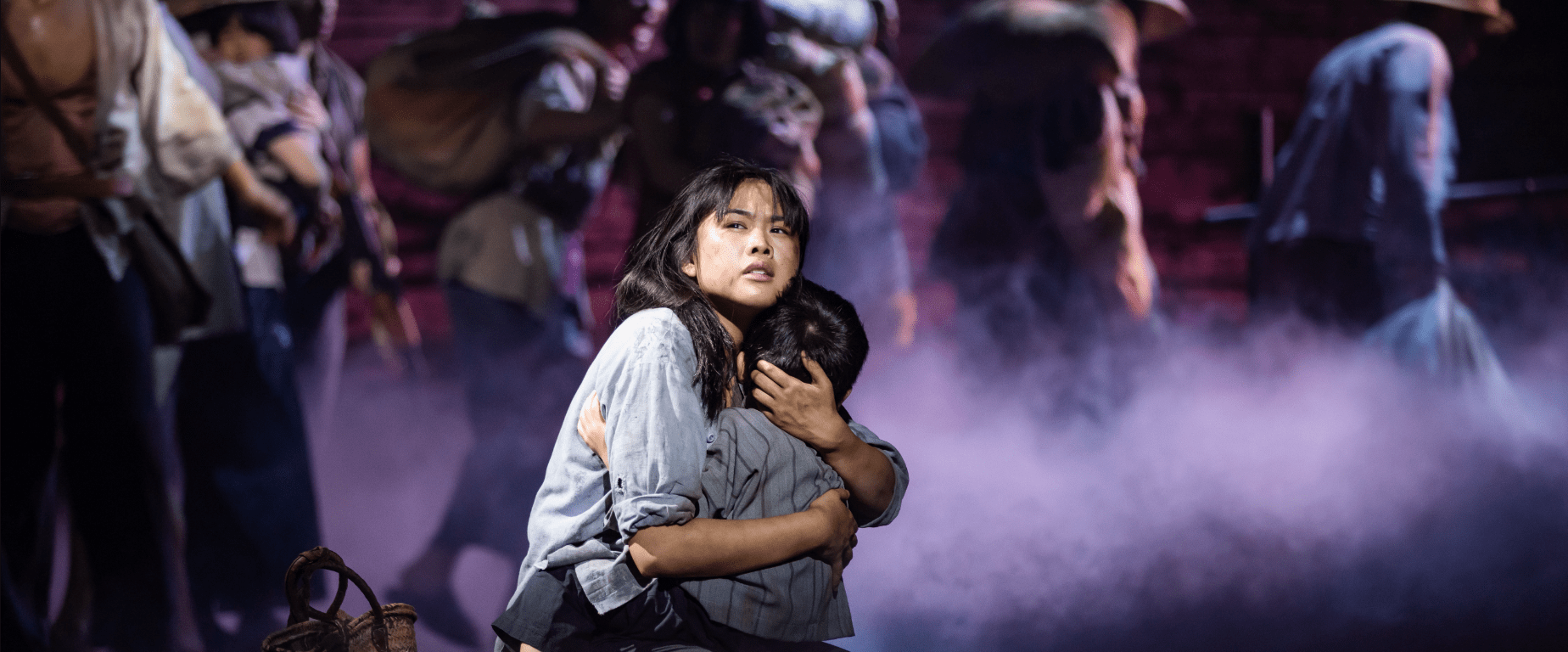

Look beyond the ‘romance’ and you’ll find a scathing criticism of war and the pain it leaves in Schönberg and Boublil’s classic tragedy.
Miss Saigon is often considered one of Broadway and the West End’s biggest legacy musicals, with a beautiful score composed by the duo that made smash hit Les Miserables, show stopping special effects and choreography that leave you breathless with its theatrics, and a lead role that catapulted a young Lea Salonga to global superstardom, along with many other Asian musical ingenues in her wake.

In this new international tour, directed by Laurence Connor, Miss Saigon retains everything that made it a smash hit to begin with, including a stellar cast that brings the characters and songs to life. Miss Saigon is set in 1970s, during the height of the Vietnam War, presenting a Saigon that is in shambles and on the brink of being razed to the ground. Girls from the village are left orphaned and homeless, and many are forced to turn to prostitution for survival, selling their bodies to their brand new clientele – the hordes of American soldiers on tour to aid South Vietnam in the brutal civil war against the North.

The musical zooms in on one specific bar – Dreamland, where innocent 17-year old Kim (Abigail Adriano) is working under French-Vietnamese pimp the Engineer (Seann Miley Moore). On an evening where the soldiers have come to have their fun, John (Lewis Francis) ends up helping his buddy Chris (Nigel Huckle) by buying time and a room with Kim. They spend the night together, falling in love, with Chris promising to save Kim from her circumstances and bringing her back to America with him. This however, completely falls through, and the two lovers are separated for three years, with Kim birthing and caring for a mixed-race son in hiding, still pining to see Chris again, while unbeknownst to her, he seems to have moved on, marrying an American wife, Ellen (Sarah Morrison), yet haunted by guilt at leaving Kim behind.

Star-crossed due to miscommunication and circumstances, a series of ordeals leads the two to reuniting again in yet another foreign land. But being based off Puccini’s Madama Butterfly, tragedy ensues when the two realise that they can no longer be together due to how much their lives have changed since that fateful meeting during the war. Realising the impasse she’s reached, Kim decides to take her own life, in order to force Chris and Ellen to take her son to America for a better life than she could ever have hoped to give him.

Before diving into the review proper, it seems important to address the criticism that has been levied at Miss Saigon over the years, largely surrounding its blatant Orientalism that objectifies Asian women as sex workers, and the perspective that they are looking for an escape by finding someone to start a new life, far away from home. Rather than an explicit ‘romance’, Miss Saigon seems to have taken on new meaning in the 21st century, where a more critical reading may instead lead us to view Miss Saigon as an anti-war musical, and the false promises America gave that left it worse for the wear, where neither side is entirely right in the end.

Throughout Miss Saigon, we view a majority of characters who are forced into their positions due to uncontrollable factors – the women working in Dreamland are damsels in distress who have nowhere else to turn to after the bombing, emphasising the destructive effects of war. Despite their enthusiastic facade and skimpy clothing, sex worker Gigi, played by Mikaila Imaguchi, manages to create sympathy for this situation in “Movie in My Mind”, and addresses how they begrudgingly recognise American soldiers as their main way out and a better future, with the American Dream weighing heavy in their consciousness, even with their abusive and objectifying behaviour.

But the American Dream is far more of a lie than any of them realise, with John outright rejecting Gigi when she begs him to take her to America, and is echoed too in the way Chris’ promises ring empty for Kim, unable to get her a visa in time before he is whisked back home. Everyone is a victim of the war and the mess it left behind, from John’s involvement in the Bui-Doi foundation trying to make amends by helping the countless fatherless American-Vietnamese children find family, to Ellen being woken up by Chris’ screams in the middle of the night. Even when one thinks they can leave the past behind, it always finds a way to haunt them and chase them back to America.

Kim, as the protagonist, must be someone without sin in order to root for her. While every other character seems to want to act selfishly and for themselves, Kim makes for a strong heroine who showcases veritable growth as you watch her go from naive girl in her ao dai, to a determined mother who will do anything for her son, making decisions of her own accord rather than at another person’s command. As Kim, Abigail Adriano is a force to be reckoned with, nailing Kim’s signature moments with her clear, crisp singing. She captures every emotion in her soaring voice and face, visible even from afar, and shares strong onstage chemistry with her scene partners. You sense the innocent love she has for Chris in duets such as ‘Sun & Moon’ and ‘Last Night of the World’, while her body language always adjusts to protect her son whenever he’s in the scene. You want her to succeed in spite of knowing her slim chances, because of her sheer force of will, to put herself through the toughest or riskiest of situations for her lover or her son, and Adriano actions allow us to see her as a fully-formed, three dimensional character.

In contrast, Chris is far from the hero of her dreams, and clearly becomes burdened by being unable to reconcile his perception of American exceptionalism with his failures to Kim, and later on, to Ellen, of being a good husband. Nigel Huckle’s performance is charming, similarly new to romance when he meets Kim, but clearly in constant dilemma over the right thing to do at every stage, a nervous wreck at being unable to find a win-win solution. This is a performance that balances both criticism of Chris for not keeping his word to Kim, and later on, almost wanting to fob her off with money, but also portraying him as a victim of circumstances, finding light where he can in the wake of his trauma, left with little choice given his fragile mental state.

Meanwhile, it makes sense that Ellen would see Kim as an interloper in their marriage, wanting to find a solution to help Kim without jeopardising her relationship with Chris. Sarah Morrison delivers genuine emotion and verve in her number “Maybe” when she makes up her mind to hold on to her marriage, and is both understandable while also evoking dislike for how much it hurts Kim.

And perhaps the most intriguing character of all is the Engineer, which Seann Miley Moore plays with aplomb. At once a comical antagonist, the Engineer evokes some of the most polarising responses from audiences throughout the performance, flipping between horror at the way he treats his girls, to adoration over the way he ad libs and brings out the diva within. Moore understands this careful balance, and feels like a genuine threat with the power and control he holds over his whores, while leaning completely into the more foppish aspects of his performance at other times, constantly flirting with other male characters and offering sexual favours, delighting in the villainy and schemes as he slinks his way across the stage. You fully understand his survivor mentality when he reveals his tragic backstory, a glimpse into what Kim’s son could potentially become if he is not saved, while performing the show’s most compelling song and dance number of all – ‘The American Dream’.

‘The American Dream’ is not only an audacious presentation of American excess and capitalism, skewering the idea of freedom through hyperbolic, over the top delusions of how the Engineer will make his fortunes, but is also the prime example of what audience come to Miss Saigon for – the sheer spectacle. With a giant golden head of Lady Liberty, female dancers dressed in glittering bodysuits and feathered headpieces, males in dapper suits, you see the stage is dripping in theatrical splendour, with the choreography lush and sultry, sheer joy emanating from the whole cast, while Moore fully indulges the audience with his antics, commanding the stage at all times even against his shimmering cast mates, taking the moment to shine and take back the spotlight whenever it turns to him, such as laying back in ecstasy on a Cadillac that arrives onstage.

To that end, all of Miss Saigon‘s mass numbers are highlights to look forward to, all of which are ostentatious affairs filling the entire stage. In contrast to ‘The American Dream’ is the similarly impressive ‘The Morning of the Dragon’, where the stage is adorned with with banners depicting the Vietnamese flag and a massive bust of Ho Chi Minh in the background, signifying the victory of North Vietnam. One sees it almost in opposition to the Statue of Liberty promoting capitalism and indulgence, instead championing ‘values’ and tradition. This sequence is a standout in the first half of the musical, and involves almost the entire cast performing synchronised flag and ribbon sequences, alongside impressive acrobatics, flipping across the stage in time to the music, and a grand dragon breathing smoke from its nostrils. Both scenes are equally impressive, and as twin scenes to each other, perhaps represent the idea that neither side is truly in the right – what matters is which country you choose to align with in the end, and whether you can live with its flaws amidst its joys.

Miss Saigon is also impressive for its detailed set pieces that further highlight the massive change Vietnam was undergoing at the time. Early on, ‘The Heat is On in Saigon’ sees all the bargirls at Dreamland partying it up with the American soldiers, in a whirlwind sequence that leads to the titular Miss Saigon competition – there is a lot going on, but always makes sense, where any moment your eyes focus on a specific character, they’ll be doing something interesting and never idle. When Kim and Chris get ‘married’, the house they perform the ceremony is lavishly decorated in florals, and even involves real candles. Later on, the sleazy part of Bangkok is filled with neon lights overhead, hawking raunchy sex and vulgar pleasures, and you immediately get a sense of unease as if stepping into an actual red light district. And it is of course a famous pulse-pounding scene in the second half that make so many fans of the show – requiring perfect timing from the entire ensemble shifting giant set pieces around, changing perspectives and singing, with special effects and theatrical magic at its finest, nailing Miss Saigon’s most epic moment in its full glory.

Miss Saigon retains its popularity even today for good reason – it has all the right ingredients for success, and a production like this one that delivers on all those fronts can be guaranteed of a good reception. It remains a prime platform for putting Asian actors onstage, and if you look at the original poster for Miss Saigon – it is not the romance between Kim and Chris is not foregrounded. Rather, it is the image of the Engineer and Kim, holding hands with her son and leading him out of Vietnam, that remains the key representation of what this musical is about. As such, Miss Saigon is in fact a story of struggle, the tale of a refugee betrayed by her American lover, and her search of a better life, a victim of war and all the pain it brings with it. In mourning the loss of Kim’s childhood and happiness, we also admire her dedication to survival and carving out a bright future for herself and her child, a familiar story to so many immigrants from third world nations. And for that, alongside its sheer theatrical spectacle and hauntingly beautiful soundtrack, is what makes Miss Saigon worth watching.
Photo Credit: Daniel Boud
Miss Saigon plays from 15th August to 29th September 2024 at the Sands Theatre at Marina Bay Sands. Tickets available here
 Bakchormeeboy