
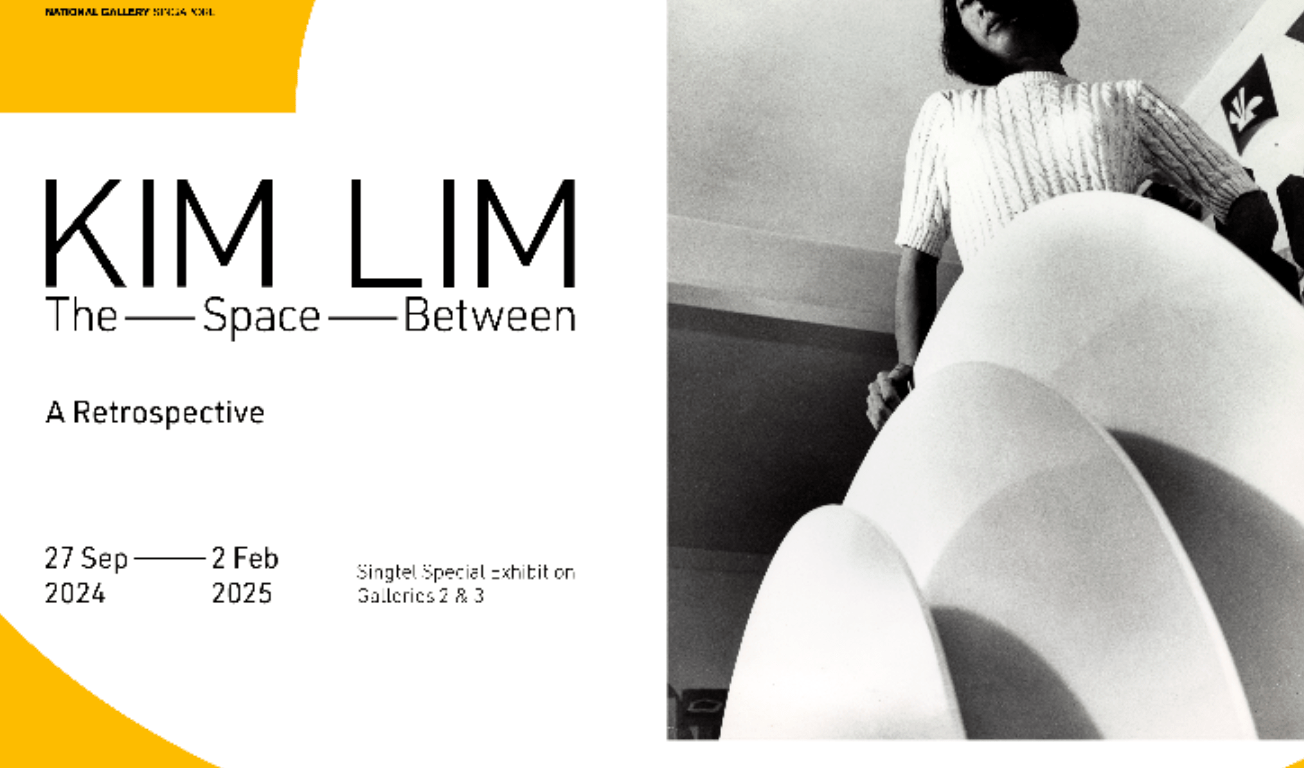
It would be impossible to talk about Singapore contemporary art without mention of sculptor Kim Lim. And it is thus with great anticipation and revere that National Gallery Singapore’s Kim Lim: The Space Between – A Retrospective finally arrives, offering a powerful and long-awaited tribute to the late Kim Lim (1936–1997).
Known for her minimalist approach, Lim was a seminal Singaporean-British sculptor and printmaker whose work explores the relationship between art and nature, capturing the delicate balance between form and space, as well as the interplay between simplicity and complexity. The retrospective provides a comprehensive view of her innovative career, highlighting her evolution from wood and stone sculptures to works on paper, and firmly establishes Lim as a major figure in the global art world.
Enriching her formal education through her extensive travels across Europe, East Asia, and Southeast Asia, Lim drew from diverse sources of inspiration to develop a distinctive visual language. Immersed in the diverse material cultures and architectural sites she encountered during her journeys, Lim’s art reflects her transcultural experiences and sensibilities. This unique approach earned her recognition within local and international art circles during her lifetime. Although Lim’s work was overlooked for some time following her untimely passing, recent major institutional shows, such as those at Tate Britain (2020-2021) and Hepworth Wakefield (2023-2024), have sparked a global revival, underscoring the continued relevance and resonance of her rich artistic practice today.

Lim deliberately forewent traditional plinths, placing her sculptures directly on the floor to suggest that they rise from the ground rather than be merely supported by it. Pieces like Centaur II (1963) exemplify her early mastery of form and material through their verticality and balanced composition. In the 1960s, when women sculptors like Lim were underrepresented in a sculptural scene dominated by hypermasculine ideals, Centaur II introduced a delicate and nuanced interpretation of strength and height. The sculpture’s dynamic interplay of slender, teal-green, bronze stalks rising from a stack of alternating curved wooden blocks sharply contrasted with the era’s emphasis on masculine power and solidity.
After Lim’s student years, she moved away from traditional sculptural methods and moved to industrial materials such as engineered blockboard, steel, aluminium, and fibreglass for her sculptures. She also sprayed brightly coloured industrial paint onto her sculptures, which gave them a uniform and flat finish that concealed the materials’ natural textures and characteristics. This approach accentuated the geometric precision of her forms and planes, highlighting her ability to achieve expressive effects through restrained and deliberate means.
The exhibition, which spans several galleries at National Gallery Singapore, is carefully curated to illustrate the development of Lim’s practice over time. It opens with a section dedicated to her early work in wood, where her minimalist approach is clearly evident. Lim explored diverse methods of delineating surfaces and constructing verticality, including stacking, segmentation, and alternation, to develop a rhythmic range of columnar expressions. Encountering Romanian pioneering artist Constantin Brâncuși’s sculptures through books was formative to her sculptural sensibility. The titles of her early works, such as Samurai (1961), Pegasus (1962), Ronin (1963), and Centaur II (1963), suggest her interest in elemental and archaic forms. These explorations laid the foundation for her enduring focus on the spatiality and scale of abstract forms, which continued to shape her practice throughout her career. These early works emphasise her belief in “less elaboration, more strength,” a principle that would guide her throughout her career.

As the exhibition progresses, visitors see a shift in Lim’s materials, moving from wood to marble and stone. The inclusion of these works represents a turning point in her career, where she began to engage with the tactile and weighty qualities of stone while still maintaining the fluidity and organic rhythms present in her earlier work. Syncopation No. 2 (1995), for example, features a large piece of slate slashed with regular cuts, creating a sense of movement despite the solid nature of the material. This shift to stone and marble is a central theme in the retrospective, illustrating Lim’s ongoing exploration of form and texture, and her ability to imbue heavy materials with a lightness and grace that reflects her understanding of the natural world.
In his opening speech, Johnny Turnbull, one of Kim Lim’s sons, shared his personal reflections on his mother’s work, noting how “creative practice was law in our household.” He recalled growing up surrounded by his mother’s art, which was both a source of strength and a reflection of Lim’s unwavering commitment to her craft. “There was a magical quality to these objects,” Johnny remarked, “they transcend the physical and reflect the beauty of her practice.” He also spoke about the significance of this exhibition, describing it as a “magnificent celebration” of her life’s work, presented with thoughtfulness and sensitivity.

The exhibition highlights the importance of space and the nuances between elements in Lim’s work, something Johnny emphasised in his speech. “The sense of space and proportion, the space between, the shadows,” he noted. “Even with her small stature, she had the ability to amplify and transform detail to scale, creating sculptures that were both powerful and beautiful.” These themes of proportion, space, and the play between negative and positive space are reflected throughout the exhibition, with sculptures and prints that invite the viewer to explore the space around them as much as the objects themselves.
A particularly poignant moment comes from Alex Turnbull, Kim Lim’s other son, who discussed the journey of bringing his mother’s work to light. “This exhibition represents the culmination of a twenty-year journey for my brother and myself,” Alex explained. His speech touched on the misconceptions that often surrounded his mother’s identity, particularly the assumption that she had relinquished her Singaporean roots after moving to the UK in 1954. “Mother never wanted to be defined as a ‘female, Asian artist,’” Alex explained. “She wanted her work to be seen for what it was, not through the lens of ethnicity or gender.”

Indeed, Kim Lim: The Space Between reveals how Lim’s work defied such labels. Her pieces, like Ronin (1963), reflect a blend of Eastern and Western influences, drawing from her multicultural heritage. Alex spoke of the personal connection to the piece Ronin, noting that it was also the inspiration for his own record label, Ronin Records, launched in the 1980s. This crossover between the arts and cultural identity speaks to the eclectic and universal nature of Lim’s work. She absorbed influences from a variety of traditions, as evidenced in her travels to China, Cambodia, Indonesia, Egypt, and Turkey, which exposed her to diverse art practices and cultural aesthetics.
One of the key themes of the retrospective is the late recognition of Kim Lim’s work on the international stage. Despite her influence on her peers and her enduring presence in the UK art scene, it wasn’t until later in her career that her work was fully acknowledged outside of artistic circles. At the First Hayward Annual in 1977, Lim was the only woman and non-white artist, a fact that both Alex and Johnny referenced in their speeches. They highlighted how Lim, despite facing significant barriers in a predominantly male and white art world, was never deterred from her path. In his speech, Alex recalled how, after their father’s death, they discovered a piece of her work that had been previously overlooked. This piece, Ronin, is now an iconic representation of her artistic journey, and it is featured prominently in the exhibition.

During the mid-1960s to 1970s, Lim adopted a serial and modular approach to sculpture, utilising materials like wood and aluminium to create basic units that can be arranged to cast varying shadow patterns. Her work from this period shifted their loci from the structures themselves to the “spaces in-between”, allowing light and space to play significant roles in shaping the appreciation of her works. A key feature in this section is the coming together of Lim’s Intervals series (1973) from the National Collection and the Tate Collection to showcase various possibilities for configuring the work. The series features ladder-like wooden structures, each with spines and prongs. Devoid of a clear orientation — top, bottom, front, or back — works from the series may be arranged according to configurations predetermined by the artist.
Johnny also thanked the curators and institutions that helped bring this exhibition to fruition. “This display encapsulates her creativity,” he remarked, praising the curatorial team for their sensitivity in presenting her work. He expressed gratitude for the gallery’s role in showcasing the depth and breadth of Lim’s contributions to art, and for ensuring that her legacy continues to grow.

The exhibition concludes with works from Lim’s late period from 1979, a significant turning point in her practice. The retrospective shows how her journey from the minimalist wood sculptures of the 1970s to the more organic and textural stone works of the 1990s reflects an artist who was constantly evolving. Each work demonstrates her ability to balance the ordered and the dynamic, the static and the organic, capturing the essence of her experiences and observations of the world. This change was sparked by her first survey exhibition in 1979 at the Roundhouse Gallery London, which made her aware of the pull between the ordered, static experience, and the dynamic rhythms of organic structured forms. Lim wanted to create metaphors that would “ricochet in the viewer and cross various boundaries of experience – to trigger responses beyond the object itself.”
Kudah (1989) exemplifies Lim’s keen interest in using lines and contouring to define form and rhythm. Here, a more organic form replaces marble’s typical architectural associations. Lim emphasised the stone’s subtle qualities through gentle undulations and vertical incisions on its surface to create gentle contrasts of light and shadow. The sculpture appears as though a large block of stone has been sliced, with the remaining section suggesting the head and neck of a horse. Lim’s precise carving — one line extending from the base and another descending from the top — guides the viewer’s gaze and introduces a rhythmic structure within the piece. The title Kudah refers to the Malay word for “horse” and evokes the knight in chess. Lim, who enjoyed playing chess with her husband, sculptor William Turnbull, often referenced chess pieces in her work from the late 1950s onward. Kudah, alongside other stone works from Lim’s late period, showcases Lim’s mastery of carving on stone and her enduring exploration of light and space as sculptural materials.

Visitors are also invited to delve into Lim’s artmaking process. The Space Between. A Retrospective unveils rarely displayed photographs and maquettes from Lim’s studio, offering insights into the ideas that the artist kept close. These elements are interwoven throughout the exhibition, enriching the viewer’s understanding of each section.
Kim Lim: The Space Between is not just an exhibition—it is a celebration of a life well-lived and an art practice that transcended boundaries. As her son Alex noted, “Our mother’s example should inspire all of us to think about how we spend our lives.” Through this retrospective, the National Gallery Singapore has provided a fitting tribute to Kim Lim’s artistic vision and unwavering dedication to her craft.
Kim Lim: The Space Between. A Retrospective runs from 27th September 2024 to 2nd February 2025 at the Singtel Special Exhibition Galleries 2 & 3, Level 3, National Gallery Singapore. Visitors can purchase Special Exhibition Passes at $25 each ($15 for Singapore Citizens and Permanent Residents) which provides access to both Kim Lim: The Space Between. A Retrospective and Teo Eng Seng: We’re Happy. Are You Happy?. Tickets and more information available here
 Bakchormeeboy