
Singapore Art Museum (SAM) unveils two new projects that delve into the evolving relationship between contemporary art and digital culture—joining hands with artists and artist collectives to offer critical insight into the unseen forces that shape art and everyday lives. By embracing technological advancements, SAM continues to lead conversations on the impact of digital culture, reinforcing its role as a dynamic platform for artistic experimentation and discourse.
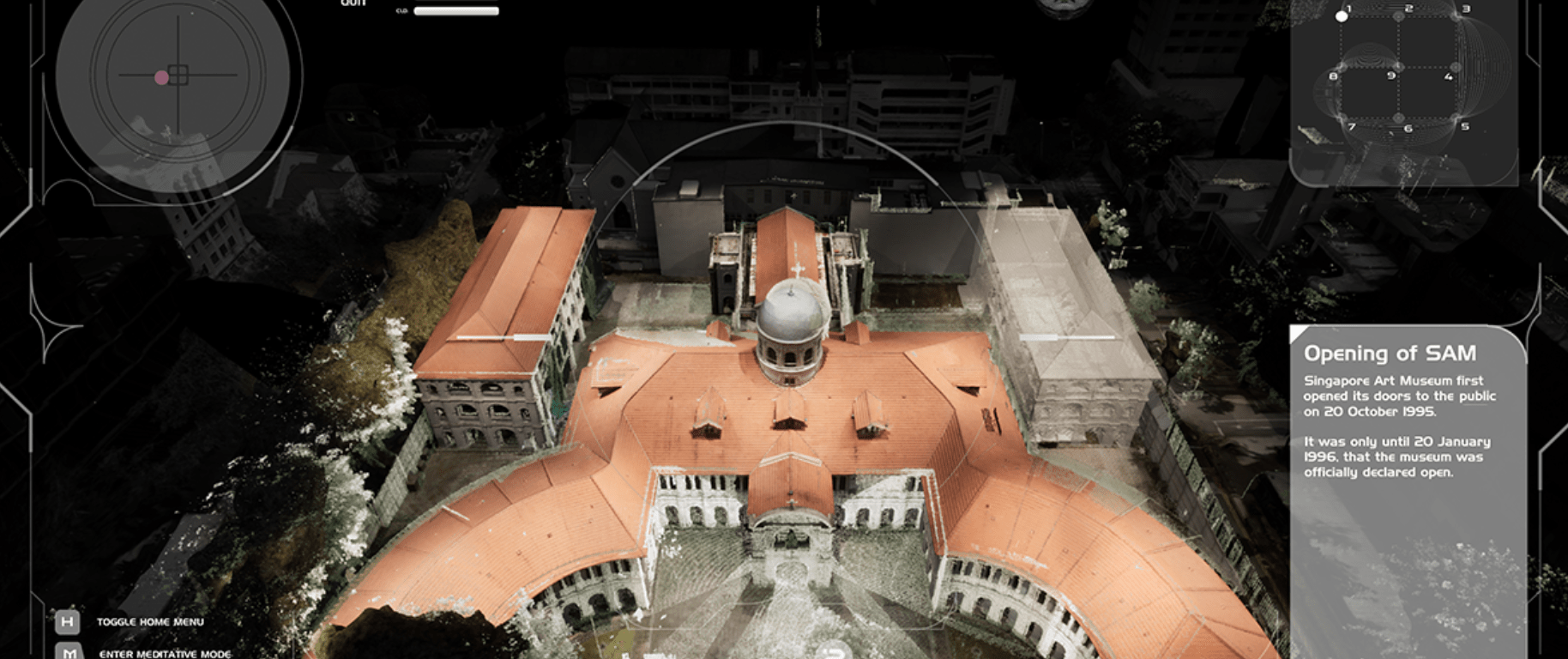
The first is Operation Kata-tropical (Aural) Bloom [ÖK(^)B], a project developed in collaboration with trans-media research lab, formAxioms. This immersive, interactive gameplay experience invites viewers to explore a future iteration of the former St. Joseph’s Institution (SJI) building, navigating its spectral remains of the site while contemplating the possibilities of virtual spaces and their impact on contemporary art. As a site with rich architectural heritage and cultural relevance, reimagining it as a meta-exhibition—blending game, digital archive, exhibition, and artwork—offers an experience that aligns with the project’s exploration of time and space while engaging with broader themes of architectural archives, institutional ownership, and cultural memory.
SAM also presents Open Systems 2_Operating Systems (OS2), the second update to its Open Systems platform, originally launched in 2023. Curated by artist collective TO NEW ENTITIES, OS2 expands its predecessor’s inquiry into the ideological and technological frameworks that govern digital culture, interrogating how these hidden systems shape artistic expression and daily life. Featuring a series of artist-led interventions, OS2 invites audiences to critically engage with the complex mechanisms underpinning our digital interactions.
June Yap, Director of Curatorial and Research at SAM, says, “In today’s technologically driven world, digital culture is an undeniable and pervasive force in our daily lives—influencing how we experience art, interact with one another, and understand society. As a contemporary art museum, SAM is committed to fostering artistic practices that reflect and interrogate these conditions. By collaborating with artists at the forefront of these explorations, we hope to engage new communities globally and spark conversations about the evolving nature of digital culture and its impact on our lives.”
Duncan Bass, curator of ÖK(^)B and OS2, adds, “These digital projects rethink the idea of medium specificity, pushing the boundaries of what digital art can be. By exploring the components fundamental to digital art, they prompt critical questions about the future of art and exhibition-making in the virtual sphere. At the same time, they urge viewers to consider the implications of the digital on how we create, consume, and understand art through the themes explored in the artworks. We hope these works inspire a more thoughtful engagement with digital culture and a critical awareness of its place in our lives.”
Together, ÖK(^)B and OS2 invite audiences to reconsider the relationship between art and technology, highlighting the possibilities of contemporary art in the digital age.

Operation Kata-tropical (Aural) Bloom [ÖK(^)B]
Now until 30 September 2025 okab.sg
ÖK(^)B is a groundbreaking immersive landscape developed by formAxioms and SAM to explore alternative modes of displaying and experiencing contemporary art. It is at once a game, digital archive, exhibition, and artwork, where players navigate the former SJI building set in the distant future year of 26777. As they explore, players encounter remnants of its past and natural forces that threaten to reclaim its architecture. Going beyond superficial translations of the physical to digital, ÖK(^)B unlocks the potential of the digital medium, presenting dynamic creations that engage users on multiple levels. Players’ experiences are shaped by real-time environmental conditions and traces left by fellow explorers, contributing to a living, ever-changing virtual environment.
As an artwork in itself, ÖK(^)B reimagines the possibilities of an exhibition space by transcending temporal and physical boundaries to reimagine historical narratives. Merging post-colonial and post-Anthropocene perspectives, ÖK(^)B confronts facts, traumas, and the persistence of colonial logics in virtual environments while envisioning alternative futures for human and non-human entities. In doing so, ÖK(^)B invites audiences to reconsider our relationship with history, technology, and the environment in the digital age.

As an exhibition, ÖK(^)B comprises two other artworks that extend its central lines of inquiry, such as Speculating the Fragmented Copy by Juan Covelli, a series of three-dimensional scans of 14 Mesoamerican artefacts from the Stavenhagen Collection at the Tlatelolco University Cultural Centre. Challenging museums’ and archives’ ownership and commodification of cultural objects, Covelli freely offers these digitised objects for users to download, disseminate, and modify. ÖK(^)B also features Hings Lim’s Homo Lanterns, which explores the lingering influence of colonialism in Southeast Asia deeply embedded within its architectural and ideological structures. Using real-time simulation to turn colonial architectural fragments into ghostly projections, Lim creates a space that feels familiar but is ultimately disconnected from our world.

Open Systems 2_Operating Systems
Now until 31 May 2025 opensystems.sg
Organised by artist collective TO NEW ENTITIES, OS2_Operating Systems expands Open Systems’ inquiry into how digital and networked environments shape artistic production and experience, exploring the implications of ideological and technological systems in an age of algorithms and hyper-connectivity and how it shapes our reality. Featuring 12 artist projects across four thematic chapters, OS2 examines traditional knowledge systems, archives, ecosystems and collective organisation. Together, these works invite audiences to critically reflect on the systems that govern our lives and their subconscious influence on our perceptions and actions.

OS2.1_Knowledge Systems
The opening chapter of OS2 features artists and thinkers who navigate, recontextualise, and problematise known historical and traditional knowledge systems that underpin culture and society. It investigates modes of transmission, such as poetry, myths, and fables, exploring their connection to indigenous and spiritual knowledge systems across generations, and how these narratives and symbols are constantly reinvented.
Dana Dawud’s video essay, Noah’s Ark reinterprets the flood myth, blending TikTok videos, eco-protests, and ancient tales to prompt reflection on our understanding of the world and ourselves. Similarly, Piña, Why is the Sky Blue? by Stephanie Comilang and Simon Spieser merges ancient narratives and technologies, following Piña, an artificial intelligence (AI) spiritual medium who collects inherited knowledge, messages, and dreams for survival. The work intertwines interviews with activists, healers, and a shaman, focusing on matriarchal lineages and the endurance of precolonial knowledge despite oppression. Lastly, the chapter features Junklord Hikayat, a new commission by Sharmini Aphrodite, fyerool darma, Shif, POFMAMAXX and Manni Wang. Through the story of art handler Bintang789, who grapples with folklore, memory, and academic jargon, the work reimagines fables, exploring how their structures and legacies translate in today’s context.

OS2.2_Archival Systems
Examining the crucial role of archives in shaping collective memory, Archival Systems considers how archival sources and methods can be appropriated and subverted to invent new ways of understanding the past, present, and future. The featured artworks in this chapter complicate the archive and propose new ways of mapping historical and contemporary knowledge.
Based on the true story, Sara Bezovšek’s The Influencing Machine reimagines the Soros Centres for Contemporary Art (SCCA) network’s impact on visual art and culture, using data to question the image of the archive as evidence of objective reality. Nawin Nuthong’s The Immortals Are Quite Busy These Days: Object Management similarly destabilises the traditional authority of an archive, presenting a fragmented view of artefacts and personal references that recur in the artist’s growing body of work to engage with the subjective nature of selection and classification. The Whole Earth Codec by Christina Lu, Connor Cook, and Dalena Tran rides on planetary sensor networks to incorporate non-human perspectives on Earth, exploring new forms of computational reasoning, and potentially, even a kind of planetary intelligence.

OS2.3_Eco-Systems
In Eco-Systems, artists explore real and imagined ecological systems and their complex network of interdependent entities. Reflecting on notions of relationality and interdependence, the artworks challenge overly uniform or rigid environments in favour of diversity and complexity, offering viewers a lens through which to consider the dynamics of change and continuity.
Artist duo Invernomuto’s cross-media project, Triton, blends ancient myths with contemporary technology, focusing on a triton colony in Val Trebbia and prompting deep reflection on the intricate interplay between nature, sentient feelings, and digital technology. One or Several Agents: Machinic Animism by Brandon Tay creates a real-time simulation where interactions between AI agents and entities generate stories offering glimpses into possible futures. Finally, MUSH by Most Dismal Swamp explores secretive, encrypted online subcultures navigating platform rules, algorithms, misinformation, and censorship. The work, titled after “Multi-User Shared Hallucination”, compares these online phenomena to the real world, suggesting that reality itself is a shared hallucination.

OS2.4_New Systems
In the final chapter of OS2, artists and artworks explore innovative ways of navigating our evolving reality, offering fresh perspectives on our relationship with technology, today’s cultural climate, and ways of gathering and collaborating in the future. Collectively, the artworks envision a new sensibility of knowledge and cultural production.
Godmode Epoch by dmstfctn is a video game artwork set where players train an AI to identify products in a simulated supermarket, exploring agency and control in relationships between human and non-human. Moving Castles by Berlin-based collective Moving Castles pioneers modular, portable multiplayer mini-verses blending art, technology, and community to create decentralised, member-governed virtual environments that promote collective agency and public participation. Finally, POSTPOSTPOST presents POSTPOSTPOST (2024), a humorous film that grapples with two accidental time travellers at the collapse of the present, questioning the nature and relevance of time.
ÖK(^)B and OS2 can be accessed on opensystems.sg, which serves as a central depository for SAM’s digital projects, including Open Systems Broadcasts, a series of interactive live streams featuring artists, designers, and curators exploring video games in and as contemporary art, as part of Open Systems 1_Open Worlds. Visitors can also access Skills Futures, SAM’s digital commissioning platform featuring performances, workshops, and experimental lectures that elaborate on new forms of intelligence that emerge through the screen. Lastly, under Screenings, visitors can also enjoy temporary screenings of videos from the SAM collection and recent commissions by SAM.
OS2 can be accessed for free from now until 31st May 2025. Additionally, ÖK(^)B can be accessed directly at okab.sg and will run from now until 30th September 2025. More information can be found at opensystems.sg
 Bakchormeeboy