
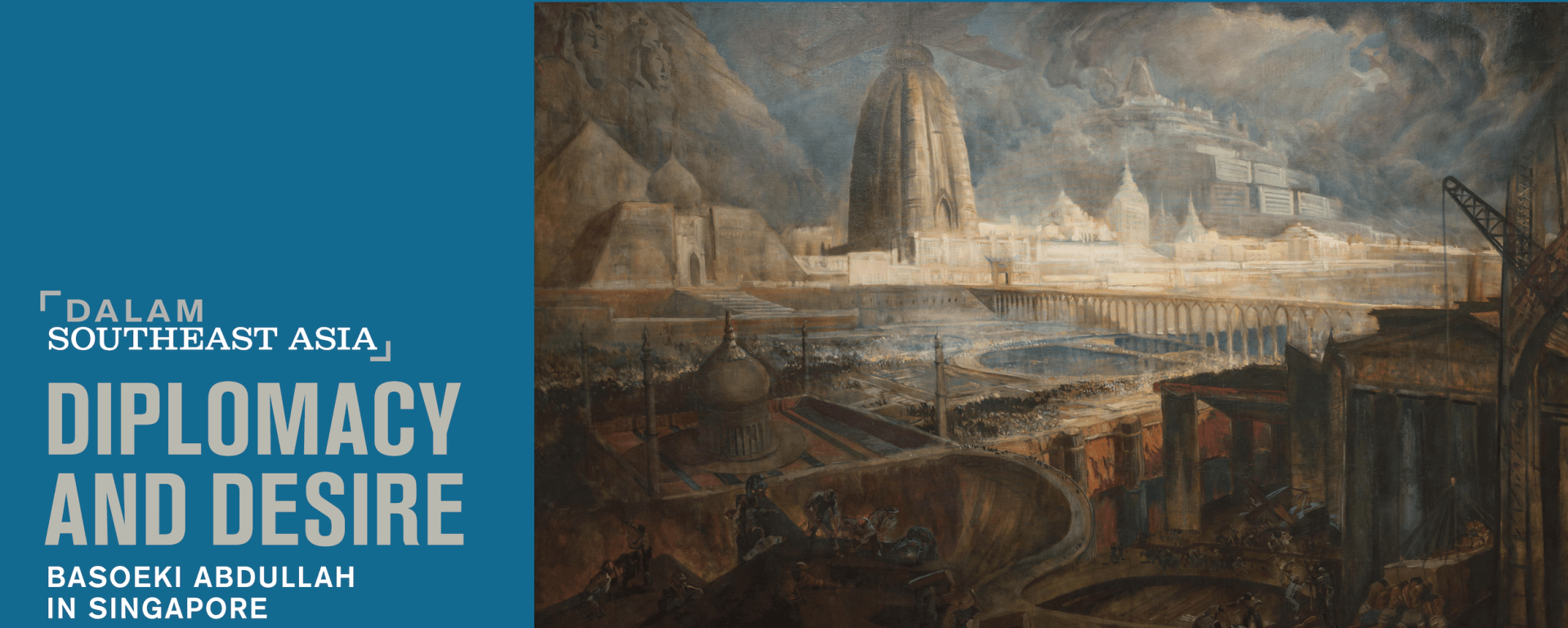

National Gallery Singapore presents Diplomacy and Desire: Basoeki Abdullah in Singapore, a solo exhibition by celebrated Indonesian painter Basoeki Abdullah (1915–1993), known for his striking portraits and high-profile patrons across postcolonial Southeast Asia.
Housed in Dalam Southeast Asia – the Gallery’s experimental project that showcases curatorial experimentation and platforms lesser-known perspectives on the region’s art and histories – the exhibition offers a provocative look at power, beauty, and diplomacy in the region through the eyes of one of Southeast Asia’s most sought-after portraitists. It explores how Basoeki navigated his roles as a high-society painter and a cultural producer attuned to the “geopoetic” agency of his art – deploying it to cultivate regional imaginations, support decolonisation efforts, and navigate geopolitical and ideological differences.

Focusing on Basoeki’s relationship with Singapore, where he lived between 1958 and 1960, Diplomacy and Desire centres on two significant artworks he gifted to the country. This period coincided with Singapore’s transition toward self-governance in 1959. Labour, which spans almost three metres long, was one of two gifts that Basoeki gave to Singapore. The artist gifted it to the City Council of Singapore in 1959, after Singapore achieved self-governance that year. When the artist returned to Singapore in 1989 to seek out this painting, he claimed that the painting represented the future of Singapore. In fact, the structures in the painting reference key historic sites, such as the temples for Ramesses II and Queen Nefertari at Abu Simbel, which had to be relocated in 1964 as part of Nassar’s ambitious Aswan Dam project (1970). This relocation project, as well as the monuments that populate the background of the image, which recall Borobudur and sikhara, may speak to how Basoeki Abdullah was inspired by the possibilities for allied progress between “coloured nations” that were shared at the seminal Bandung Conference of 1955.

InStruggle for the Re-establishment of the Democracy and the Right for the People, the painting is supposedly inspired by the formation of the Association of Southeast Asian Nations (ASEAN) in 1967. The five founding nations are depicted as pearls, which according to the artist, are gems produced out of a painful process for oysters – a possible oblique reference to the difficult process of decolonisation experienced across the region.

The exhibition also features a selection of pastel drawings of women and luminous portraits of political figures in post-war Singapore. In 1957, the year before he moved to Singapore, Basoeki had visited the island and shared with the local press at the time that Singapore girls made ideal models, and made several portraits of local models that Basoeki drew while he was in Singapore. These were works that cemented Basoeki’s reputation as one of the region’s most sought-after painters. These pieces explore the entanglement of aesthetics and influence, revealing how beauty and power were negotiated through art. Drawn from Singapore’s National Collection, these works were part of a significant 1994 donation by Lok Bok Sim to the Singapore Art Museum.
Basoeki’s patrons included some of the most prominent regional leaders of the time, such as Indonesian Presidents Soekarno and Soeharto, Philippine President and First Lady Ferdinand and Imelda Marcos, King Bhumibol Adulyadej and Queen Sirikit of Thailand, Prince Norodom Sihanouk of Cambodia, and Sultan Hassanal Bolkiah of Brunei. For the first time, archival photographic assemblages made by the artist, on loan from Museum Basoeki Abdullah, Indonesian Heritage Agency, are also being shown publicly.
Photo Credit: National Gallery Singapore
Diplomacy and Desire: Basoeki Abdullah in Singapore runs from 9th May 2025 to 1st February 2026 at Supreme Court Wing, Level 3, UOB Southeast Asia Gallery, Dalam Southeast Asia, National Gallery Singapore. More information available here
 Bakchormeeboy