
Serving up family feuds, tantalising drama and the ever-present question of legacy and the future in Nine Years Theatre’s homage to Singaporean food culture.
In Home Kitchen, Nine Years Theatre (NYT) serves up a lovingly prepared, emotionally resonant, and at times unexpectedly layered dish that speaks directly to the heart of any Singaporean. Commissioned by the Singapore Chinese Cultural Centre (SCCC) as part of their Cultural Extravaganza 2025 programme, this original Mandarin production blends both traditional and experimental fare, naturalism and metatheatre, all within the confines of a Teochew family restaurant kitchen.
Written and directed by NYT artistic director Nelson Chia, Home Kitchen follows the story of Gim Hiang Restaurant, a three-generation Teochew eatery helmed by the formidable Lau Dua Gim. For decades, Dua Gim has ruled the roost with his time-honoured recipes and firm discipline with an iron ladle in hand. But times are changing: rents are rising, customers’ tastes are shifting, and the younger generation is pulling away from tradition. As he wonders what the future holds for the restaurant, enter Zhi Ren, the prodigal youngest son. Once the golden child of the kitchen, he stunned the family by leaving Singapore for culinary training in Paris. Suddenly returning home for his mother’s 60th birthday, Zhi Ren is now a new man, transformed by his time in a fine dining restaurant in France. Bearing both new ideas and old scars, it makes the perfect recipe for reigniting long-buried family tensions, clashing values, and unanswered questions about legacy, change, and identity.

Chia’s script comes at a timely moment for Singapore’s culinary and cultural landscape, tackling head-on a wide swathe of issues currently facing the food industry: rising rental costs, generational gaps, the erosion of family-run businesses, the tension between authenticity and innovation, and even touches on the rise of newfangled careers like food influencers. And yet, at its core, Home Kitchen is a play about family – how we fight, how we love, and how difficult it can be, especially in Asian households, to say what we really mean. Chia is no stranger to family dramas, having established a strong track record of such scripts through NYT’s growing canon of original work. But Home Kitchen feels like a fascinating hybrid of both familiarity and a bold step into more experimental terrain. The play isn’t just content to simmer quietly, and occasionally delivers a flourish of contemporary theatrical techniques.
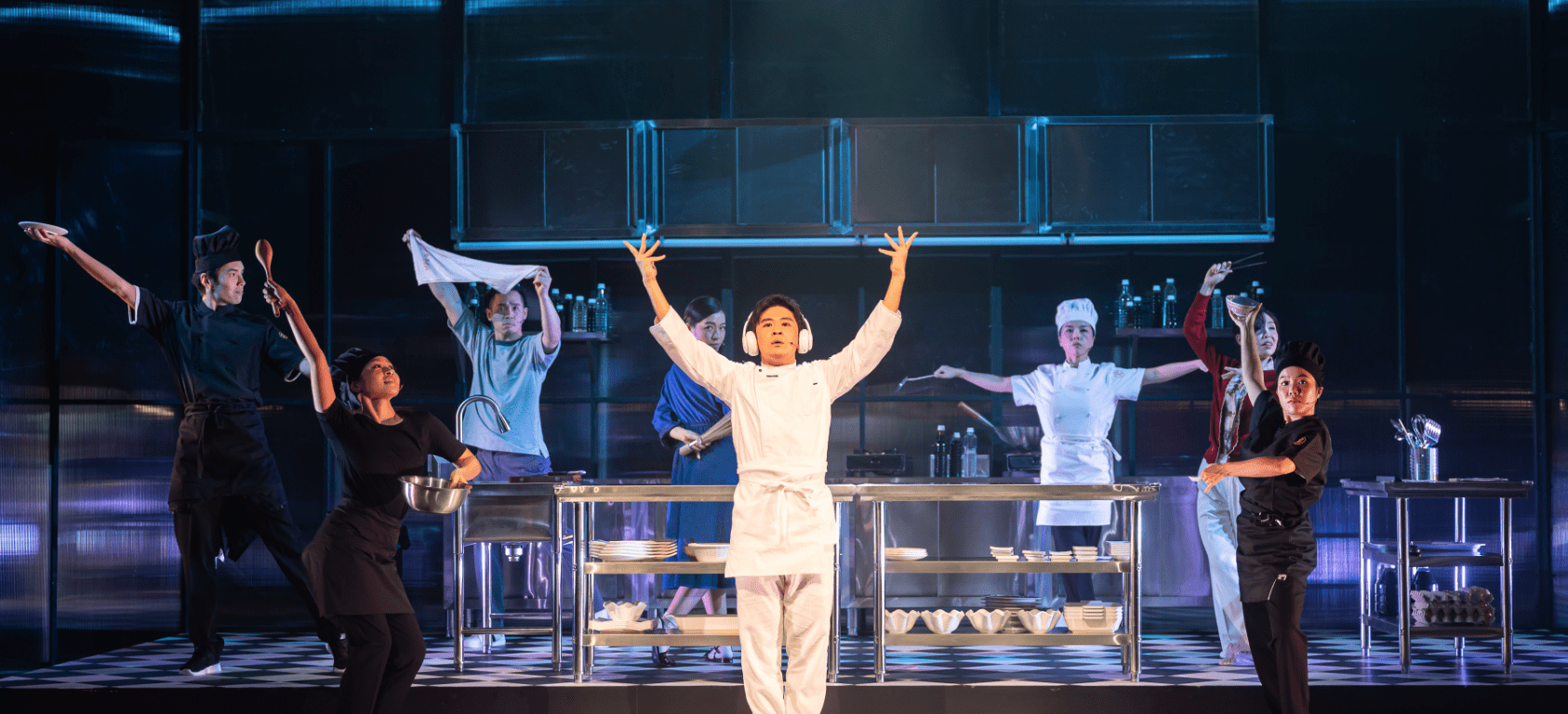
The production design is a standout, with Mohd Fared Jainal’s chrome kitchen set gleaming with both menace and functionality; it’s a place of fire, pressure, and burn risk, but also one of contemplation and creativity, physically embodying the dualities of the play, and making the perfect battleground for the characters, as they juggle hungry customers, clashes of ideas, and making sure the beef doesn’t end up burnt. Audrey Tang’s costume design is deceptively detailed, and even within the standardised kitchen attire, subtle differences express each character’s personality.
The opening scene alone sets the tone for this experimentation: the full ensemble descends from the SCCC Auditorium stairs, bearing culinary paraphernalia before lining up across the stage in a black-and-white ensemble. They break the fourth wall, speaking directly to the audience about food culture in Singapore, almost like warming up with rapid fire tongue-twister-like sequences that move fluidly across dialects and languages, establishing both the local F&B scene and multilingual landscape. This metatheatrical prologue is both educational and entertaining, although some of the dialect play feels forced, and is more subtly effective when left unselfconscious rather than highlighted or used for multilingual puns. Still, it’s a daring and welcome theatrical flourish that immediately signals the piece’s ambition.

The central conflict between Dua Gim and Zhi Ren is the emotional backbone of the play, with their ideological clash around tradition versus innovation is ever-present. While it initially seems like a simple case of cantankerous older father unwilling to welcome newfangled techniques, Home Kitchen isn’t content with such a simple conflict, and instead reveals Zhi Ren’s contentious return as the culmination of years of regret on Dua Gim’s part, and his personal gripe with the burden of responsibility to his own father and founder, and that all-too-familiar pressure of living each day as the head and face of a heritage brand.
This is of course, supported by the anchoring performance of Rei Poh, who returns to the stage with gravitas and soul. As this gruff 65-year-old patriarch grappling with health issues and legacy anxiety, Poh delivers a tour-de-force characterisation, playing up his age and gravitas with his voice. He captures the awkwardness of an Asian father’s well-intentioned affection, the brittle frustration of ageing, and the silent pain of a man who doesn’t really know how to let go. Every word lands with weight; every pause is meaningful, a masterclass in restraint and resonance, and makes us think of our own stoic fathers who try their best every day.
Opposite him, the young Joel Tan brings vigour and complexity to Zhi Ren, which may well prove to be his breakout role. Tan has charisma in spades, and more importantly, he has range. His performance captures the confidence of a chef who has made it abroad and the vulnerability of a son unsure how to act upon his homecoming. Even when silent, Tan’s body speaks volumes: the way he drags his feet in disappointment, or clenches his jaw in frustration, lends the performance an unexpectedly textured, each time he speaks to Dua Gim an exercise in restraint as he navigates their complex relationship, eyes full of hope as he seeks his father’s approval.

Playwright Chia clearly loves his characters, and each of them is imbued with enough backstory and depth to endear themselves to us. NYT’s ensemble work has always remained some of the best in the local scene, and from the first scene in the kitchen, it already feels alive with banter, teasing, and casual conversation, and you feel the camaraderie of a team that has worked together for years. Every character is imbued with specificity, history, and a lived-in texture that makes you believe they’ve been part of this restaurant long before the play began, with the banter and their ease with each other, the teasing and the casual nature of conversation while working like clockwork. Even without actual food and ingredients onstage, there is so much commitment to the movements and realism of the kitchen environment that you do believe that there are hungry customers waiting outside.
Among the ensemble, Audrey Luo shines as the loyal sous chef, her chemistry with Rei Poh adding warmth and humour, and a reliable rock among the kitchen staff, always ready to support. The formidable Jodi Chan, playing Zhi Ren’s mother and Dua Gim’s wife, is pitch-perfect as the archetypal peacemaker – gentle but grounded, always present with sagely advice without being intrusive; you feel her warmth and how she’s something of an expert handling and worrying for these emotionally-stunted men in her life. Timothy Wan, as the slightly brash but lovable eldest son, maximises every second of his stage time with comic timing and heart. And Regina Toon, as the sensible second sister, showcases natural star quality in this role, exuding quiet confidence and polish, an air of kindness and reliability and voice of reason. You can’t help but wish to see her in a lead role in future productions, and one wonders about the possibility of a singing role, with her evocative single ‘Strange Blame‘ getting a feature in one of the most emotional scenes of the show.
Much like how his own characters quip how innovation requires one to be bold enough to innovate, we too see how NYT balances both tradition and experimentation in theatremaking. Beyond the metatheatrical opening scene, one of the production’s most delightful surprises is a parallel scene set between Singapore and France, two kitchens placed side by side, where Dua Gim and his wife’s conversation mirrors Zhi Ren and his girlfriend’s, their dialogue segueing into each other’s. It’s a classic device that could be seen as hackneyed, but Chia stages it with sincerity. Also, while often in the producer’s chair, it is refreshing to get to see Mia Chee’s choreographic direction taking centre stage in a standout scene where Zhi Ren prepares his reinvention of orh nee (yam paste dessert), staged like a dance set to the dramatic Habanera from Bizet’s Carmen. It’s whimsical, over-the-top, and utterly delightful, elevating cooking into performance art, with Joel Tan backed by the ensemble in perfect synchronicity, Alberta Wileo’s lighting further elevating it to a worthy sequence.

There’s also an undeniable sense that while tackling serious themes, Chia has also given himself permission to have fun. The play leans into lighter fare with an entire montage set in Paris as the characters embark on a whirlwind trip to the biggest tourist attractions, complete with stereotypical red scarves, faux-French accents, and dad jokes galore from mispronunciations and miscommunication. It’s a refreshing, if a little silly, and certainly unexpected from a company more commonly associated with emotionally-heavy drama. Yet they work, because at the heart of Home Kitchen is joy in performance, in food, in family, and in the act of storytelling itself.
There are times where NYT might have considered holding back more, with moments that sometimes come across as overtly didactic. Some conversations feel like thinly-veiled “motherhood statements,” particularly in scenes between Dua Gim and Zhi Ren’s girlfriend, where discussions about heritage and innovation veer into talking points that might have come straight out of a National Heritage Board speech. Chia isn’t wrong to point out these debates and clearly wants audiences to think about finding a happy medium between heritage and modernity, but they sometimes stick out not because they lack substance, but because they feel less like real dialogue and more like an op-ed amidst the otherwise narratively sound and sincere conversations.
But in the end, Home Kitchen is a significant and welcome entry into NYT’s growing body of original work. Drawing from the best of Taiwanese family dramas but localised with unmistakable Singaporean flavour, from its brand of humour to its casual multilingualism, Home Kitchen is a work that feels generous, and represents our country’s love for food, and highlights our growing concern for the continuity of heritage that may well be lost forever if we do not find a way to preserve and reimagine it. You walk away from Home Kitchen as you would from a good home-cooked meal – it is heartwarming, reliable, and leaves you satisfied, perhaps even already thinking about coming back for seconds. If we view its concerns in parallel to Singapore’s theatre scene, then seeing Nelson Chia and Mia Chee holding the fort with aplomb, the legacy of Singapore Chinese theatre is in good hands, continuing to serve excellence and commitment to dishing out quality works of art.
Photo Credit: Singapore Chinese Cultural Centre
Home Kitchen plays on 10, 11, 17 and 18 May 2025 at the Singapore Chinese Cultural Centre Auditorium. Tickets available on SISTIC
Production Credits:
| Playwright/Director Nelson Chia Producer Mia Chee Cast Rei Poh, Joel Tan, Audrey Luo, Timothy Wan, Jodi Chan, Regina Toon, Xuan Ong, Seah Janice, Choy Chee Yew Set Designer Mohd Fared Jainal Lighting Designer Alberta Wileo Sound Designer Lynette Quek Costume Designer Audrey Tang Makeup The Make Up Room Hair Ashley Lim |
 Bakchormeeboy
One thought on “★★★★☆ Review: Home Kitchen 家囝成厨 by Nine Years Theatre”