
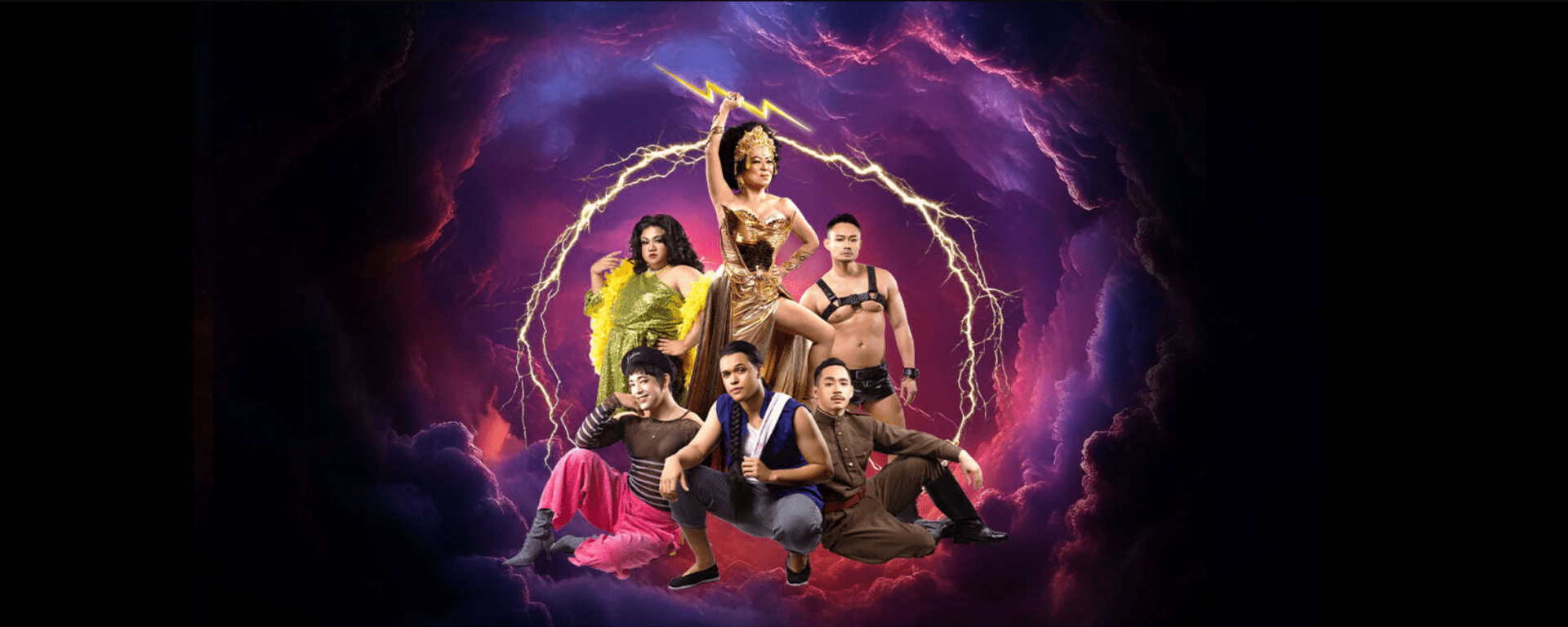

Flamboyant, unabashed examination of the gay scene in Singapore investigates the origins and evolution of the queer condition over the decades through scenes both campy and poignant.
A dildo as a magical compass. Trans women throwing shade and competing in a pageant. Coolies and samsui women vying for the affections of other men while reciting Gloria Gaynor’s ‘I Will Survive’. These are just some of the myriad elements that make up the spectrum of colours that make up the rainbow of Wild Rice’s new production of Dreamplay: Asian Boys Vol. 1.
Based off August Strindberg’s A Dream Play, Alfian Sa’at’s classic is back for a new staging this Pride month, with a fresh cast at Wild Rice’s home at Funan. Directed by Ivan Heng, Dreamplay is a surreal, flamboyant romp through Singapore’s queer landscape, both historical and modern, as the goddess Agnes is sent to Earth on a mission to ‘save mankind from itself’. Accompanied by a young local known only as Boy, the dynamic duo travel across time and space, from Tanjong Pagar to the virtual realm of Grindr, as they attempt to find out just why these gay men are so unhappy.

First and foremost, Dreamplay is very much a product of its time when it was first staged by The Necessary Stage in 2000. In many ways, despite it having some elements updated for the modern era, its references to IRC (internet relay chat), Category 302, or even toilet graffiti may well be lost on the new generation of digital natives, where queerness is no longer something relegated to the shadows, and despite still facing a large degree of prejudice, is much more widely discussed. In that sense, Dreamplay feels like a blast to the past, a nostalgic, sometimes painful reminder of the struggles of Singaporean queer millennials and older, and very much an important historical archive and form of education for the younger audience members, more so than shedding new light or adding new opinions to the discourse of today.
Having been written by Alfian at just 23 years old, Dreamplay also showcases the playwright at a very experimental phase, with so much to say and a want to entertain that often, the mood between and even within scenes evokes a sense of whiplash as it switches from the slapstick to the genuinely emotional. One of the most glaring issues with the script that still remains unfixed is Agnes’ actual mission – throughout the play, we never quite understand what her end goal is. There are times she deliberately wants to prevent the gays from reproducing or creating martyrs that propagate the lifestyle, while there are times she seems to listen with sympathy, and try to resolve their problems. By its end, when she returns to the heavens, we are still unsure what exactly she has achieved or even set out to do with mankind.

Yet, while this is initially somewhat jarring, it’s impressive how the audience eventually accepts the incongruity, and allows ourselves to immerse into this absurd world where samsui women impregnating themselves with semen from a spittoon leads to us reflecting on the (still relevant) inner conflict between familial duty and individual desire. As such, as a whole, there is a fervent, youthful energy to the script that speaks of an ache, an anger, and poeticisms that mark the thoughts and reflections of a queer person growing up in a Singapore decidedly against one’s sexuality, not unlike his collection The Invisible Manuscript. For all its silliness, its overt references to pop culture and even Journey to the West, Alfian manages to eke out scenes that feel painfully real at times, such as the web of desire woven between gay men eyeing and judging each other at the bar, each one burdened by their own traumas, be it the need to assimilate and possess the ideal ‘straight-acting’ male body, or the tinge of regret felt by older gay men as they realise they are no longer on the market, luring nubile twinks in with the promise of money and ‘safety’ instead.
It is all these fluctuating emotions that ultimately make Dreamplay such a fascinating show to watch, despite its inconsistencies, and encapsulates just how messy and confusing navigating the gay world can be. In many ways, it can and should be considered a cult classic then, and being presented here and now, under this new direction by Ivan Heng, is tightened as best as it can be, supported by a strong cast that clearly has fun with each scene and showcase strong onstage chemistry with each other. At the centre of it all, Pam Oei has been cast exactly right as the goddess Agnes, not only due to her status as Singapore’s biggest Faghag, but because she is capable of commanding the stage when she channels her inner goddess, reacting with a snap comic timing, and her voice lulling soft when she finally chooses benevolence as ‘Aunt Aggy’, always possessing a sense of the celestial about her and great comic timing.

Ryan Ang, as Boy, proves capable of playing innocent, encapsulating the role’s qualities as a tour guide-type character. Izzul Irfan plays beyond his age and carries a spiritual weight to him as an older male figure in a bar, while also finding sympathy as a chubby man who can’t find a single date, lest they are blackout drunk. Irsyad Dawood capitalises on his fireball energy and allows it to lead his characters with force and gusto, whether it’s as a drag queen or a Japanese soldier. Goh Seng Henk toggles between nerdy newly out to boy next door, and shares strong onstage chemistry with Timothy Wan as would-be lovers during World War II, rooting for them in their scenes together. As the actor playing the ‘straight-passing’ role in most scenes, Timothy also manages to reflect that pressure of living up to expectations and displays of masculinity across his roles, a strong presence amidst the cast.
Much of this production’s success can be attributed to the creative team and their designs as well. Wong Chee Wai, who by now knows the Wild Rice space intimately, has crafted a white pantheon-like set that sets the stage for its celestial shenanigans. It also provides the perfect backdrop for Alberta Wileo’s lighting, especially important considering each scene is characterised by a specific colour, without making it feel overwhelming. And perhaps the standout of the evening is Flex Chew’s multimedia design, which envelopes the stage in everything from planets whizzing across the cosmos, to mystical space typhoons and portals, to a stream of headless bodies on Grindr, to a literal magic carpet, always making the world feel bigger than the limits of the space. Sound designer Paul Searles has crafted a soundscape that goes from disco to emotional at the right moments, while Ashley Lim, Bobbie Ng and Max Tan ensure that the cast looks right and well-coiffed in every scene, particularly impressive when it comes to the quick changes between drag and regular stage getup.

Perhaps across the entire play itself, one of the most interesting and unintentionally timely scenes is the metatheatrical scene referencing the Marxist crackdowns against various theatre companies in the ’80s. In this production, it has now been updated, where Agnes, as an IMDA officer, interrogates ‘Ivan Heng’ (Timothy Wan, in a near perfect imitation), ‘Alfian Sa’at’ (Irsyad Dawood), and ‘Goh Seng Henk’ (Seng Henk, as himself) for the agenda behind staging Dreamplay. Arriving in the wake of IMDA’s ban on Wild Rice’s dramatised reading of new work-in-progress script Homepar (written by Dreamplay assistant director Mitchell Fang), this is a scene that takes on new significance, as the creatives mock and bite back at the IMDA officer for her determination to find fault with the play, triumphant and taking on new meaning as a form of resistance against allegedly blind censorship and accusations.
That in itself echoes and emphasises the importance of staging such a show. Wild Rice remains a champion of local theatre, always pushing back against injustice and with a play like Dreamplay especially, seeks to find light within the grey, joy and hope amidst a landscape that constantly tries to denounce or downplay the existence of what the state deems as incorrigible, when one must look beyond the black and white, and find ways to help and not simply crush with an iron fist. As Agnes returns onstage in a divine metallic gold ensemble, a giant disco ball descending onto the stage as Lady Gaga’s ‘Born This Way’ plays, Dreamplay, for all its flaws, spreads its final message – to finding the little joys in a society that pressures you to conform, to embrace the mess, and to live as you are. That is the fleeting dream that can be made a reality, if we follow the rainbow, and ride it to the end.
Photo Credit: Wild Rice
Dreamplay: Asian Boys Vol. 1 plays from 20th June to 12th July 2025 at The Ngee Ann Kongsi Auditorium. More information available here.
Production Credits:
| Playwright Alfian Sa’at Director Ivan Heng Assistant Director Mitchell Fang Cast Pam Oei, Ryan Ang, Irsyad Dawood, Goh Seng Henk, Izzul Irfan, Timothy Wan Set Designer Wong Chee Wai Lighting Designer Alberta Wileo Multimedia Designer Flex Chew Sound Designer Paul Searles Costume Designer Max Tan Hair Designer Ashley Lim Make-Up Designer Bobbie Ng |
 Bakchormeeboy
2 thoughts on “★★★★☆ Review: Dreamplay – Asian Boys Vol. 1 by Wild Rice”