
Little romance in this historical jukebox musical and SG60 tribute to Lee Kuan Yew and Kwa Geok Choo.
We always knew that during SG60, theatre companies would bring on a plethora of restagings and shows celebrating national heroes and historical events. But it takes a very specific kind of bravery to dare to take on the story of our nation’s founding father, something which the team at Toy Factory has decided to do with new Mandarin musical Moonlit City.
Directed by Toy Factory Artistic Director Goh Boon Teck, with a script written by Jedidiah Huang and translated by Ang Shuang, Moonlit City is a historical drama that follows the lives of Lee Kuan Yew (Timothy Wan) and his wife Kwa Geok Choo (Sunny Yang), starting from their first meeting in Raffles College, all the way to Mrs Lee’s death in 2008. Marketed as a romantic musical that shines a light on the rarely seen love lives of the Lees, Moonlit City is also significant for its use of eight songs by Singaporean composer Tan Kah Beng, including its iconic title song 城里的月光.

Dealing with historical figures in theatre however, has never been an easy task, a feat that often requires creatives to take greater artistic liberties when it comes to the source material, or risk becoming a mere retelling of publicly-known historical events. This is particularly challenging when it comes to a highly-respected figure like Lee Kuan Yew, whose presence still weighs heavily in the minds of many Singaporeans, leaving it nigh impossible to take on any new interpretations without risking character-assassination. For Moonlit City, what this results in is a by-the-numbers retelling of Singapore history, something which The LKY Musical and even Toy Factory’s own Kwa Geok Choo, both staged in 2022, have already done much better and with more emotion.
Moonlit City often finds itself torn, trying to focus both on the personal lives of its lead couple and the founding of modern Singapore, resulting in a show that succeeds at neither, coming across as rushed and done for the sake of coinciding with SG60. In trying to cover so much ground, Moonlit City spreads itself extremely thin, with every scene a mere snapshot of events that took place that tries to express plot rather than emotion. Even when they try to do the latter, it is often spoken out loud so blatantly that it loses all nuance, leaving little room for us to feel rather than be told what to feel. Moonlit City as a whole suffers from a pacing issue, where the time jumps are often so violent, we feel like we’re watching three different plays by the end of the show.

In terms of its script, playwright Jedidiah Huang has introduced some new elements to the story of the Lees that do add to what we already know, such as the semi-recurring motif of Western poetry as a secret love language between them. In addition, perhaps after tackling Kwa Geok Choo, Toy Factory has also managed to elevate her role in Singapore nation-building in a genuine way, capturing her importance in drawing up the Women’s Charter alongside the other wives of the PAP men in white, and highlighting their solidarity as early feminist pioneers in Singapore. Alongside another great moment where Kwa motivates Lee after Separation, likening them to lawyers mapping out the terms of a divorce settlement, Sunny Yang shines in the role, completely committed to this headstrong character she has made her own, alongside a confident singing voice. Later, there’s even a tender moment between her and son Lee Hsien Loong as well after losing his first wife, which shows her motherly, caring side beyond her fiery exterior.
However, Jedidiah is also clearly more comfortable with material that is well-documented in history books, and ends up using it as a crutch for the most part. So much of the dialogue in the segment about Singapore’s founding years feel like they’re taken straight out of a textbook, flat, factual and engineered. Figures like Lim Chin Siong (Joel Tan) and Tunku Abdul Rahman (Clement Yeo, in an unfortunate casting decision) are one-dimensional antagonists, complete with sinister music playing when they make their appearance. There are few conflicts that carry on from one scene to another, so easily resolved with a simple talk that they end up a blip in our memory.

Which brings us to the matter of Lee Kuan Yew himself, who creates the primary source of tension by positioning him and Kwa as unequal partners, unable to fulfil his promise of letting her lead alongside him due to optics. Timothy Wan seems unsure of how exactly to play Lee, neither leaning into emotional territory, nor capturing the essence of what we knew of Lee as a public figure. There is a constant sense of distance we feel towards his version of Lee, so much that in their final days, as Lee dances with Kwa in the hospital room, you find it hard to believe that the emotional payoff has been earned, with their lack of onstage chemistry contributing to how little we feel for them.
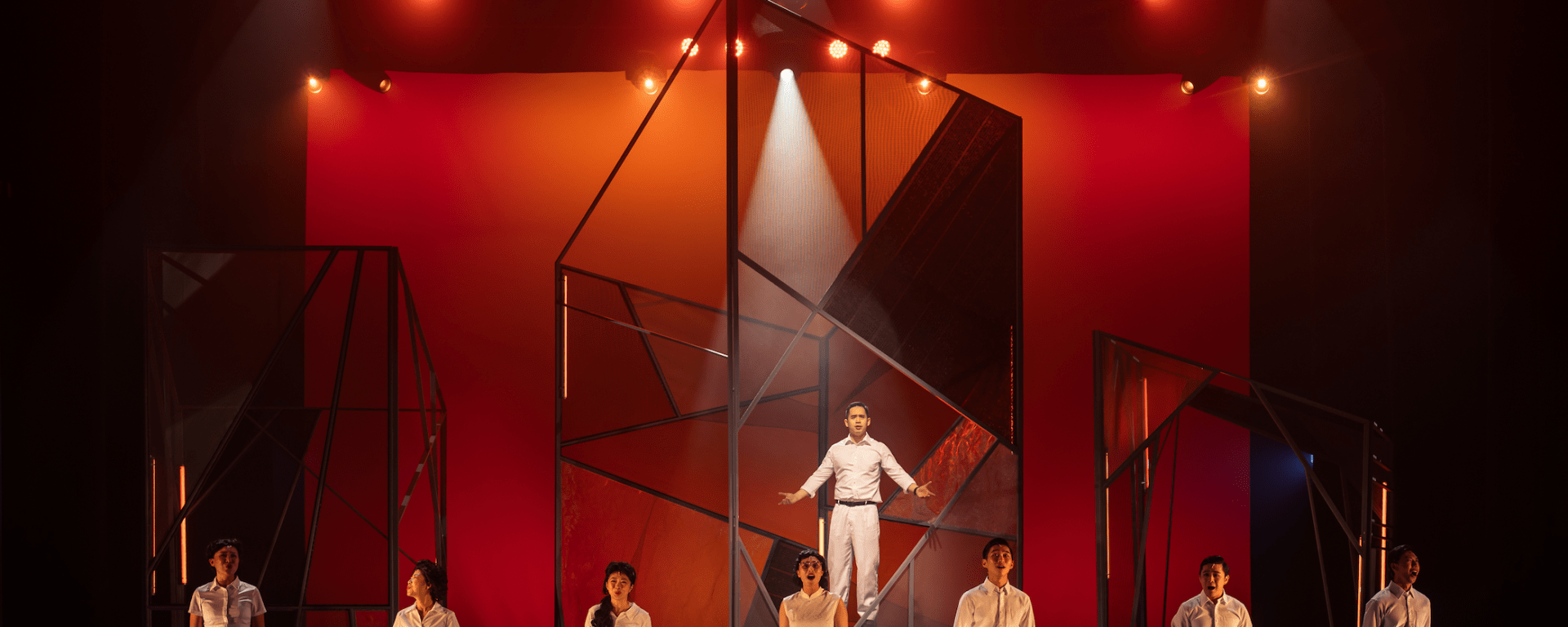
For a play that wants to take on such heavy and historically-significant subject matter, the design elements also leave one wanting. Tan Jia Hui’s costumes are good, in that there is enough variety to differentiate characters from each other, and are period-appropriate, while also taking direct reference from photos of the Lees. On the other hand, Goh Boon Teck’s set, comprising four abstract, black, tall and angular structures, seems intended to evoke the skyscraper-filled modern skyline the Lees imagine for Singapore’s future, but never quite commit to that symbolism.
These also hamper Alberta Wileo’s lighting design, where the light cast on the set pieces is absorbed by their black surface, while other decisions also make for some very confusing moments during the play; the scene in Cambridge for example, has a red, white and blue backdrop that resembles the French flag rather than England’s, glaring lights blind us from the radio, while fireworks at a party are almost comically flashed on and off, like cheap effects. That’s not to say Alberta isn’t capable of doing well – a gorgeous, photorealistic moon eventually appears at the end of the show, but there is a clear inconsistency in terms of quality of lighting throughout.

Certain directorial decisions are also baffling, with props that make little sense, from a baby that isn’t swaddled, making it clear it’s a doll with its arms frozen and outstretched through the entire scene, or a barbell Lee brings out during the confrontation with Lim Chin Siong, lifting it at the end to show his intellectual superiority, only to never be seen again, while a pot of crocuses is ‘re-homed’ by simply setting it down on the ground.
From a directorial standpoint, the Japanese soldiers are cartoonish villains when they appear, complete with forcing Lee to sing the Japanese national anthem, which they begin to echo before twirling away. The Lees walk in slowmo as they exit a party, while later, Joel Low, far too old to play a teenage schoolboy, appears as a young Lee Hsien Loong for all of one minute in Catholic High School uniform. Many of these moments are unintentionally funny, and makes one wonder just how thought through this whole musical war.

One of the most egregious faults of Moonlit City however is the treatment of Tan Kah Beng’s music. While it is understandable that jukebox musicals can take some liberty with featured songs used, it is fundamentally baffling why it cuts most of the songs down to a single verse and chorus, or even less, before swiftly moving on to the next scene. Whether familiar or not with these songs, none of the songs are given sufficient airtime to properly appreciate, completely undercutting their power in musicality and lyrics.
Under music director Benny Wong KG, actors also break into song abruptly during conversation, with little instrumental lead-in, so much that you can hear the whiplash in their gasp as they switch to their singing voice. Neither Lee Kuan Yew nor Kwa Geok Choo are given musical leitmotifs or refrains, and the songs really just serve as musical interludes, inserted for the sake of it. This, alongside the butchering of ‘Majulah Singapura’ and other national day favourites, makes us wonder why even bother making it a musical, if this is how they treat these iconic songs.
Moonlit City is the kind of bold, ambitious production that, in another context, might have benefited from deeper development, more rigorous dramaturgy, and a longer creative runway. Its choice to pair the lives of the Lees with the music of Tan Kah Beng is intriguing on paper, but the execution rarely lives up to that promise. Instead of immersing us in either an intimate love story or a compelling retelling of Singapore’s founding years, the musical attempts to do both, and ends up diluting the impact of each. There are fleeting moments of sincerity, particularly in its portrayal of Kwa Geok Choo, but they are too often lost in the rush to cover historical ground. As much as the final scene tries to drive home a sense of lasting legacy and achievement, it doesn’t quite ‘stick fast’ as it so dearly hopes to do, too scattered to truly resonate with its audience.
Photo Credit: Poh Yu Khing
Moonlit City plays from 25th July to 3rd August 2025 at Gateway Theatre. Tickets available from SISTIC
Production Credits
| Original Song Writer Tan Kah Beng Director and Set Designer Goh Boon Teck Producer Justin Wong Playwright Jedidiah Huang Script Translator Ang Shuang Cast Sunny Yang, Timothy Wan, Misha Paul Tan, Clement Yeo, Katherine Tang, Joel Tan, Mabel Yeo, Joel Low Music Director Benny Wong KG Vocal Coach Elaine Chan Lighting Designer Alberta Wileo Set Consultant Marc Andre Therrien Sound Designer and Sound Engineer Vick Low Costume Stylist and Wardrobe Manager Tan Jia Hui Hair and Make-up Designer Cheng Kum Hong Antonio |
 Bakchormeeboy
2 thoughts on “★★☆☆☆ Review: Moonlit City 城里的月光 by Toy Factory”