
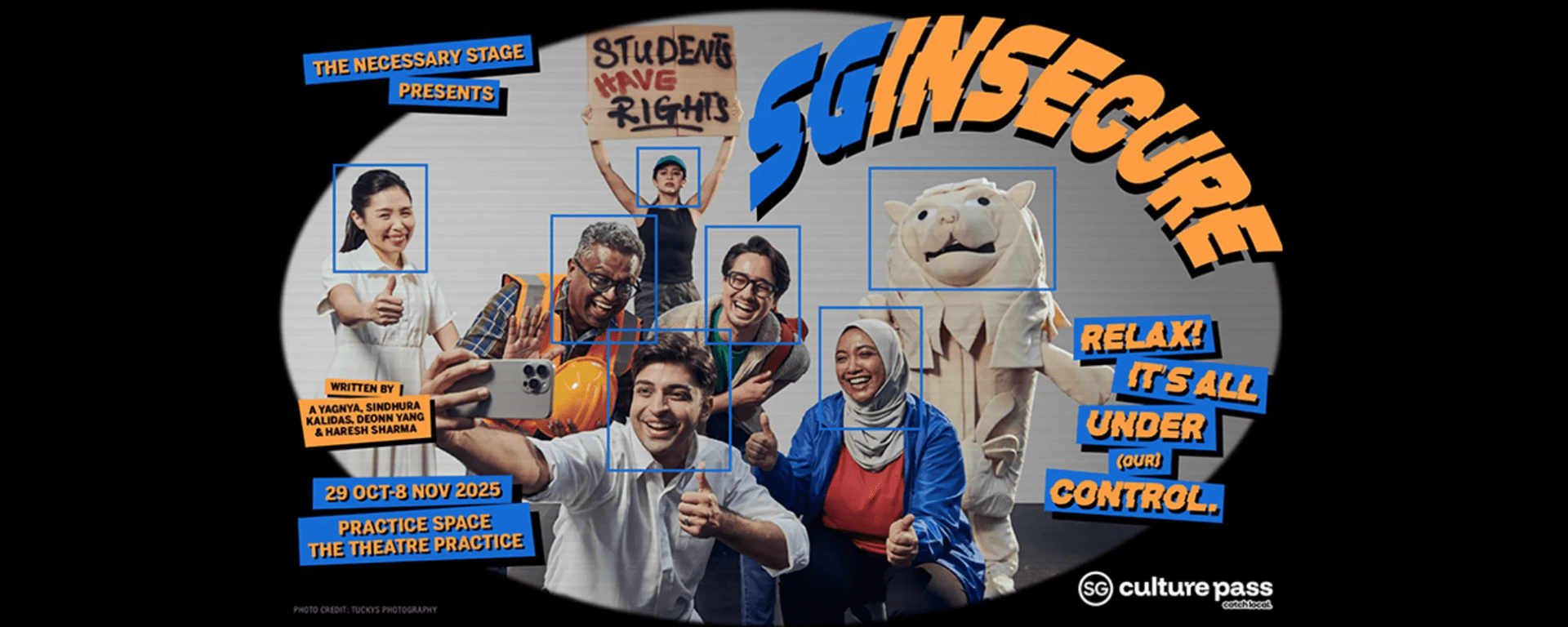
This October, The Necessary Stage (TNS) premieres SG Insecure, promising a bold new work about nationhood, belonging, and the contradictions that come with being Singaporean at a pivotal juncture in our history. As Singapore marks 60 years of independence amidst an era of global uncertainty, most other companies and organisations would find it a time of celebration.
Instead, SG Insecure chooses to interrogate the stories we’ve told ourselves and the stories we’ve left behind. Delving into migrant workers’ contributions across history, the 1954 Fajar Trial, and the surveillance systems that increasingly shape our lives, the work comprises a triptych of short plays written by TNS Associate Artists A Yagnya, Deonn Yang and Sindhura Kalidas, interwoven with additional texts by Resident Playwright and Cultural Medallion recipient Haresh Sharma.
In true TNS fashion, audiences can expect a blend of drama, comedy, serious issues and local parody, all within a production that questions and reflects on six decades of nationhood, and celebrating SG60 in the most TNS way imaginable.
The project began with a deceptively simple writing brief. “We always knew we were going to write an SG60 piece, and began with the idea of how it started / how it’s going as a starting point,” Sharma explains. “I didn’t even ask them to write plays. I just said: respond however you want. I was also bracing myself to see whatever came back. I wasn’t going to dictate to them what they could or couldn’t do, and felt it was a good time to challenge ourselves to put whatever they came up with together into a single show that would showcase their talents and lead to good discussions about Singapore.
The result is SG Insecure, a work that brings three distinct visions together under one theatrical frame: the SG Insecure Task Force, a device that links and comments on the triptych. “I was confident they’d all write good things,” Sharma continues. “I’ve worked with them in Playwrights’ Cove and other projects, and I knew they’d find something interesting, not just a play for someone else, but something specific they cared about and represents their artistry.”

For Sindhura Kalidas, the story came quickly. “The daunting part for me – Haresh gave options, it didn’t have to be a full play, just short and sweet. But in terms of the content itself, surprisingly it came to me quite quickly. I’d already been thinking about student activism, what it means to be a young person in SG today, and what we’re actually nurturing. That part came easily. But the actual writing – making it succinct – that was, and continues to be, the toughest part.”
Her play draws inspiration from the 1954 Fajar Trial, in which young student leaders were accused of sedition for their political writings. It imagines undergraduates navigating the risks of speaking up, portrayed by Shrey Bhargava, Munah Bagharib, Jamil Schulze and Cheryl Ho. Her piece ultimately reflects a larger question about education’s paradoxical role: it teaches civic consciousness, yet limits how far students can exercise it.
Kalidas explains: “In view of recent events involving student activists, I feel it’s important for us to acknowledge that dissent and dialogue, especially from young people, have always been part of our history. As an educator, I constantly ask myself what kind of future we are shaping if young people no longer feel like they can question or aspire beyond what currently exists?”
Researching her script, Kalidas spoke to current-day varsity students to learn about present-day challenges, from dorm segregation to how campus administrators respond to protests, and also went to find out how exactly investigations unfolded. “On one hand, they’re told to be civic-conscious, to do projects around social problems. But at the same time, there are only so many specific outlets to actually exercise that civic consciousness. It can be confusing – that’s what I was interested in exploring,” she notes. “In some ways, there’s more space now – more resources and platforms to air views on social media and forums. But in terms of content, what can we say and where can we say it? I don’t know. It doesn’t seem that way.”
Kalidas also recalls her initial draft being more surreal and sci-fi. “Haresh said: why do you need to go there? The dystopia is already here. No need to overcomplicate – it’s real and happening now,” she recalls. “So I spoke to current students to get a sense of college life today and what they deal with. Sometimes it’s logistical – dorm rooms, or rather ‘suites,’ gender segregation, etc. But also: what is college administration like? Have there been cases where people want to speak up but get shut down?”
Her research extended further: “Students do stage sit-ins and protests. So I wondered: what is being said, especially on the admin side? I even spoke to a police officer who’d been involved in investigations with young people – very forthcoming about how these interviews happen. Even if you’re over 21, there are rules to follow.”
“Is there no power in anger? Is it wrong to be angry in Singapore? Are young people allowed to be angry?” Sindhu asks. “The young characters in my play aren’t angry per se, but they truly care about the society they live in. And as young people, they’re figuring things out, discovering their voices. Maybe 10–15 years later, they’ll look back and regret. But isn’t it a good thing when students care enough to say or do something?” she muses.
“Ultimately, I wanted to explore how fear and insecurity operate inside young people themselves – projecting their own fears, which don’t need to be explicitly said. So I kept a bit of grey area. What does fear do to you? And how do good friends, who believe in the same values and principles, navigate that?”

On the other hand, A Yagnya produced a work on the treatment of migrant workers past and present, and comes at a most timely point in our 60th year of nation-building. With increasingly urgent voices by advocacy groups fighting to secure better transport measures, safety, welfare and recognition for our migrant workers, it is undeniable that we have much to work on and Yagnya’s play hopes to lend a voice to the matter.
She shares how her process began in a very different place: “My brother had co-published and co-edited the Singapore Terrestrial Conservation Plan (STCP), and we laughed about potentially doing STCP: The Musical. It’s a masterplan on Singapore’s wildlife and nature conservation. So I was thinking about the environment a lot at first. The struggle was finding the human entry point – humanising the story.”
That entry point came through the history of rubber plantations. “Rubber plantations in the 1900s changed everything – they started with 11 seeds in Botanic Gardens, and it wiped out a lot of local flora and fauna. I springboarded off that and dug into the history of rubber plantations. What struck me was: who fuelled the industry? The migrant workers. The Indian workers – no rights. That’s what I latched onto.”
The research journey, she recalls, was painful. “So little information from the perspective of the labourers themselves. Fifteen thousand people in plantations – but you can’t even find the name of a single worker. Disturbing, because identity is rooted in your name. They may not have been working just in plantations – linked to caste and background – so I had to search archives for names, where in India they’d come from. I got lucky meeting people researching rubber plantations in Malaysia – it was more alive there, lasted longer. I even found an Instagram account called Plantation Life, who kindly sent me a photocopy of an old book – a collection of plantation songs. It reminded me of reading about slave songs in America, and that connection carried me toward migrant workers, past and present.”
Veteran television and film actor Sivakumar Palakrishnan takes on the roles of migrant workers through time, beginning as a rubber tapper in 1919 and ending as a modern-day worker caught in the crossfire and aftermath of the 2013 Little India Riot. On that note, Yagnya ponders, “I look at our post-independence treatment of migrant workers who leave their entire lives behind to come here and build our nation up. Our colonial masters left this land, but have they left our minds and mindsets?”
For Yagnya, this project also connects deeply with her voice as an artist. “TNS has always made me ‘the angry Indian woman’, bringing out my activist side and the desire to speak up when things are not right. This play cements that, and as citizens, the issues I write about need government action. Governments take action only when citizens complain, when we don’t look away, when we care beyond bread-and-butter issues.”

Finally, for Deonn Yang, who dons dual hats of being Assistant Director as well as one of the playwrights, offers a work inspired by Singapore’s relationship with water and questions how our nation’s pursuit of security and control have shaped the way people live. Featuring an affable trio comprising Jodi Chan, Moli Mohter and Munah Bagharib, Yang’s play reaches into the societal gaps created by a booming metropolis that prioritises efficiency above all else.
The work follows the journey of two unlikely individuals, and a national icon, who find each other with a common hope for warmth, belonging and friendship. On the important questions she hopes to spark in the audience, Yang asks, “In our relentless chase towards a man-made image of perfection, who gets left behind? Who gets forgotten? As we move forward, can we still make space for genuine human connection, both now and in the future?”
She recalls how the idea emerged: “I was excited about the prompt. I had an idea at first, but due to a scheduling conflict, I had to change it. I’d been thinking of White, All White, and how relationships are core to the work I do. What I landed on developed as it went along – not rooted in water necessarily, but the question of who does Singapore belong to? The whole ‘sleepy fishing village’ narrative. We cleaned up the rivers – but where do the people in-between fit in?”
Water, for Yang, became a powerful motif. “I was thinking of someone who had to cross the Causeway. Water both connects and separates. Then I read an article about Lee Kuan Yew cleaning up the Singapore River, because it was so stinky, bumboats couldn’t pass, and so we couldn’t progress. So while the clean-up led to change, it also led to displacement, where people removed in the name of progress. Where do they fit in, especially in the echelons of power? And the Merlion’s involvement, well, the Merlion was at the front of the Singapore River from the get-go, during the cleanup – this tourism symbol, created by white men, living on forever. All of that mishmash of identities, and how water connects and divides.”
At its heart, her play is about connection. “As I’ve grown and developed my work, I realise that’s the core of who I am – how we relate to each other, exist within society, and support each other. The play still aligns with that. It expands beyond familiar relationships, to our connections as people, how we care and support each other in the face of whatever comes. That’s my ethos.”
Yang, who also took on the role of Assistant Director, explains: “I loved assistant directing with Haresh. He’s done a great job with this Task Force idea. When we were directing, in our discussions, there was already a framing. We’ve created a certain groove. The throughline is the Task Force device, seeing how the plays connect.”
She adds: “Fundamentally, it goes back to the idea of the human spirit prevailing – across all three plays. Even the Task Force characters, in contrast to the ones in the plays: how they work as individuals, as a collective, as unknown oppressors. There’s a sense of ‘people versus something,’ and that political aspect. It’s about human spirit – standing up for one another, gathering strength collectively and individually – despite disadvantages and obstacles.”
For all three playwrights, SG Insecure also represents a milestone in their journeys with The Necessary Stage as Associate Artists. “Before joining TNS as an associate artist, I was mostly doing independent work, semi-self-producing. Different dynamic from working with a company structure,” Yagnya reflects. “Something about working with TNS – with mentors like Haresh and Alvin – helped me with getting a lot of professional feedback. That eye is on your work, pushing you to be a better theatremaker.”
She traces a clear line through her TNS works. “From Hi, Can You Hear Me?, to Eclipse, and now this, what has underscored my time at TNS has been the genocide, which has underscored everything I’ve created here. I’ve always spoken up. Even back when I interned here in 2013/14, it already sparked the need to use theatre to talk about sociopolitical issues, and shaped who I am today. As artists – when unspeakable things happen – how do you move forward? This play is me trying to figure that out. It’s about getting people to care. We can’t look away.”
She remembers a conversation with Haresh: “The genocide still continues to make me angry and upset. But at one point I had a poignant convo with Haresh: what am I doing in the arts if I can’t make them care about such an important issue? He said some people may struggle to care about global events. So why not start by making them care about what’s in their own backyard first? That got me reflecting. Hi, Can You Hear Me? was loud, global. Now I make the shift to something more local, to entice people to care about what’s close to home, with questioning that’s sharper, more focused.”

For Sindhu, the opportunity has been transformative. “It’s not lost on me what a privilege it is to be an associate. So many people out there are self-producing, wanting to make work but without platform or money. We’re lucky to have a company backing us – to make whatever’s in our heads into reality. It still feels crazy to me.”
“Back then, I had one foot in the theatre industry and a full-time job. TNS took a chance on me. Before this, I was mostly a performer, but this helped me develop other skills. Haresh asked Deonn and me: what do you want to do? What do you want to learn? I said I was scared to write, but wanted to try. They didn’t know if I’d be good or bad – but that’s all you need sometimes, an opportunity. Now I’ve honed facilitation, writing, dramaturgy. And it all goes back to community – being part of a theatre community, helping each other.”
She also reflects on care in the rehearsal room: “I’ve been thinking a lot about what care looks like. Conversations with Haresh about how things were in the 90s versus now – the importance of check-ins, of base-level care. TNS has been a great place to start thinking about that. They’ve played a huge role in building community in Singapore theatre. Learning from mentors like Haresh and Alvin – their willingness to adapt, evolve, their humility to admit ‘I don’t know’ – and figuring things out together. That’s been my biggest takeaway.”
Yang, who describes herself as “from the school of TNS,” notes how her own practice has been shaped. “In a lot of ways, I feel like I’m from the school of TNS. Haresh and Alvin have been pivotal in my growth as an artist, and I’ve been involved with so much work for years. I wouldn’t have been where I am without them. That trust they place in you, and the room they give for you to explore – that’s rare. To have that kind of space in Singapore theatre is very precious.”
The conversation also turned candidly to bigger questions – about patriotism, censorship, and their own relationship to Singapore. The artists are frank about the risks of speaking against the grain in Singapore. “TNS has never censored me,” Yagnya says. “They’re not the type to play it safe. They always tell me, make sure you can back it up. Don’t say something just to say it. IMDA will do their job, we’ll do ours.”
Yang acknowledges the fear but insists: “If it keeps you up at night, just do it. Otherwise what are we even doing? I self-censor sometimes, but I remind myself to find ways to say what I need to. It is scary, but if it bothers you, you have to say lah. Hopefully people will rally around you.”
Kalidas adds: “It forces us to innovate. Like with students — if they keep doing something, maybe I need to teach differently. Same with theatre: how do we repackage our messages so people listen? What makes a nation is its people — with all our blemishes, complexities, quirks. That’s worth celebrating.”

Ultimately, all four return to one thing: people. “I’m a very heartland girl,” says Yang. “The skyscrapers are nice, but the real Singapore is in kopi-o, in hearing the accent on TikTok, in how we support each other. That’s who I want to celebrate.”
“I love Singapore,” says Yagnya. “This land gave me opportunities, taught me the miracle of intercultural living. But we can do more than just pat ourselves on the back. At 60, let’s not be insecure. Let’s question who we want to be.”
And for Sharma, it’s about holding space for all these perspectives. “As a company, it’s been wonderful working with our associates. They came with their own interests, their own concerns. We gave them space to experiment. And at the same time, they pushed us too. It’s not just one way – we also learn from them. That exchange is important,” he says. “Human connections, freedoms, migrant workers, students, heartlanders. Even poking fun at government. Some say it’s good to be taken care of. Others say we can do more. These views should coexist. That’s what SG Insecure shows.”
SG Insecure is not just a marker of Singapore at 60, but also of TNS’ continuing legacy – nurturing new voices, opening difficult conversations, and daring to imagine what Singapore can become. As Sharma puts it: “It’s about asking questions. Not giving answers, but asking questions. That’s what theatre can do. And that’s what keeps us going.”
As Sharma quipped in the press release, ‘SG Insecure is not a show gov.sg will endorse. But that’s exactly what the audience will like about it.’ SG Insecure is exactly what TNS has always stood for, but now seen through fresh eyes and younger playwrights. “We’ve always been open – to dialogue, to different perspectives, to taking risks. That’s what keeps the work alive. And seeing the associates carry that forward – it gives me a lot of hope,” concludes Sharma.
Photo Credit: The Necessary Stage
SG Insecure plays from 29th October to 8th November 2025 at Practice Space @ The Theatre Practice. Tickets available from BookMyShow.
 Bakchormeeboy