

Joel Tan’s new play is a manic punk dream that takes us on a trippy ride on being a rebel without a cause in sanitised Singapore.
In Singapore, rebellion often feels like a memory we’ve outgrown. We live orderly lives, shaped and honed for maximum efficiency, stability, and safety. Yet beneath that calm hum, there’s the quiet ache of a frustration we rarely name. To live here is to be conditioned toward compliance: study hard, work harder, avoid trouble, stay grateful. It’s a fair trade for security, until one day you realise how little room is left for disobedience, and how adulthood itself can feel like a lifelong act of submission. We don’t burn down the system but we learn to function within it. And that, perhaps, is the most horrifying thing of all.
It’s this tension between the comfort of conformity and the longing to rebel that sits at the heart of The Serangoon Gardens Techno Party of 1993, Wild Rice’s newest play written by Joel Tan and directed by Sim Yan Ying “YY”. Staged within a gleaming white-tiled box at Wild Rice’s intimate theatre, the production literalises Singapore’s obsession with cleanliness and control. TK Hay’s set looks like both a bathroom after a bender and a sterile experiment in order, the perfect space to stage a rebellion that’s doomed from the start.

Set in 1993, the play follows sixteen-year-old Candice, who’s chafing against her devout Christian mother, her school, and the quiet politeness of her Serangoon Gardens neighbourhood. Dreaming of becoming a music journalist, she lives through MTV, alt music radio stations and indie magazines, with Joy Division, Red Hot Chili Peppers, and always envying the glamorous chaos of lives louder than hers. When her mother burns her stash of tapes and posters, Candice snaps. She runs into the night, tumbling through a feverish odyssey of sex, drugs, danger, and freedom.
It’s a thrilling premise, this Singaporean coming-of-age story filtered through the static of grunge and the pulse of techno, the fantasy of rebellion against a place that insists on staying neat. Coco Wang is well cast as Candice, capturing the combustible energy of youth, always restless and surging with a desperation to feel something ‘real’. She’s angry, impulsive, and heartbreakingly sincere, whether she’s spouting off a string of expletives or when she’s awkwardly flirting. Wang manages to make Candice’s chaos feel authentic, even when the script veers at times into addled nonsense, and her performance is the emotional core of a production often distracted by its own spectacle.

Karen Tan, one of Singapore’s most accomplished actors, plays the older Candice, a weary narrator reflecting on her past and looking down from a room above the main performance area. She also plays an array of supporting roles: Candice’s mother, a classmate, a pregnant woman, a judgmental auntie, and while it’s amusing, it’s also a waste of her depth. The direction spreads her too thin, leaving none of the roles enough room to fully breathe. Her older Candice especially should have been the show’s anchor, the voice of reckoning that gives the chaos shape, but she’s mostly used as connective tissue. It’s frustrating, because Tan has the gravity to turn reflection into revelation, and the play just doesn’t let her.
The rest of the ensemble moves around Candice like fragments of a dream. Shane Mardjuki leaps between caricatures with manic energy; Jackson Hurwood, as the son of an American diplomat, arrives halfway through like a live wire. He’s wild, magnetic, and genuinely unnerving, a burst of danger that jolts the production to life just when it seems to run out of steam, and one that we’ll be keeping an eye out for in future productions.

Then there’s Jun Vinh Teo as the 21-year-old police officer who becomes Candice’s love interest, perhaps simultaneously the most troubling and oddly compelling part of the show. The relationship is inappropriate by design, but the production doesn’t seem sure how to frame it. Instead of interrogating the power imbalance, it romanticises it, asking us to pity him and sympathise with him. And yet, paradoxically, their chemistry also produces the play’s most affecting moments. You believe them, however briefly. The awkward tenderness between them hints at what this play could have been, more than a night of spectacle, and instead homing in on the intimate, uncomfortable character study about longing, morality, and the mistakes we mistake for love that neatly ties in with the play’s concerns about paradoxes and contrasts.
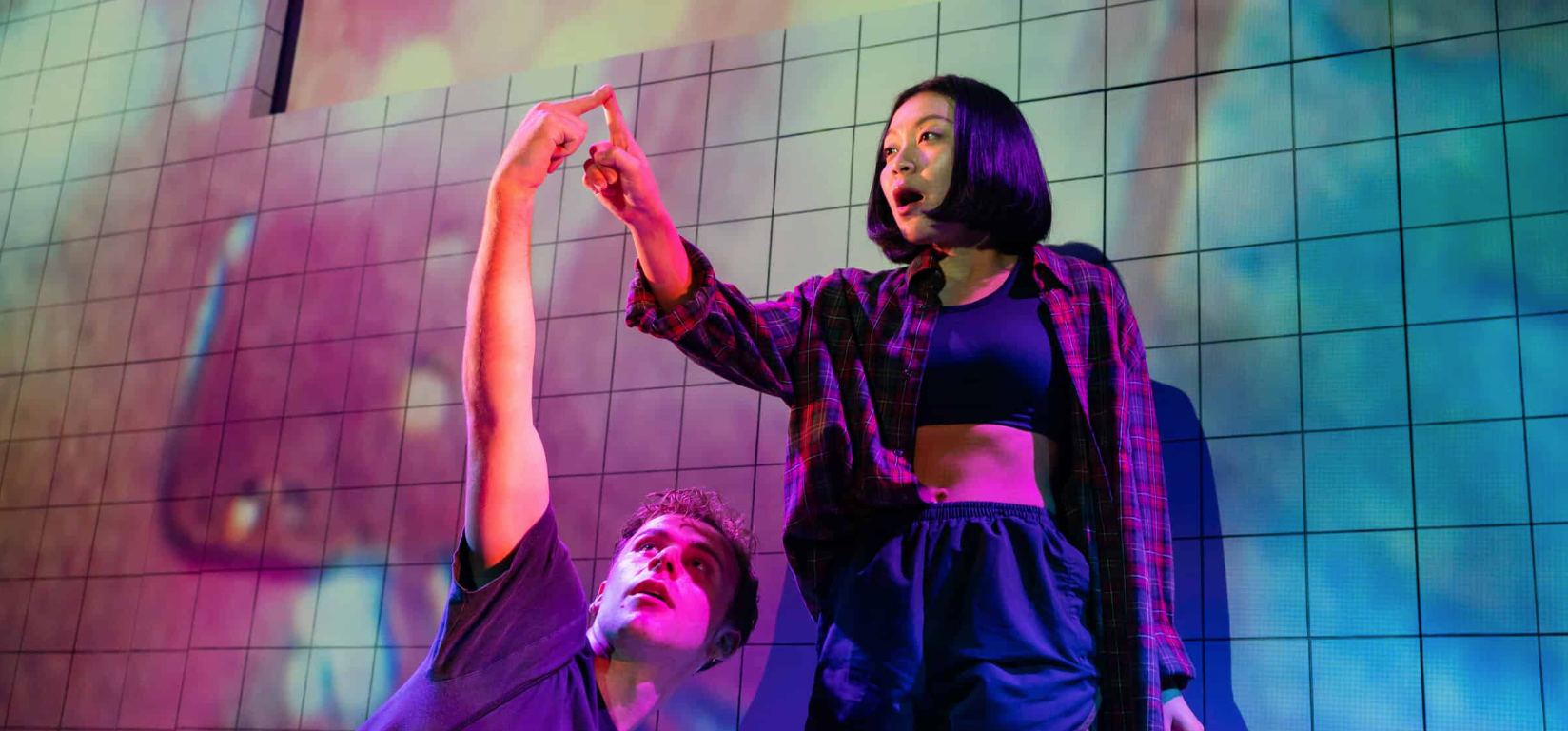
Visually, the show remains striking. A large part of that is thanks to the exceptional multimedia design by NONFORM, who utilise archival footage and trippy rave scenes that play across the set like restless memories, giving the show a kaleidoscopic rhythm. NONFORM also takes charge of the sound design, providing a swirl of 90s techno and rock that adds to the adrenaline rush, making the air vibrate with the sense that something is about to erupt. The interstitial projections quoting upcoming scenes are clever too. Though at times overused, they lend the show a cinematic rhythm reminiscent of Pink Floyd’s The Wall. When at its best, the experience feels immersive, as though the audience has been pulled into the dizzy, dangerous high of Candice’s night.

On the other hand, the white-tiled set gleams under harsh light, evoking both the sterility of Singapore’s order and the grime that festers beneath it. But at the same time, the design is restrictive. The elevated layout limits sight lines from certain angles, and the constant popping out of hidden compartments grows predictable. Even the stagehands’ visible movements feel caught between deliberate and accidental, as though the production can’t decide how messy it dares to be.
While amusing, The Serangoon Gardens Techno Party of 1993 never fully commits to its camp potential in its initial scenes, and makes the eventual transition into the darker second half less impactful, itself. Even when it does want to create a sense of danger, there are only flashes of it, where even the drug scenes feel stylised rather than real. And most egregious of all is the twist, which, while in line with the narrative, feels tacked on and doesn’t actually have any impact or bearing on the plot. It’s a clever idea in theory, but in practice, the sequence breaks the spell entirely, and the play stops being about rebellion and turns into a meta exercise that never finds its footing.

By that point, The Serangoon Gardens Techno Party of 1993 seems to have lost its sense of direction. The story loses the point it’s trying to make, and the emotional core, already fragile, dissolves under the weight of spectacle and cleverness, and it flubs its ending despite a promising premise. As much as it tries to ask a pertinent question of what does rebellion mean in a country that rewards obedience, and for what, that purpose and meaning never quite gets answered even in its final scenes, leaving us only with a simple idea: to live here is to long for chaos, even as we keep everything clean.
Photo Credit: Wild Rice
The Serangoon Gardens Techno Party of 1993 plays from 17th October to 1st November 2025 at Wild Rice at Funan. Tickets available here
Production Credits
| Playwright Joel Tan Director Sim Yan Ying “YY” Cast Jackson Hurwood, Shane Mardjuki, Karen Tan, Jun Vinh Teoh, Coco Wang Dramaturg Cheng Nien Yuan Set Designer TK Hay Lighting Designer Alberta Wileo Sound & Multimedia Designer NONFORM Costume Designer Johanna Pan Hair Designer Ashley Lim Make-up Designer Bobbie Ng |
 Bakchormeeboy
3 thoughts on “★★★☆☆ Theatre Review: The Serangoon Gardens Techno Party of 1993 by Wild Rice”