
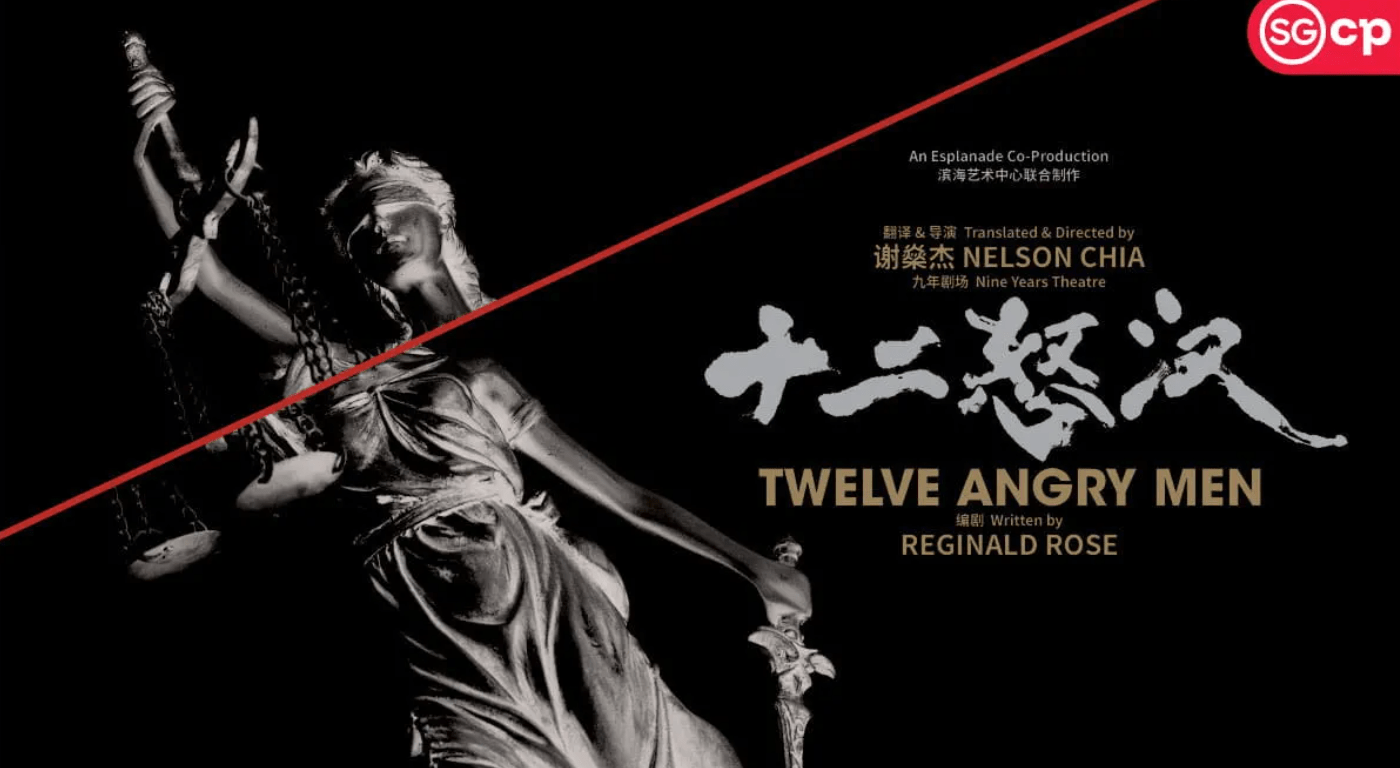
A verdict that decides life or death. A clash of prejudice and justice. An intense midnight quarrel leads to the murder of a man. Witnesses take the stand as his 16-year-old son is tried for homicide. With all testimonies against the boy, his fate hangs by a thread as 12 jurors must render the final verdict.
In the stifling heat of the jury room, 12 personalities collide in a bout of logic and intuition, reason and conscience. Will they emerge as defenders of justice—or are they destined to become hangmen?
Reginald Rose’s 1954 teleplay Twelve Angry Men remains one of the great courtroom dramas of classic film history. And when Nine Years Theatre (NYT) adapted it in Mandarin in 2013 as part of Esplanade’s Huayi – Chinese Festival of Arts, it was a breakthrough moment for the then very young company, who was finding their footing and audiences. In that staging, the production sold out all four performances, won four awards at the 14th Life! Theatre Awards, including Best Director and Best Ensemble, and cemented NYT’s reputation as a company to watch.
For artistic director Nelson Chia, who both directs and translates the play, Twelve Angry Men occupies a special place in NYT’s history. “It was technically our first official production under the Nine Years Theatre name,” he recalls. “Before that, Who’s Afraid of Virginia Woolf? was presented under my own name, but Twelve Angry Men marked the beginning of the company. It also began our long-term relationship with Esplanade, which commissioned us for three consecutive years—a first for a local theatre company.”
Twelve years on, NYT returns to this classic with an almost entirely new cast. The ensemble features an eclectic mix of talents: established actor and host Danny Yeo, original cast member Tay Kong Hui, veteran Mediacorp actor Wu Wei Qiang, alongside Oliver Pang, Dwayne Lau, Tang Shaowei, Timothy Wan, Tan Guo Lian Sutton, Ryan Ang, Clement Yeo, Pauli Haakenson, and Vester Ng. “This cast is quite special,” says Chia. “We have an European actor who speaks Mandarin, actors from English-language theatre, television personalities, and newcomers. The diversity brings new layers to the work and will also attract a broader spectrum of audiences.”
The decision to restage the play after more than a decade was not taken lightly. Chia explains that the timing felt right: “People had been asking for years whether we would restage it. We wanted to find the right moment, not just when the company was ready, but also when the audience was ready to see it again. Twelve years later, with the company’s 12th anniversary, it felt fitting to revisit it.”
Though Chia resists heavy-handed reinterpretations, he believes the play will inevitably feel different in 2025. “I don’t impose obvious interpretations on my work; I prefer to let the play usher the audience into a space where they can make their own meaning. But the truth is, it’s already new, because twelve years have passed. In that time, we’ve gone through a pandemic, world crises, wars, and challenges to democracy. Audiences will bring that history with them into the theatre, and they’ll see the play in a very different light.”
The production also moves to a new stage: the Singtel Waterfront Theatre. Unlike the black box intimacy of the Theatre Studio where the 2013 staging was performed, the Waterfront Theatre is a larger, more conventional proscenium stage. This shift presents both opportunities and challenges. “In a black box, the audience feels like they share the same space as the play,” Chia notes. “In a proscenium theatre, there’s more distance. So the task is to find ways, through acting, blocking, or design, to embrace the audience, to make them feel that what’s happening on stage is happening in their world too.”
One design element returning is Wong Chee Wai’s celebrated set, which uses forced perspective to create a subtle sense of distortion in the jury room. “At first, I wasn’t sure if it would work,” Chia admits with a laugh. “The table narrows upstage, so the actors joked about having to ‘shrink’ as they walked. But in performance it was powerful, it felt familiar yet strangely disjointed, which suits a play about conflicting perspectives. We’re bringing that back, with some modifications for the new space.”
Language itself also shapes the play’s impact. Performed in Mandarin, the adaptation removes the question of whether the characters are American, Singaporean, or something else entirely. Instead, says Chia, it creates a unique theatrical world. “When it’s in English, the issue of accent and cultural context comes up. But in Mandarin, it becomes a world of its own—familiar yet strange. That estrangement, what Brecht called the ‘alienation effect,’ makes the audience look at the play with fresh eyes.”
Twelve Angry Men may be set in a jury room, but its real subject is humanity: the prejudices, biases, and convictions that shape how we negotiate with one another. “It’s really about human interaction,” Chia reflects. “Twelve people with their own baggage, locked in a room, making a life-or-death decision. That’s why the play endures, it’s timeless, and it will always hold a mirror to the society watching it.”
“This play is like a mirror. You see a story, but you also see yourself in these twelve men. Sometimes you might be surprised to recognize yourself in more than one of them. That can be uncomfortable, even frightening. You laugh, you’re entertained, but by the end, there’s a discomfort because you’ve seen yourself in them, and you don’t really want to talk about it.”
Presented by Esplanade and co-produced with Nine Years Theatre, Twelve Angry Men returns to the stage, still powerful, provocative, and utterly gripping. “I think the world now, with social media and the internet, gives us an illusion of choice. We think we’re choosing sides, forming opinions, making up our own minds—but that’s not true,” Chia concludes. “We see what we want to see, we believe what we want to believe. The choices are, in a way, an illusion. These twelve men in the play, when they shift or change, it’s not because they’ve suddenly decided something new. It’s because their faith in themselves has been shaken, and they start to doubt their own autonomy. That is when change can finally begin.”
Twelve Angry Men plays from 7th to 9th November 2025 at the Singtel Waterfront Theatre. Tickets available from the Esplanade
 Bakchormeeboy