
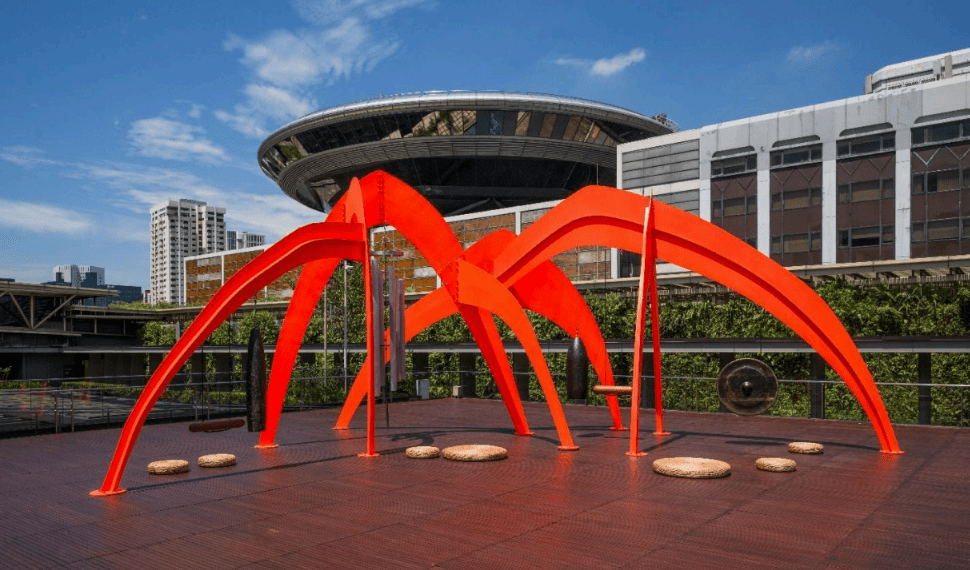

Visitors stepping onto the Ng Teng Fong Roof Garden Gallery at National Gallery Singapore encounter a cluster of suspended shells, bells and chimes that glimmer with both menace and promise. Touch becomes participation. Sound becomes memory. The installation, titled Temple, marks the Gallery’s first rooftop commission to entwine motion, sound and public interaction.
Temple is the latest milestone in the practice of Vietnamese-American artist Tuan Andrew Nguyen, who has spent decades pursuing the stories that linger after conflict. Born in Saigon and raised in the United States after fleeing as a refugee, Nguyen folds lived experience, research and community engagement into artworks that re-situate history through tenderness and imagination. His global acclaim includes solo exhibitions at the New Museum (2023) and the Smithsonian American Art Museum (2024), and works held in the permanent collections of MoMA, the Whitney Museum and more.

Temple’s key concept and materials are derived from defused unexploded ordnance (UXO) from Quảng Trị, Vietnam’s most heavily bombed province. Visitors are invited to activate these transformed remnants, producing tuned frequencies including one bell that resonates at 432Hz, a pitch popularly associated with healing.
Nguyen’s motivation comes from both history and personal relationships. “This is the culmination of like years and years of research and working with this very specific community in Quảng Trị, which technically is known as the most bombed place on Earth,” he shared at the installation. He pointed to the chilling reality that more civilians have died from UXO accidents since 1975 than American soldiers did during the war. The work, he emphasized, springs from witnessing how local people “have turned sorrow and suffering and disaster into really beautiful ways of approaching the history.”

Temple honours a story that became a conceptual catalyst. In the 1960s, a bomb fell beside a temple in central Vietnam but did not explode. The monk defused it, hung it as a bell, and declared that it should “have compassion on human life.” Nguyen explained: “I thought that was such a beautiful story, understanding that compassion can exist everywhere. It should be echoed and resonated continuously.”
The structure itself glows in day-glo safety orange. The colour nods to UXO hazard markers scattered across Vietnam’s terrain, even as the sweeping sculptural form conjures limestone mountains that once sheltered Nguyen’s grandmother.

Nguyen’s orange swoops also refer to Alexander Calder’s modernist stabiles. By meditating upon Calder’s stabiles, Tuan actually invokes the spectre of modernism. And in doing so, he invites the spectre to transform into something else. Nguyen later revealed his surprise in discovering Calder’s activism: “He was very adamant against the American involvement in Vietnam at a time where we’re faced with so much violence and the silencing of voices, I thought that was a beacon of light.”
His film connected to the installation even imagines a character who believes she is Calder reincarnated, forging new forms from bomb metal in search of healing through sound. It’s a little chilling, especially since each time he speaks of Calder, we hear the sound of the wind chimes, as if a ghostly presence remains. Nguyen laughed, describing the conceptual leap: “If sound can be weaponized, then sound could probably be used to do the opposite. To help.”

Visitors are encouraged to sit on water-hyacinth mats woven by artisans in Vietnam, lingering inside the sculpture’s sonic chamber. Nguyen described the installation as “a kind of space for rebalancing, re-centering, a reprieve from the chaos of the everyday wars out there.”
He insisted the audience is vital: “I’d like people to kind of interact with it, to become agents in their own, moment for them to kind of take a breath.” With a smile, he adds: “Everybody, I’m hoping everybody, kind of interacts with it and activates the sound.”

Temple forms part of both the 8th Ng Teng Fong Roof Garden Commission and Singapore Biennale 2025: pure intention. As explained, these initiatives encourage audiences “to not only experience art conventionally using your powers of sight, but really to then engage with a sensing body.” The Biennale framing allows Temple to “dialogue with the other works that will be shown that are both historical and contemporary in the same building.”
Said Gallery CEO Dr Eugene Tan: “This year marks the 50th year since the Vietnam War ended in 1975. The residual effects of war carry on for several generations after wars end.” Nguyen’s project acknowledges this milestone not as closure but as continuing responsibility.

Temple thus asks what we can build from the wreckage. In Quảng Trị, the bombs still lurk beneath the soil. Nguyen has chosen to raise them into the air instead, recast them as instruments of empathy, and let their resonance carry forward. Struck lightly or boldly, they ring out with possibility. Temple stands as a call to listen to the past, and from it, find the vibrations that resonate, vibrations we can reshape together.
Photos courtesy of National Gallery Singapore
Temple is on view from 25th October 2025 to 11th October 2026 at the Ng Teng Fong Roof Garden Gallery. Admission is free. More information available here
 Bakchormeeboy