
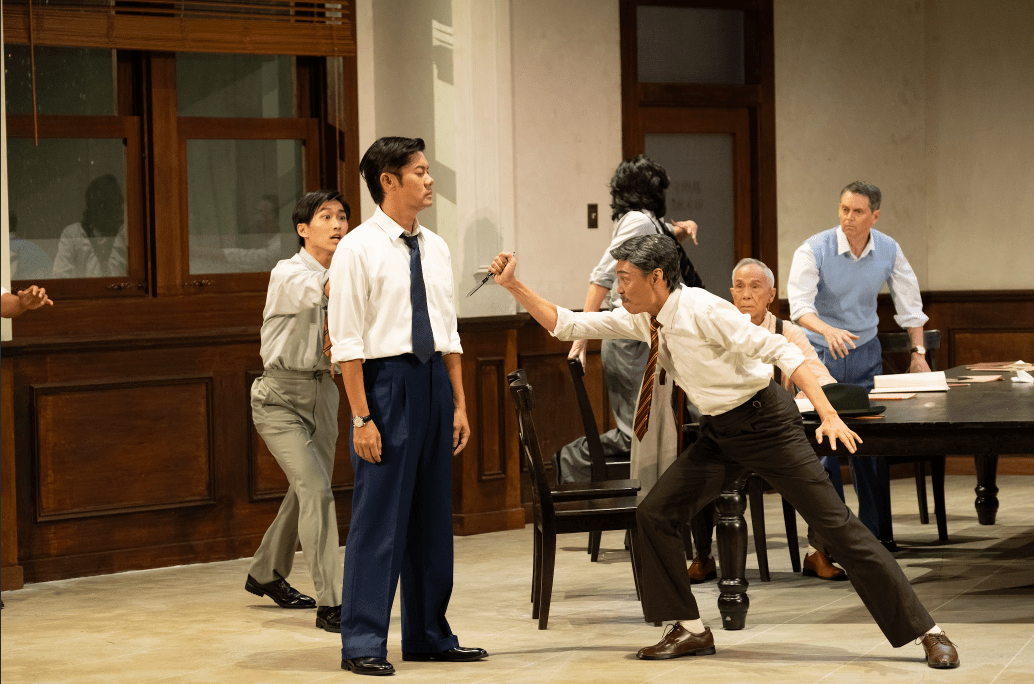
Biases unravel and tempers flare in Nine Years Theatre’s powerful revival of this classic courtroom drama.
There is something unsettling about the image that accompanied the publicity for Twelve Angry Men: twelve faces, marked by a single red stroke. Is it erasure, censorship, or judgment? The ambiguity lingers as the lights dim, an apt prelude to Nine Years Theatre’s searing revival of Reginald Rose’s courtroom classic, translated and directed by Nelson Chia and produced by Mia Chee.
Before a single actor appears, sound designer Jing Ng already has the audience on edge. Through the speakers come the stern instructions of a judge (voiced by 2012 cast member Johnny Ng) the formal, disembodied reminder that these twelve ordinary citizens are to decide on a first-degree murder. Then: the muffled screams, the scuffle, and three sharp thuds of a gavel. It is as though the world itself has announced the play’s beginning. The twelve jurors file into the room, each carrying the invisible weight of civic responsibility, and, as it will soon emerge: private prejudices.
Wong Chee Wai’s set recreates 1957 in almost obsessive detail: the heavy wooden table, creaking fans, peeling walls, and a clock that seems to tick more slowly as tempers rise. There is no air-conditioning, only the restless hum of the city outside; when the windows open, we hear traffic, distant voices, the ghostly continuation of a world untouched by deliberation. Real rain hits the windows during more dour, reflective moments. Yet the brilliance of the design lies not only in its authenticity but in its invitation. The table, narrow at first, seems to widen and edge toward us as the debate intensifies, until we find ourselves seated at the same table, unwilling spectators turned silent jurors. It is an astonishing illusion, one that makes us conscious of time, of heat, of the slow suffocation of responsibility. The period costumes by Anthony Tan, together with The Make-Up Room’s styling, fix us firmly in time, and yet, in this heat and stillness, everything feels terrifyingly current.
Chia’s direction makes the room itself breathe. The table, angled towards the audience, seems to extend outward as the hours pass, pulling us into the debate. The atmosphere thickens with what can only be called the viscosity of emotion: belief pressed against belief, pride against truth. Every silence feels heavier than speech.
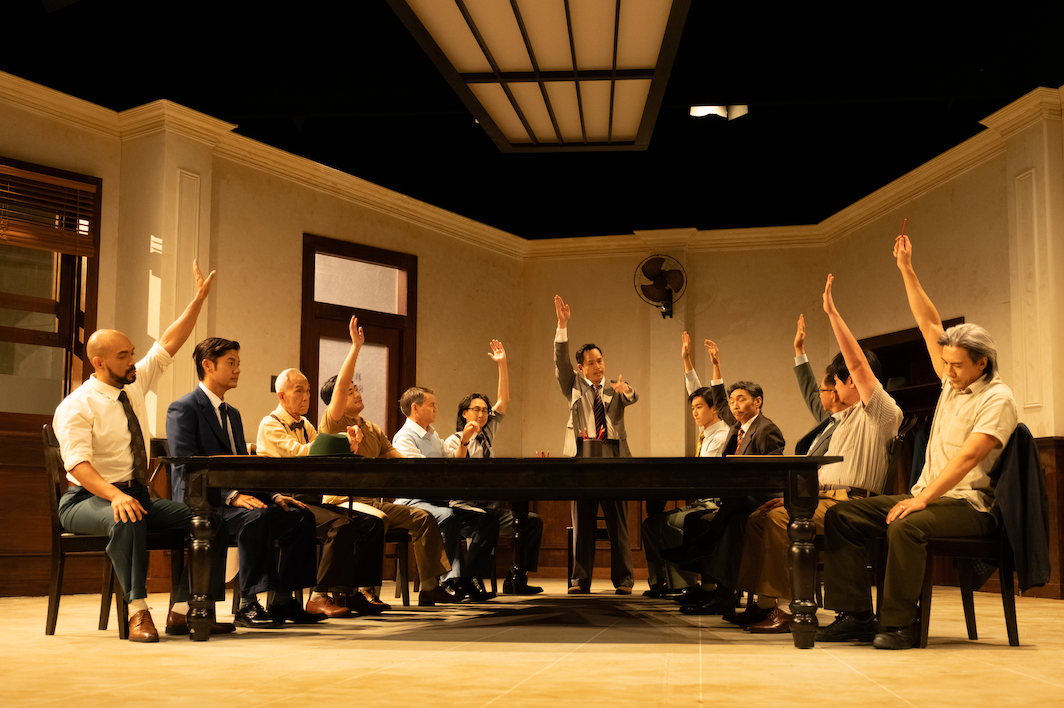
The first vote is almost perfunctory: eleven for “guilty,” one for “not guilty.” Danny Yeo’s Juror 8 emerges not as a rebel, but as a man compelled by doubt. He is at the centre of the storm, a quiet dissenter infuriating to some, yet indispensable to all. He refuses to take evidence at face value, and Yeo plays him with a calm persistence that borders on provocation, the kind of irritating intelligence that everyone loves to hate, until it becomes impossible not to admire. Beneath his composure lies an unyielding moral pulse: do we simply send a sixteen-year-old boy to the gallows, or do we first question the very foundation of our certainty? In Yeo’s hands, that question expands beyond the courtroom, asking what it means to judge at all. Opposite him stands Tay Kong Hui’s Juror 3, a man wound so tightly by pride and pain that every word seems to scrape against his own restraint. Tay plays him as a father hollowed by disappointment, a man whose fury masks a deep, unhealed wound. His bluster fills the room, his sarcasm lashes out like defence and confession in one breath. Tay’s performance is heartbreaking in its precision a portrait of masculine fragility, of conviction eroded by grief, where Yeo’s quiet reason, his unraveling feels inevitable, and devastatingly true.
When Danny Yeo’s Juror 8 first lays a knife identical to the murder weapon on the table, the room freezes. It is a gesture reasonable doubt, a quiet challenge to the rest to look beyond the surface of “facts.” In that instant, the play pivots: doubt enters the air, soft but irreversible. As he presses his case, the hum of the broken fan becomes almost unbearable; when it finally sputters to life, it feels as if the room itself exhales, the first hint that something is beginning to shift.
All around them and throughout the play, the ensemble breathes as one. Timothy Wan’s Juror 1 keeps order with a steady, methodical calm; he maintains leadership and control, even when all hell threatens to break loose, all the anger simmering. Meanwhile, Clement Yeo’s timid Juror 2 grows into quiet conviction, his voice eventually finding its shape amid the clamour. Oliver Pang’s Juror 4 delivers a cool, almost surgical precision as the analytical stockbroker. Vester Ng’s Juror 5, sensitive to slights against “slum kids,” radiates dignity; Tan Guo Lian Sutton’s Juror 6 brings integrity and quiet strength.
As the lights shift and the storm outside subsides, another kind of storm brews within. The tension between Dwayne Lau’s impatient Juror 7 and Juror 11, Pauli Haakenson’s courteous immigrant watchmaker, crackles with unnerving familiarity. Under Nelson Chia’s direction, their exchange becomes a clash of temperaments that also mirrors our own quiet prejudices. Dwayne’s brusque frustration, his disdain for “foreigners who think they know better,” lands with uncomfortable truth; Pauli’s measured restraint, his dignity under fire, only sharpens the contrast. It’s a scorching dissection of bias and belonging, and feels incredibly urgent in that moment. Ryan Ang’s Juror 10 turns bluster and xenophobia into a chilling mirror of modern intolerance, while Juror 9 Wu Weiqiang’s elderly juror watches and listens with heartbreaking empathy, Finally, Juror 12 Tang Shaowei’s advertising man flits between opinions with anxious charm. Each performance is fully lived, and together they form an organism of breath and tension, an ensemble so finely tuned that the smallest glance can change the room’s temperature.
Like the characters onstage, we keep glancing at the clock on the wall, willing it forward, yet unable to look away. It becomes a silent witness. We, too, keep glancing at it, feeling the drag of time, the endlessness of debate. What began as an open-and-shut case becomes an ordeal of conscience; what was once certainty dissolves into empathy. Nelson Chia’s direction refuses the comfort of rhythm – time stretches, folds, and loops until even the audience feels locked inside.
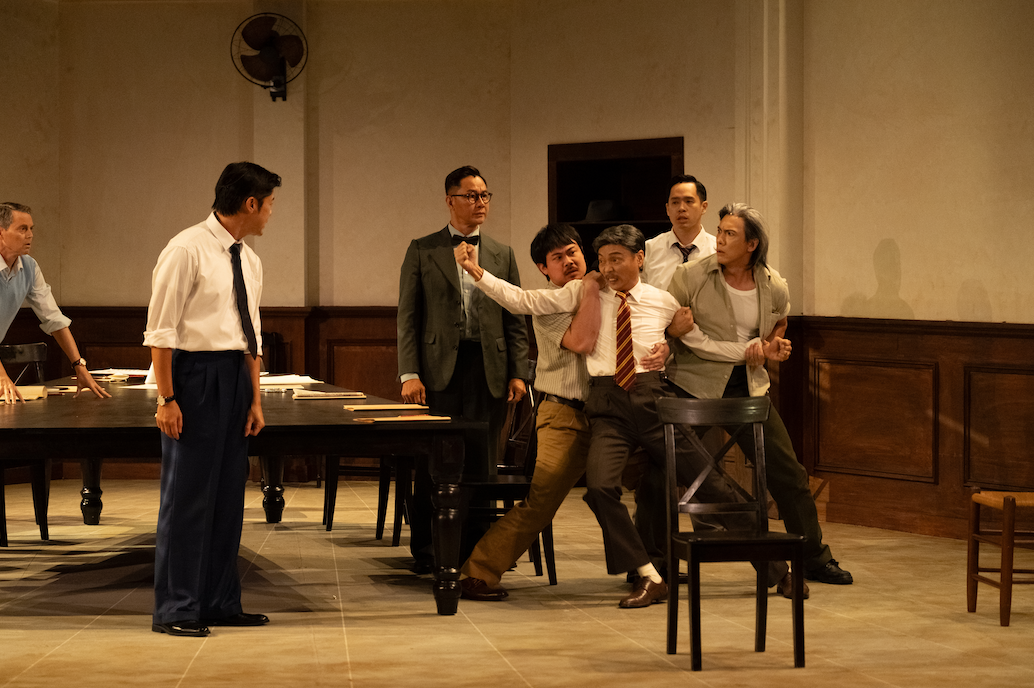
The knife returns, and now, an object of fury. Tay Kong Hui’s Juror 3 demands a demonstration of how the murder happened, and Danny Yeo steps forward once more, blade in hand. He lunges, not to wound, but to prove, as the theatre lets out a collective groan of shock, as though the very idea of harm were far too close. It is a moment of unbearable tension, and belief pitted against belief, each man forced to confront the weight of his own certainty. When the fan fails to start, then sputters to life, it feels like the room itself is exhaling. And when the rain comes, Genevieve Peck’s lighting dims to bruised gold as real water runs down the windowpanes, the storm outside mirroring the chaos within, and for a moment, everyone onstage and off seems to hold their breath. It is in moments like these that theatre feels utterly alive, where one can almost imagine this is exactly the level of immersion most productions can only dream of, where you hold yourself back at every step from speaking, interjecting, and leaping on stage to join these men at the table.
As the vote ratio changes rapidly, from a clear majority to a deadlock, the intensity and frustration escalates. The arguments are no longer about evidence alone but instead about lived experience: the fragility of respect, the ache of fatherhood, the bitterness of being dismissed. When Tay Kong Hui finally erupts into confession, his voice cracking as he speaks of his estranged son, the theatre seems to contract around him. It is a performance of extraordinary honesty, met by Danny Yeo’s wordless stillness.
By the end, the rain has softened, and the jurors, once adversaries, are drained. Some believe deeply in the verdict they’ve reached; others yield simply to end the ordeal. A unanimous vote is finally reached, but whether or not they have complete conviction in their vote varies. Life isn’t that simple, and the truth will always be a little grey. Either way, the jurors rise, put on their coats, and leave one by one, individuals again, yet forever changed by what they’ve shared.
Only two remain. Tay Kong Hui sits slumped, hollow. Danny Yeo quietly offers his coat. It is a gesture so small and humane it nearly breaks the heart: an unspoken apology, a reconciliation between strangers, perhaps even between father and son. Tay passes him the knife, before Yeo sheathes the blade and slips it into his pocket. No words are needed. As the lights fade, Yeo looks out at us, both contemplative and questioning. The audience, too, is left examining its own judgments.
Every detail in Nine Years Theatre’s Twelve Angry Men, from Wong Chee Wai’s immersive 1957 set and Jing Ng’s meticulous sound design to Mia Chee’s precise coaching, converges under Nelson Chia’s assured direction to create a piece of theatre that is both intellectually taut and emotionally saturated. The pacing, the rhythm, the very air itself are calibrated to draw us in until we, too, are part of the deliberation. Twelve years on, this revival transcends its courtroom setting to become a living debate on the fragility of justice, and it is clear why this work stands among the finest in Nine Years Theatre’s oeuvre.
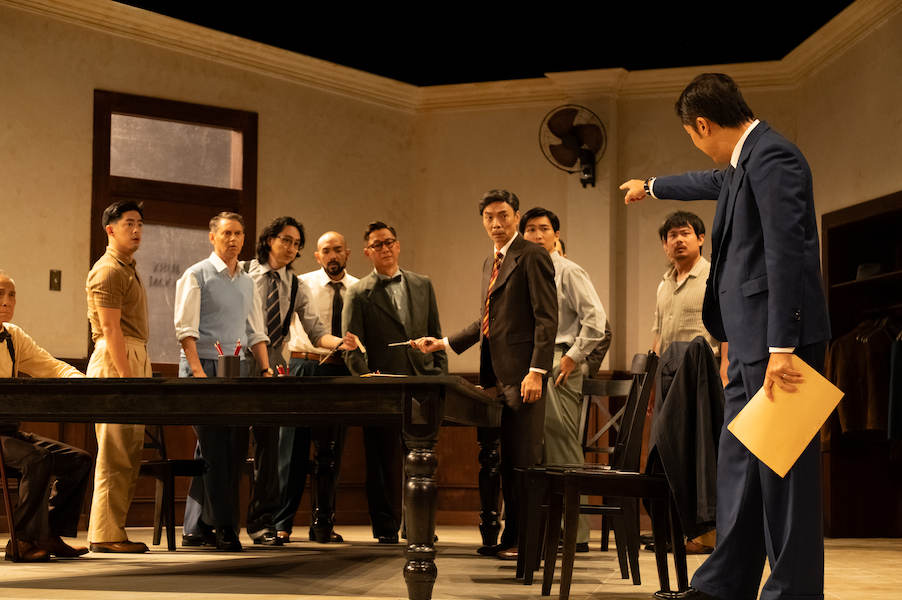
It is rare to feel such human viscosity onstage: that dense, palpable tension when belief meets belief and refuses to yield. This production makes us feel it in our lungs. Twelve Angry Men reminds us that truth is rarely unanimous, and compassion, rarer still. Rigorous, heartfelt, and quietly devastating, it is a masterclass in ensemble craft and directorial control, a production that renews our faith in the power of collective storytelling. A triumph for Nine Years Theatre, and unquestionably, one of the year’s most profoundly realised works.
Photo Credit: Tan Ngiap Heng, courtesy of Nine Years Theatre
Twelve Angry Men played from 7th to 9th November 2025 at the Singtel Waterfront Theatre. More information available from the Esplanade
Production Credits
| Playwright Reginald Rose Director/Translator Nelson Chia Producer/Speech Coach Mia Chee Cast Danny Yeo, Tay Kong Hui, Wu Weiqiang, Oliver Pang, Dwayne Lau, Tang Shaowei, Timothy Wan, Tan Guo Lian Sutton, Ryan Ang, Clement Yeo, Pauli Haakenson, Vester Ng Set Designer Wong Chee Wai Lighting Designer Genevieve Peck Sound Designer Jing Ng Costume Designer Anthony Tan Makeup The Make-Up Room Production Hair Leong Lim Production Manager Karisa Poedjirahardjo (The Backstage Affair) Technical Manager Ian Tan Stage Manager Tennie Su Assistant Stage Managers Cristabel Ng, Lee Boon Gee Brenda Crew Lilith Tan (The Backstage Affair) Props Coordinator Teo Li Lin Lighting Programmer Yi Kai Sound Associate / Operator Jean Yap RF Operator Tan Suet Peng Wardrobe Mistress Theresa Chan Dresser Kng Man Xuan Surtitle Operator Teo Pei Si Judge Voiceover Johnny Ng |
 Bakchormeeboy
2 thoughts on “★★★★★ Theatre Review: Twelve Angry Men《十二怒汉》by Nine Years Theatre”