
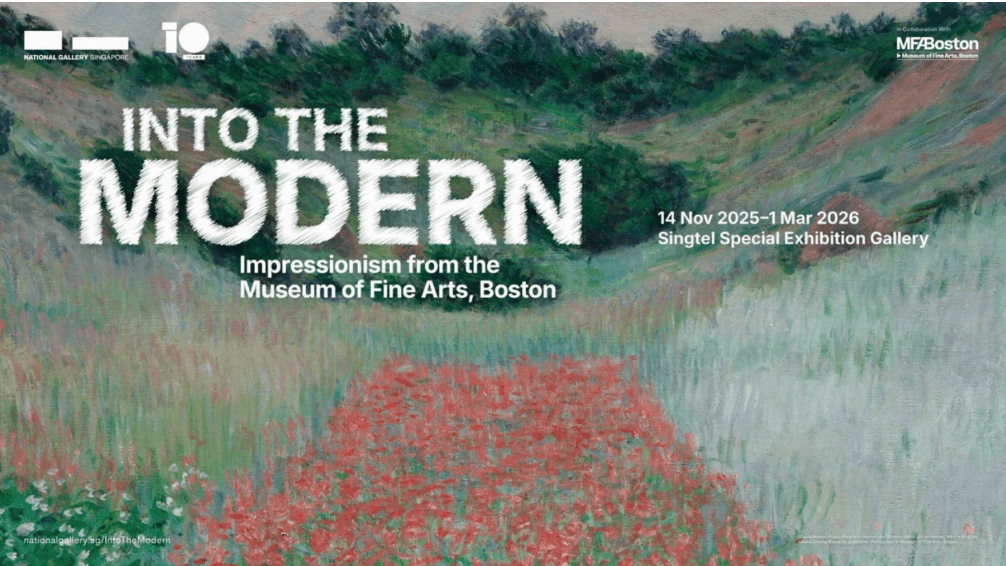

This November, Singapore becomes the unlikely capital of Impressionism in Asia. In an unprecedented partnership with the Museum of Fine Arts, Boston (MFA Boston), National Gallery Singapore presents Into the Modern: Impressionism from the Museum of Fine Arts, Boston, Southeast Asia’s largest-ever presentation of French Impressionism, making it one of the most significant art events the region has ever seen.
Opening 14th November 2025, the blockbuster exhibition brings more than 100 artworks by 25 foundational artists of the movement, including 17 Monets, alongside rare works by Renoir, Manet, Cézanne, Morisot, and Degas, and even a recently rediscovered self-portrait by Victorine Meurent, the artist and muse long overshadowed by her association with Manet. For many, this will be a once-in-a-lifetime encounter with icons typically accessible only in Paris, New York, or Boston.
Going beyond just bringing in the artworks themselves, Into The Modern also provides a complete re-framing of Impressionism for a contemporary Asian audience: a story of modernity, global exchange, and how light, life, and labour continue to shape the world we inhabit today.

Says Dr Eugene Tan, CEO and Director of National Gallery Singapore: “The exhibition marks a significant collaboration between the Museum of Fine Arts, Boston and the National Gallery, Singapore, bringing together an extraordinary collection of masterpieces, and providing a rare opportunity to encounter these fine works of modern art.”
“These works have been thoughtfully curated to resonate with Singapore’s own narratives of modernity, examining the social and political context in which these artists lived and worked, and revealing how these artists responded to the profound social and technological changes of the time,” he adds. “The exhibition reflects how the Impressionists sought to translate the fleeting, transient quality of modern life, a theme that perhaps resonates in Singapore, a nation that has itself been shaped by rapid progress and constant renewal.”

Says Ms Angie Morrow, Senior Director of Exhibitions at the Museum of Fine Arts, Boston: “The partnership between MFA Boston and National Gallery Singapore “is a testament to the potency of that vision and its enduring impact, championing the power of art to connect people across time, cultures and place.”
“Into the Modern brings together over 100 carefully selected works, and uncovers the stories behind the transformative changes that reshaped modern life in the late 19th century. The exhibition highlights how the Impressionists responded to the dramatic shifts across society, technology and the physical landscape in their art, and how we can find resonance in these experiences in our own lives today. It is the result of years of remarkable collaboration, of notable vision, creativity, patience and teamwork. On behalf of MFA Boston, I extend our gratitude to the exceptional team at the National Gallery and to the extraordinary sponsors and partners who brought this exhibition to life.”

Housed across three expansive galleries, Into the Modern unfolds in seven thematic chapters, from early plein-air experiments in the forests of Fontainebleau to Monet’s late meditations on time and memory. The contemporary, cool-toned exhibition design instantly resets expectations. These masterpieces are not relics of an untouchable past, but fiercely present, where archival photographs blown up to architectural scale, graphic posters, and immersive scenography place visitors inside the rapidly shifting world the Impressionists themselves knew, one of new railways, rising cities, and expanding coastlines. It is a clever reminder that Impressionism, though idyllic on the surface, was born from upheaval.

The exhibition begins with Seeking the Open Air, tracing how mid-19th-century painters turned to the French countryside as both subject and sanctuary. Upon entering the first gallery, visitors will find themselves facing an immersive design element of archival panels and projections of trees which place visitors within the forested landscapes that inspired mid-19th-century artists.
Against this immersive backdrop, paintings by Théodore Rousseau and Claude Monet appear like windows into actual forest clearings. Rousseau’s Edge of the Woods (Plain of Barbizon near Fontainebleau) anchors the room. Approaching the canvas, visitors notice how the colossal trees dominate the scene, their trunks a mixture of warm browns and silvery greys, painted with a reverence that borders on spiritual. Only after a moment do the small figures of wood gatherers become visible, almost hidden, as if swallowed by the forest. This spatial relationship underscores Rousseau’s belief in the intrinsic grandeur of nature and his concern over its rapid destruction.

Walking a few steps further, visitors encounter Monet’s Woodgatherers at the Edge of the Forest, significantly smaller but glimmering with early signs of his later style. The palette brightens; shadows are rendered in lavender and rose. The brushwork loosens. Seen in dialogue with Rousseau, the painting feels like a breath of cool air—evidence of a young Monet absorbing Barbizon’s lessons but beginning to push them toward something new.
Before leaving this first gallery, visitors turn back toward the forest projections, now noticing how they echo the themes in the paintings: nature as both refuge and contested landscape; observation as a form of preservation; the beginning of a movement rooted in direct experience.

Moving into the next gallery, the atmosphere brightens dramatically with Plein Air Impressionism. Walls lighten to soft creams and pale blues; overhead, the lighting mimics natural daylight. Visitors feel as though clouds have parted. Two seemingly contrasting scenes introduce the diverse approaches within early Impressionism.
Renoir’s Woman with a Parasol and Small Child on a Sunlit Hillside pulls viewers into its warmth. Standing before it, one can almost feel the midday heat radiating from Camille Monet’s dress. The hillside grass glimmers with short, powdery strokes, capturing the sensation of movement, perhaps a soft breeze brushing past. The child in the distance appears only momentarily still, ready to run out of the frame at any second. Visitors often lean in closer here, noticing the delicate flickers of pink, blue, and yellow Renoir uses to make white fabric shimmer.

A few steps away, Degas’s At the Races in the Countryside offers a counterpoint. Instead of sunbaked stillness, this canvas hums with contained energy. Visitors may find themselves drawn first to the baby in the centre, surprising in a racing scene. Then their eyes drift to the cropped horses and riders in the background, glimpsed “mid-stride,” as if caught in a peripheral glance. The unusual framing mimics a moment observed but not staged, reinforcing Degas’s fascination with modern, fleeting vision.
Together, these works show Impressionists as collectors of moments: some quiet and sunlit, others fractured and lively, but all rooted in the immediacy of life as it unfolds.

The next gallery, Labour and Leisure on the Water, sees the colour palette shifts to cool blues and riverbank greens. The walls are punctuated by views of rivers, ports, and beaches.
Sisley’s The Loing at Saint-Mammès becomes the focal point. Standing before it, visitors sense the quiet rhythm of a working riverbank. Short brushstrokes flicker across the water’s surface, giving the river a gentle tremor. Fishing boats rest in the foreground; barges drift in the distance; and beyond them, the faint silhouette of the railroad viaduct hints at industrial modernity encroaching on rural tranquillity. Visitors can almost imagine the muffled roar of steam engines somewhere behind the trees.

Turning toward Boudin’s Fashionable Figures on the Beach, the scene shifts from labour to leisure. Elegant silhouettes, parasols, hats, long skirts, are arranged like notes in a musical composition. Visitors often linger here, observing how Boudin captures subtle social choreography: how people stand apart, gather in pairs, or turn toward the shimmering water. The horizon glows, painted with luminous restraint, as if the sea breeze could be felt right in the gallery.
Moving through this section, visitors sense the duality of 19th-century waterways: as arteries of commerce and as playgrounds for emerging forms of tourism.

In Shared Ambitions, the gallery becomes even more intimate, as it draws attention to detailed surfaces, and explores the networks, experiments and ideals of the era. Common goals united the Impressionists: to depict modern life as they experienced it and to exhibit their work publicly. Camille Pissarro was a central and constant presence within the group, participating in all eight Impressionist exhibitions between 1874 and 1886. His connections to different members of the circle are evident in this section, reflecting both mentorship and collaboration. He worked alongside contemporaries such as Paul Cézanne and Paul Gauguin and also remained open to new approaches and willing to learn from younger artists, exemplifying the spirit of experimentation that characterised Impressionism.
Visitors approach Two Peasant Women in a Meadow (Le Pré) and immediately see how Pissarro’s careful, almost rhythmic brushwork gives the meadow a soft vibration. Standing in front of the canvas, the women appear mid-conversation, their gestures relaxed, their presence unidealised. The small dabs of colour that form the grass and sky encourage viewers to step closer, the way one might examine the weave of a fabric.

Beyond technical experimentation, Pissarro’s works reflect his social and political ideals, which resonate with his broader engagement with contemporary society and everyday life. Unique to the Gallery’s presentation, visitors will encounter Pissarro’s experimental print series Woman Emptying a Wheelbarrow (1880). Three prints from the series which share this motif will be displayed. He devoted careful attention to an ordinary subject, emphasising the labour of the working class. Each version of the print was created by augmenting the initial base plate and varying the inking for each impression, introducing different visual and textural effects. The layering of etching, drypoint, and aquatint allowed forms to evolve across states, blending precision with the painterly expressiveness of Impressionism.
This progression allows visitors to witness Pissarro thinking, adjusting, refining, layering: a rare chance to see an Impressionist artist’s process revealed incrementally. The room conveys a sense of community, mentorship, and shared pursuit. Even without the other artists present, Pissarro’s presence feels connective, demonstrating why he was both mentor and experimental peer.

In Modern Encounters, the next section expands spatially, evoking the broad new boulevards of Haussmann’s Paris. Paris underwent a significant transformation in the mid-19th century, as urban revitalisation projects reshaped the city’s layout and appearance. Poorer neighbourhoods were demolished to make way for vast boulevards and grand apartment buildings, while suburban areas became popular retreats for city dwellers. New entertainment venues, including cafés, theatres, parks, and racetracks, encouraged social interaction in new ways. In this context, Paris became more open and connected between different parts of the city.
Dominating the entry to this gallery is Renoir’s Dance at Bougival. Nearly life-sized, the couple pulls viewers immediately into the swirl of movement. Visitors often remark on the man’s firm yet gentle hold, or on the woman’s swirling dress whose brushstrokes blur to suggest rotation. The ground, littered with cigarette butts and petals, feels faintly gritty, an unvarnished detail that grounds the romanticism. By placing this painting at the gallery’s threshold, visitors are invited into the social vibrancy of 19th-century leisure culture.

Around the corner, the atmosphere grows quieter and more introspective. Manet’s Street Singer confronts visitors with a single figure stepping forward, cloak gathered in one hand, guitar in the other. Manet captures a figure familiar from the new, urban public spaces of Paris: a female street musician. Manet used his favourite model, Victorine Meurent, to stage the scene. The large-scale painting elevates her presence, with a direct gaze that challenges the viewer and conveys dignity to this generally marginalised figure. Her direct gaze halts many visitors mid-step. Her presence—confident, full-scale, dignified—feels almost confrontational, challenging assumptions about class and propriety in modern Paris.

Meurent was not only an artist’s model, but also a dancer and a painter. Shown alongside three images of Meurent produced by Manet, her Self-Portrait (c. 1876), presents a mature, confident woman, rendered with refined attention to the textures of hair, skin, and fabric. This painting was likely the one she had accepted into the 1876 Paris Salon, the annual exhibition of the Académie des Beaux-Arts, the same year that Manet’s own submissions were rejected.

Displayed alongside is Manet’s Olympia (Large Plate) (1867), a work for which Meurent also modelled and for which the painted version caused a sensation at the 1865 Salon as a scandalous depiction of a nude prostitute, this pairing underscores Meurent’s dual identity as both model and accomplished artist. It also highlights the evolving roles of women in society and the arts, reflecting their increased agency and visibility. Through these works, visitors are invited to consider not only the individual subjects but also the broader social and cultural transformations that shaped these encounters. This gallery encourages reflection on the shifting identities and encounters that shaped Parisian modernity, not just in the streets, but in the art world itself.

In Reimagining the Commonplace, we enter a smaller, quieter gallery, offering a moment of contemplation. This space highlights how Impressionists elevated still life from an academic exercise to a site of innovation. The room feels like a studio: quiet, reflective, open to experimentation. Here, familiar objects take on unexpected prominence in still lifes. Morisot’s White Flowers in a Bowl greets visitors with a luminous delicacy. Up close, the blossoms dissolve into confident, fluttering strokes, their edges deliberately soft, as if in motion. The bowl rests gently on an undefined surface, the background left airy and open so that the flowers seem to float. Visitors often notice how Morisot balances restraint with spontaneity—how the composition appears effortless while being meticulously considered.
Morisot’s work illustrates how Impressionists used familiar genres to push boundaries. Critics of the time, however, sometimes misinterpreted her avant-garde brushwork as evidence of incompleteness, unfairly attributing it to her gender rather than recognising it as a deliberate technique. Yet Morisot’s achievements speak to her artistic authority: she was a prominent member of the male-dominated Impressionist circle, participating in all but one of the eight Impressionist exhibitions and had also previously achieved mainstream success at the Paris Salon.

And yet, the final gallery manages to remain a cut above the rest, with Monet – Moment and Memory, opening into a bright, serene space with softly diffused lighting, evoking the enveloping glow of Monet’s outdoor world. Visitors are met with an impressive array of nine canvases—a nearly panoramic exploration of Monet’s evolving vision.
At the entrance, Poppy Field in a Hollow near Giverny sets the tone. Visitors often pause here, taking in the swaying red blossoms and the sense of depth that pulls the eye into the hollow. The work feels both expansive and intimate, a portrait of a place deeply known, a depiction of the lush countryside around his home, demonstrates his sensitivity to both the grandeur and intimacy of the rural landscape.

Moving deeper into the gallery, Grainstack (Snow Effect) appears like a quiet exhale. Standing before it, visitors sense stillness—the muffled quiet of snow. The grainstack glows faintly, touched by winter sunlight, showing how Monet could transform a simple rural form into a meditation on time, exemplifying Monet’s study of shifting light and seasonal change. He painted at least twenty-five canvases of grainstacks in Giverny, transforming a familiar subject through time and weather. Here, sunlight glances across a dusting of snow, brightening an otherwise chilly, wintry day.

Finally, at the far end of the gallery, visitors encounter the crescendo: The Water Lily Pond. Beneath the arching Japanese-style footbridge, the lily-strewn pond mirrors the surrounding willows, showcasing both the reflective quality of water and the subtle effects of shifting light. The pond became a vast laboratory for Monet’s exploration of the ephemeral qualities of nature over the following decades. The canvas shimmers with layered reflections; greens and blues ripple across the surface; the footbridge arches gently overhead. Visitors often fall silent here, absorbing the painting’s contemplative energy. The work seems to move even as it stands still.
Together, these works illuminate Monet’s central idea: preserving the sensation of an instant. His canvases transform fleeting impressions into enduring images, offering viewers not only the memory of a place but the experience of time itself, an approach that was radical in his day and remains profoundly resonant today. This final space offers an emotional experience: a lesson in seeing slowly. Visitors leave with a sense of having accompanied Monet, from the fields of Giverny to the shifting light on wate, —in his lifelong quest to capture the ephemeral.

One of the exhibition’s most distinctive contributions is how it expands Impressionism beyond France. Through three reflection zones and interactive ARTelier stations, visitors discover the movement’s unexpected resonances in Southeast Asia.
A newly commissioned animated film traces the rise of plein-air painting in Vietnam.
Another explores Singapore artist Georgette Chen, whose treatment of light and reflection, seen in Singapore Waterfront (1963), reveals an artistic kinship with the Impressionists. Visitors can even try brushstrokes inspired by her style.
A third ARTelier highlights Lim Yew Kuan, whose iterative printmaking echoes Pissarro’s use of seriality.
This is where the exhibition transcends nostalgia. It reveals Impressionism not as a European chapter to be admired from afar, but as part of a global story, one that Southeast Asian artists absorbed, reinterpreted, and reshaped. As Dr Eugene Tan, notes, the exhibition connects “conversations about society, the environment, and urban life” from the 19th century to the present, while situating Singapore as a crossroads where regional and global art histories meet.

Because no major cultural event in Singapore would be complete without culinary and curated retail moments, Into the Modern extends well beyond its galleries. From 14 November to 31 December 2025, the legendary French pâtissier Pierre Hermé Paris presents an exclusive pop-up at National Gallery Singapore. Expect coveted macaron box sets adorned with iconic Impressionist artworks from the exhibition: the ultimate edible souvenir.

From 6 November 2025 to 31 January 2026, award-winning bar and tea lounge ANTI:DOTE at Fairmont Singapore offers up An Impressionist-Inspired Afternoon Tea, featuring a menu of sweet and savoury delicacies inspired by the colours, textures, and moods of Impressionism. Think brushstroke-esque pastries, edible palettes, and jewel-toned confections, an immersive sensory extension of the exhibition.

From umbrellas to totes, coasters to catalogues, the Museum Store’s special-edition collection ensures visitors can also bring a piece of Impressionism home.
Said Mr David Neo, Acting Minister of State for Culture, Community and Youth and Senior Minister of State for Education: “This is the largest exhibition of French Impressionism ever shown in Southeast Asia, and we are proud that it is taking place right here at the National Gallery Singapore. Singapore is and must continue to be a bridge between different cultures and parts of the world. Through the arts, we bring people together, foster deeper cross-cultural relationships and understanding, and exhibitions like this allow visitors to experience and appreciate the masterpieces that have shaped modern art, reflecting the vision of Our Arts Plan 2.0 to build Singapore as a vibrant, connected and global city of the arts.”

For all the romance associated with Impressionism, the works in Into the Modern are deeply relevant to current concerns. They grapple with climate and environmental loss, urban transformation, the dignity of labour, the emergence of global tourism, shifting gender roles, and the tension between tradition and modernity. As Pierre Terjanian, Director of MFA Boston, puts it, these paintings “underscore issues that still impact all of us today, more than a century after these works were made.” By placing these masterpieces in dialogue with Southeast Asia and the contemporary moment, the exhibition becomes more than an artistic milestone: it becomes a cultural mirror.
If 19th-century Paris had the Salon, grand, ambitious, awe-inspiring, then 21st-century Singapore has Into the Modern. It is not simply a display of masterpieces; it is a vivid meditation on what it means to see, to move, to change, and to belong to a world in constant motion. And like the flicker of light the Impressionists chased across water, city, and sky, this exhibition, too, is ephemeral, so see it while you can.
Installation Photos courtesy of National Gallery Singapore
Into the Modern – Impressionism from MFA, Boston runs from 14th November 2025 to 1st March 2026 at National Gallery Singapore. Tickets and more information available here
Gallery’s 10th Birthday Bash takes place from 15th to 16th November 2025 at National Gallery Singapore. Full line-up and registration at www.galleryturns10.sg
Free admission for most programmes; registration required for selected sessions.
 Bakchormeeboy