
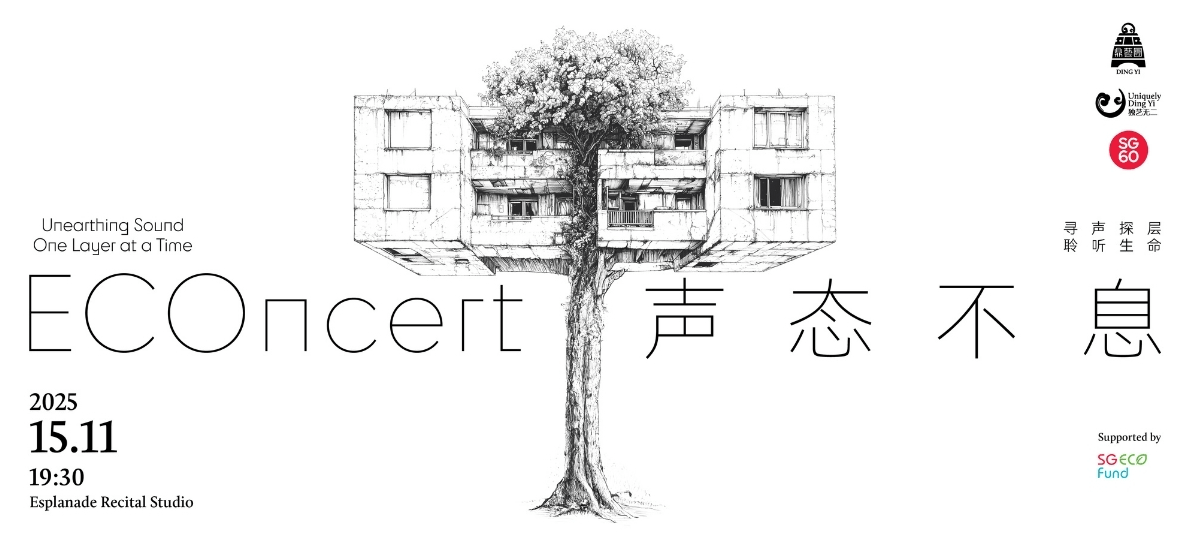

A collaborative, multi-genre invitation to forest bathe in the Esplanade Recital Studio, and co-exist with nature all around us.
Now in its third edition, Ding Yi Music Company’s ECOncert has come to embrace an identity unmistakably its own, one rooted in environmental consciousness, an attentiveness to the natural textures of sound, and a desire to re-enchant the everyday landscapes around us. This year, the team turns its gaze towards a subject hiding in plain sight: Singapore’s secondary forests.
Often dismissed as scrubland or “undeveloped” terrain, these forests are, in truth, teeming ecosystems—messy, resilient, and ecologically indispensable. ECOncert 2025 makes it its mission to lead audiences into these overlooked spaces, and, more importantly, to let the forests speak.

The transformation of the Esplanade Recital Studio is the concert’s first triumph. Under Faith Liu Yong Huay’s atmospheric lighting design, the space dissolves into a deep twilight: shafts of light fall like hesitant sunbeams through foliage, while shadowy pockets mimic the forest understorey. The production’s collaboration with visual artist Robert Zhao Renhui—fresh from representing Singapore at the Venice Biennale—further grounds the experience. Structures resembling tangled masses of branches flank the stage; live-feed videos show creatures navigating these sculptural “habitats,” echoing Zhao’s long-standing meditation on the gaze between humans and nature. Together, they create the uncanny sense of entering a habitat rather than a concert venue within a building.
Directed and dramaturged by Ang Xiao Ting, and conducted by Wong De Li, Dedric, the concert unfolds as a journey through seven layers of the secondary forest, moving from surface debris and forgotten urban remnants to the hidden networks of roots, fungi, and soil beneath. It is a simple framework, but an elegant one, allowing the evening’s music to travel downward in both physical and emotional depth.

The concert opens with Yih Kah Hoe’s Urban Residue, a restless evocation of city life built from field recordings of traffic, voices, construction dust and machinery. Ding Yi’s blend of traditional Chinese instruments and recycled or found instruments, rattling, clinking, and humming, translates the city’s mechanical rhythms into something strangely alive. The recurring motif drawn from Di Tanjong Katong threads a cultural memory of old Singapore through the contemporary soundscape, a reminder that history persists even in the city’s most fragmented edges.
Abandoned Lines continues this excavation, shifting focus from bustle to buried infrastructure: pipes, cables, concrete remnants—the detritus of progress. Metallic scrapes and hollow percussive echoes evoke the invisible systems beneath our feet. Here, Kah Hoe draws out the fragility of the artificial, alluding to the fact that even our most “permanent” structures erode, crack, and return to the earth. It is a quietly powerful movement, emphasising not loss but the strange poetry of what the city leaves behind.

Korean composer Kim Bumki charts a parallel emotional descent. In Echoes from Secondary Forest, echoes of Di Tanjong Katong drift in like half-remembered refrains. This layer of the concert feels like a reconciliation: instruments breathe independently at first, then slowly braid into a single ecological pulse, suggesting nature’s capacity for renewal. The sudden cessation of the melody at the end is a jolt, a reminder of the abruptness with which environments can be erased.
Silent Resonance: Bulbul’s Heart Has Grown Cold and Beneath the Cicada’s Lament turn their attention to the creatures that inhabit these fragile spaces. Drawing inspiration from the bulbul, a bird ubiquitous in Singapore, Bumki captures both the warmth of natural song and the cold harmonies of encroaching urbanity. In these works, the pain of environmental disruption feels personal; the tension between human emotion and natural sound blurs until they become indistinguishable.

Yet it is his composition Black Plastic Snow Falls Among Trees that lingers most hauntingly. Imagining a Singapore where snow falls upwards, and where that “snow” is made of black plastic, the piece is a stark allegory of pollution: beauty inverted, the natural cycle corrupted. The ascent of the music, rather than descent, creates a strange grief, as though the forest itself is exhaling its sorrow toward the sky.
Throughout the concert, Joanna Dong appears as a kind of forest narrator, sing-speaking poems by Cheyenne Alexandra Phillips. Her voice threads prayer, lament, and longing through the performance, underscored by video montages noting the clearing of various secondary forests for redevelopment. These textual moments tether the audience to the present day: behind every clearing is policy, bureaucracy, and human desire. Behind every patch of green is something alive, waiting to be heard.

Across the evening, the motif of Di Tanjong Katong surfaces repeatedly, sometimes tenderly, sometimes distorted, sometimes disappearing mid-phrase. The familiarity of the melody evokes an older Singapore, an island fringed by water and kampungs. But ECOncert refuses to romanticise the past; instead, it uses the motif to ask a harder question: In a hyper-urban city, what is our relationship to land now? Each deeper “layer” of the concert suggests that the forest’s richness exists regardless of whether we see it. It is the act of attention that must change.
The final piece, Tanjong Katong: Where the Land Reborn, co-composed by Kah Hoe and Bumki, offers a gentle reversal: hope rising rather than sinking. Here the orchestra leans into warmth, and the earlier motifs bloom anew. It is a fitting gesture during the 50th anniversary of diplomatic ties between Korea and Singapore, a shared wish for peace, renewal, and coexistence.

In a whimsical but meaningful touch, audiences leave the venue and are handed kangkong seeds, supported by Ground-Up Initiative, with instructions on how to plant them. The symbolism is obvious but heartfelt: conservation begins with small acts, and planting is an act of belief.
Ding Yi’s ambitious layering of sound, text, video, and installation occasionally results in a slightly cluttered stage and elements all around. But the sincerity of the project, with its careful dramaturgy, its evocative music, its commitment to ecological storytelling, ultimately holds the experience together.

By the time we “ascend” back to the entrance of the Esplanade Recital Studio, we feel as though we have completed a forest bath: hearing the rumble of storms, the stirrings at dusk, the hush of hidden life. ECOncert 2025 succeeds not only in presenting a concert but in offering a quiet provocation: that beneath the concrete and headlines, there is a living world still humming, waiting for us to look deeper, and listen.
ECOncert played on 15th November 2025 at the Esplanade Recital Studio. More information available here
 Bakchormeeboy