
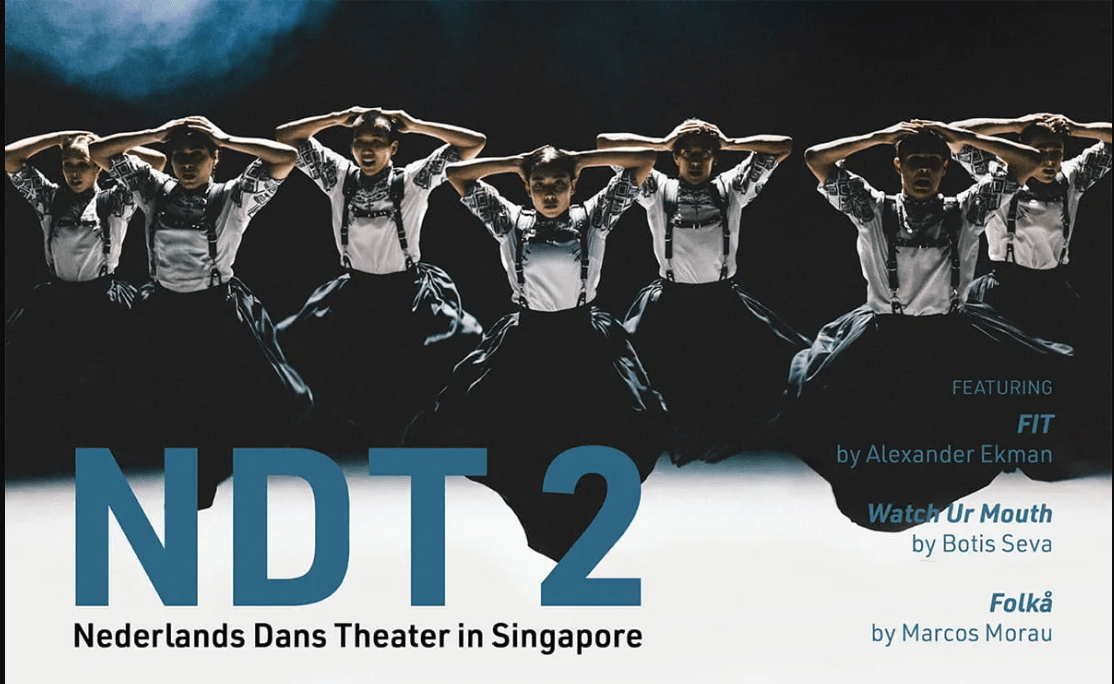

Ten years on from their last tour here, Nederlands Dans Theater 2 (NDT 2) returns to the Esplanade this season with a trio of works that Artistic Director Emily Molnar describes as “a programme that truly shows where we’re at.” For Molnar, bringing NDT 2 back to Singapore is “an absolute pleasure,” and the triple bill, featuring works by Alexander Ekman, Botis Seva, and Marcos Morau, has been carefully chosen for its range, vitality, and emotional breadth.
“All three choreographers were given carte blanche to develop their work,” Molnar says. “That was important. We wanted them to go wherever they wanted to go, and as a result you see this range of artists, dancers, emotions, ideas, theatrical styles and designs, all very different approaches to contemporary dance in one evening.”

She believes the line-up of work, which have all previously been performed as part of other programmes and showcases, speaks equally to audiences who know NDT’s legacy and to those discovering the company for the first time. “You’ll see something meaningful even if you’ve never seen us before,” she says. “But if you have followed NDT, you’ll also recognise the depth and curiosity we are constantly cultivating.”
Anchoring the programme are three choreographic voices Molnar calls “extremely important voices right now in contemporary dance,” each defined by a singular artistic language. For Marcos Morau, whose Folkå (2021) will be seen in Singapore for the first time, a pulsating visual and auditory landscape centred around ritual, where an evocative story is told about community and its customs and traditions.. Molnar describes the experience as “being taken into this extremely compelling world, as if you’re going back into a ritual or a primitive society. It celebrates humanity, music, dance, and the spirit of who we are as human beings.”
Botis Seva’s Watch Ur Mouth (2025) marks another first: it is his debut creation for a company outside his own collective, and forms an amalgamation of hip hop, physical theatre and contemporary dance. His experiments with form, structure and theatrics result in an intricate and emotional language of movement. . “Botis comes from urban dance, from his own world,” Molnar says. “He’s never had access to a guest group of dancers like ours. For me as Artistic Director, it’s exciting—finding voices who have never worked with a company like ours.”
The collaboration was transformative on both sides. “He has such a specific movement style. It challenged our dancers to grow with him, and at the same time he was building something from their unique skillsets. It was an incredible process of sharing different approaches to the body and finding new vocabulary—him in one way, and our dancers in another.”
But Watch Ur Mouth is deeply personal for Seva. “He’s ten years into his work, and he’s feeling what it means to launch into success and deal with criticism,” Molnar explains. “He took inspiration from a review of a recent work that wasn’t well received, and was figuring out what that meant for him. I’m so proud of how he dared to speak so openly about his life and incorporate such a vulnerable moment into his work, especially with a company he’d never worked with before.”

In contrast, Alexander Ekman’s FIT (2018) bursts with humour, theatricality, and musical precision. Set to The Dave Brubeck Quartet’s swinging Take Five, this full-company work bursts with energy, bold costumes, and Ekman’s signature humour, wit, and absurdity. “In all of his incredibleness, Alex is always clever, whimsical,” Molnar says. “He uses humour, design, text, musicality, all with such precision. And he’s asking: what does it mean to fit in, or not? Should we try to fit in?”
NDT, Molnar notes, is a space where rigour and experimentation coexist. “This is not a place for every dancer to thrive,” she says frankly. “You need a very specific skillset, ballet, contemporary, and 90% of the work we do is new. The dancers come because they’re challenged in so many directions and because they want to be co-creators. They are deeply committed to the expression of the body. We are a house for creation, and I hope that we continue to platform new voices just as we have for 60 years, and dare to do things they may not have tried before.”
Working at NDT also means embracing the ephemeral nature of dance. “The history of a work can only be carried by the people who were there in that empathic moment,” Molnar says. “It’s very rare, and it’s challenging. We work so many hours, and part of me sometimes gets jealous of musicians show up for a concert rehearsal and there’s a conductor to lead them. There’s a large part of our work where we conduct ourselves—and it’s frankly insane,” she adds. “But it also excites us, that we’re constantly in motion and changing and growing at any stage of the creation process.”
The lifespan of a dancer, too, is uniquely short. “At 35 or 40, with the kind of work we do, you’re transitioning away from performing, when most people are entering midlife in their careers,” she says. “That’s why I’m excited NDT 3, which focuses on performances from older dancers, is returning in 2028 in a project-based model—so we can meet dancers at every stage of their career.”
Molnar speaks about the company’s many cross-disciplinary creations, referencing NDT’s long-term collaborations with creators such as Simon McBurney, and Crystal Pite. “We’re always expanding the ways we make work,” she says. “It’s not always about something ‘brand new’, but about trying things that are new for us.”
McBurney, in particular, reshaped the company’s theatrical sensibilities. “It made us so aware of how even a simple gesture can say so much,” Molnar reflects. “We get excited about movement invention, and he reminded us of the simplicity of the body. These things are exciting.”
She is equally excited about how artists from photography, theatre, technology, and dance are influencing each other, and the power of cross-pollination. “The body can unlock something when working at such a high level; it touches on things you don’t even know are possible,” she says. “With all the technologies and research emerging, the live body is becoming more unique than ever. This is our moment in dance. It’s the perfection of the imperfect—that’s who we are as human beings.”
As NDT 2 returns to the Esplanade stage, Molnar is deeply curious about how Singapore will respond. Touring, she says, reveals surprising cultural nuances. “If a work is good, it will always resonate, but it’s always interesting to see which parts of a work resonate more with different audiences,” she notes. “When we took Folkå to Japan, it was their first time everyone in the theatre was seeing it, compared to the audience in the Netherlands. It becomes a completely new experience for us to witness.”
Ultimately, she hopes the works spark reflection rather than resolution. “The beauty of performing arts, and abstract forms like dance, is that they allow people to go into that grey area beyond liking or disliking,” she says. “It’s about evoking dialogues, what spoke to you, what didn’t, why? Maybe it gives you an opportunity to sit in ambiguity, even be comfortable in the discomfort of ambiguity.”
For Molnar, connecting with audiences is the core of NDT’s work. “It’s not just about selling a ticket,” she says. “It’s a person in a seat, and growing their appreciation and experience of arts and culture. What is their experience before they arrive, during, after they leave? If we’re not building long-term relationships, then why are we building the work?”
As NDT 2 prepares to step back onto the Singapore stage, Molnar returns to a simple hope: “I hope people are moved by the work—wherever it takes them. I hope they’re not afraid to go beyond simply liking or disliking a work, and allow themselves to enter this grey area that an abstract form like dance offers.
It’s really evoking dialogue, questioning what did or did not resonate, and perhaps, find comfort even in the discomfort of ambiguity. ”
Photo credit: Rahi Razvani
Nederlands Dans Theater (NDT 2) in Singapore plays from 29th to 30th November 2025 at the Esplanade Theatre. Tickets available here
 Bakchormeeboy