
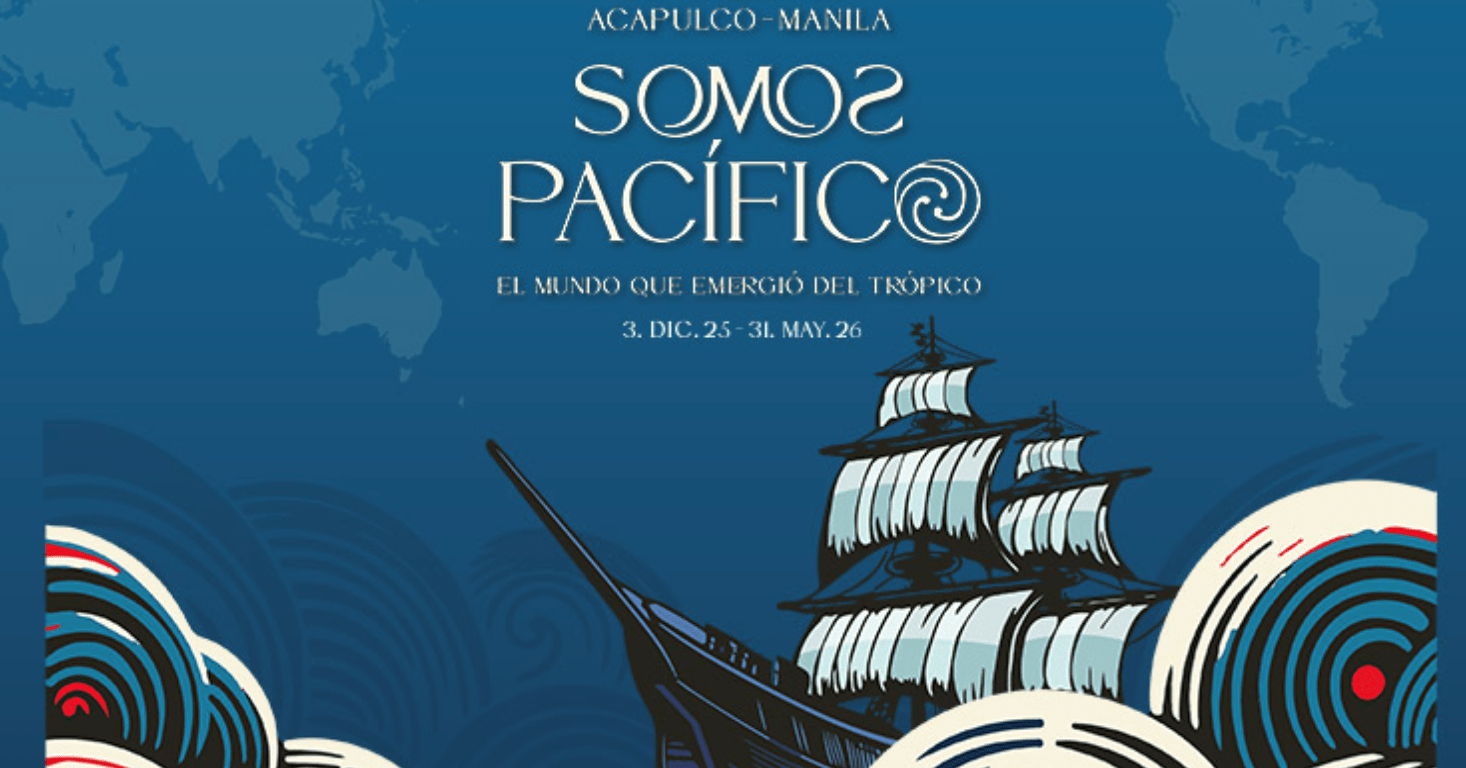
For 250 years, an unbroken line carved itself across the world’s largest ocean. It was not drawn on maps alone, but etched into languages, markets, kitchens, faiths, and imaginations from Mexico to the Philippines. Today, that story: vast, human, and still unfolding—anchors a major new exhibition at the Colegio de San Ildefonso: The Acapulco–Manila Galleon. We Are the Pacific. The World that Emerged from the Tropics.
Running from 3rd December 2025, to 31st May 2026, the exhibition reframes one of history’s most ambitious maritime routes as more than a commercial corridor. It presents the Acapulco–Manila Galleon as an early engine of globalisation—one built not just on silver and silk, but on encounters, negotiations, and cultural reinventions that reverberate to this day.

Between 1565 and 1815, the annual galleons connected Asia, the Americas, and Europe through a circulation of goods and people that transformed life on both sides of the Pacific. Mexico became the hinge of this global system, a crossroads where imperial ambitions collided with everyday improvisations. Markets shifted, new dishes emerged, hybrid artistic traditions flourished, and languages folded into one another.
San Ildefonso’s new exhibition captures this dynamic vision. Conceived originally by Clement Onn for Singapore’s Asian Civilisations Museum and expanded by an international curatorial team, the show positions Mexico as a true axis mundi—a place where worlds once met, and still meet.

More than 300 objects from museums and private collections trace this centuries-long exchange: Ming porcelain traded in Manila’s Parián market, Japanese lacquerware admired in New Spain, Talavera pottery influenced by Asian aesthetics, devotional ivories, textiles, maps, and even navigation instruments that once guided sailors across the daunting open Pacific.

Spread across 1,271 square meters, the exhibition unfolds chronologically through seven thematic chapters—each illuminating a different dimension of transpacific life. We Are the Pacific sets the stage by bringing forward the deep histories of the peoples who navigated and shaped the region long before the Spanish arrival. Archaeological pieces and early illustrations reconstruct these maritime cultures and their intimate relationships with land and water.
From there, The Construction of the Mexican Pacific explores how shipyards, ports, and diverse crews gave rise to a new, hybrid world. Identities blended. Landscapes changed. A shared cultural lexicon emerged between Mexico and the Philippines—one reflected in foodways, artistry, and daily rituals.

In The First Global Trade Route, visitors encounter the full scale of the galleon’s economic power. Mexican silver financed a transcontinental marketplace stretching from Acapulco to Manila to China, India, Japan, and Southeast Asia. Goods, ideas, and styles crossed oceans in both directions, turning the Pacific into a highway rather than a boundary.

One of the exhibition’s most evocative chapters, Mission Hasekura, recounts the extraordinary diplomatic voyage of the samurai Hasekura Tsunenaga, who traveled from Japan to Mexico, then onward to Europe between 1613 and 1620. Though his mission did not achieve its commercial goals, it endures as a symbol of early transpacific dialogue—and a reminder of how individuals can shift the tide of history.
The route’s eventual dissolution unfolds in The End of the Galleons, which charts the geopolitical and economic upheavals that culminated in the final galleon’s return to Manila in 1815. Independence movements fractured old connections; Asia drifted from Mexico’s maritime horizon until the late 19th century.

From there, the narrative leaps into the 20th century with Tropical, a striking exploration of how Latin American and Southeast Asian artists transformed colonial legacies into modern vocabularies. Diego Rivera, Miguel Covarrubias, Victorio Edades, S. Sudjojono, and others reveal the “tropical” not as a stereotype, but as a space of resistance and reinvention.
Finally, The Pacific Today brings the story into the present, showing how migration, art, and memory continue to bind Mexico and Asia. Contemporary works probe identity and diaspora, reminding visitors that the Pacific—once crossed by timber giants—is still crossed today by ideas and communities.

Fittingly for its subject, the exhibition itself is the product of wide-ranging cooperation. Institutions from Singapore, the Philippines, and Mexico—including the Asian Civilisations Museum, UNAM, INAH, National Gallery Singapore, Ayala Museum, and many others—have contributed expertise and collections. Objects from private lenders, many never before shown publicly, deepen the exhibition’s narrative.
The timing is significant. In addition to marking five centuries since the first transpacific voyage, the exhibition celebrates 50 years of diplomatic relations between Mexico and Singapore, underscoring the continued relevance of Pacific connections in shaping scholarship, culture, and policy.

What emerges from We Are the Pacific is not a nostalgic longing for a vanished world, but a recognition: that oceans unite as much as they separate, and that the histories they carry remain alive in food, art, ritual, and identity.
Each object, from a mother-of-pearl chest to a lacquerware tray to a centuries-old map, feels less like an artefact than a witness. Each bears the imprint of hands that crossed seas, dreamed of opportunity, endured danger, forged relationships, or simply lived in an increasingly connected world. In retracing these journeys, the exhibition asks visitors to consider their own place in the ongoing story of the Pacific: a world still shaped by encounters across water.
Photo Credits: Courtesy of El Colegio de San Ildefonso
The Acapulco–Manila Galleon: We Are the Pacific. A World Born of the Tropics runs from 4 December 2025 to 31 May 2026 at the Colegio de San Ildefonso, Mexico City. For more on the exhibition, visit the Colegio de San Ildefonso, the Asian Civilisations Museum, and the National Gallery Singapore.
 Bakchormeeboy