
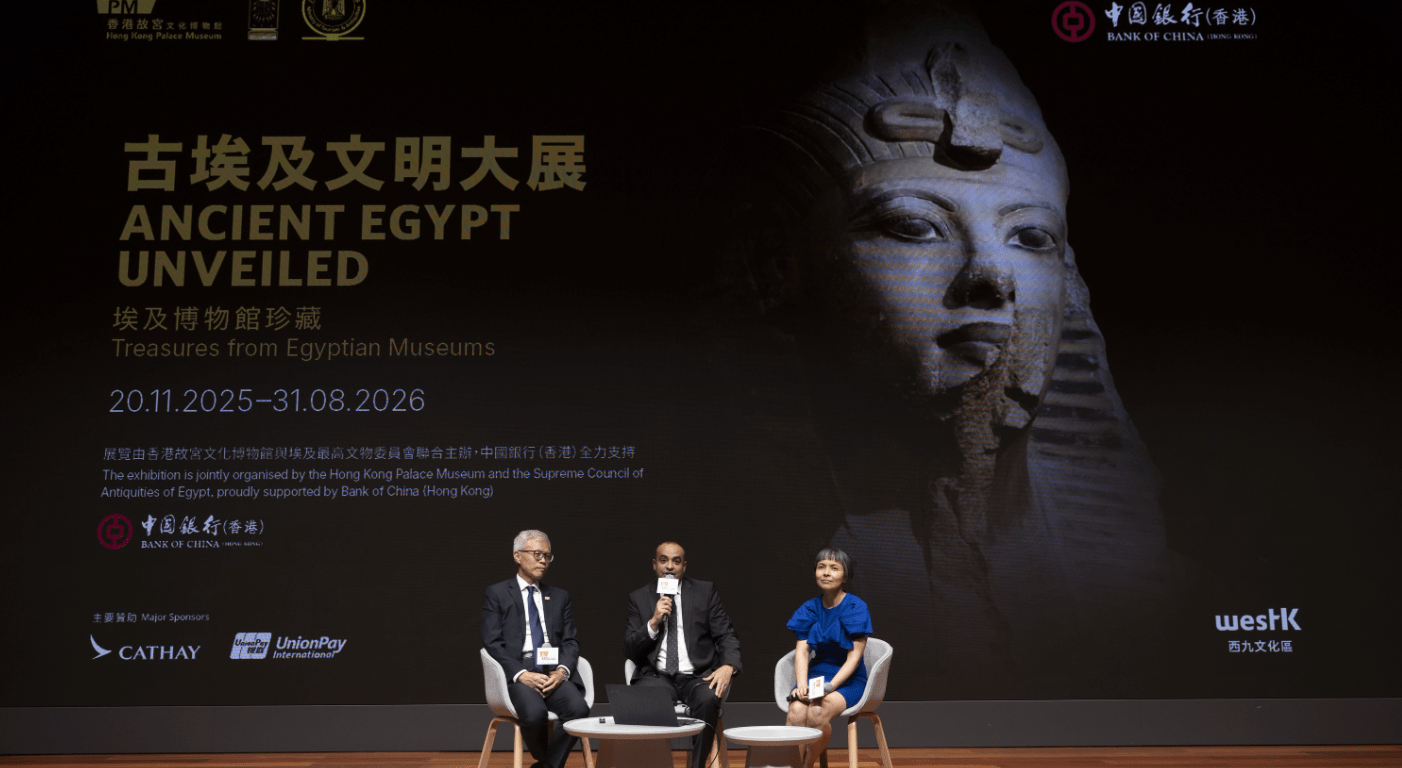

HONG KONG – Hong Kong’s cultural landscape has taken a giant step into the world of ancient civilisations with the grand opening of the Hong Kong Palace Museum’s (HKPM) latest special exhibition, “Ancient Egypt Unveiled: Treasures from Egyptian Museums”. Opening to the public on 20 November 2025 and running through 31 August 2026, the exhibition marks the first time a major collection of Egyptian artefacts has been displayed in Hong Kong, spanning nearly 5,000 years of history and featuring 250 masterpieces from seven of Egypt’s premier museums.
Jointly organised by the HKPM and the Supreme Council of Antiquities (SCA) of Egypt, the exhibition is the largest, most comprehensive, and longest-running display of ancient Egyptian treasures in the city. It includes monumental statues, painted stelae, gold and gemstone jewellery, mummy coffins, masks, and never-before-seen finds from Saqqara—Egypt’s oldest burial ground and one of the world’s most important archaeological sites.

“The first time to bring artefacts here to Hong Kong was inspired by our successful exhibition in Shanghai,” said Dr. Mohamed Ismail Khaled, Secretary-General of the SCA. “After the success there, the Hong Kong museum contacted us to take some of the artefacts that were displayed in Shanghai. We agreed, and that is why we have some of the collection here. It is important because the success in Shanghai attracted a lot of visitors, and we thought it would also attract many Hong Kong people to come and see the exhibition, and hopefully visit Egypt afterwards.”
The opening ceremony was attended by leading figures in Hong Kong and Egyptian cultural circles, including Rosanna Law, Secretary for Culture, Sports and Tourism of the HKSAR; H.E. Yomna El-Bahar, Deputy Minister of Tourism and Antiquities of Egypt; Bernard Charnwut Chan, Chairman of the West Kowloon Cultural District Authority; and Dr. Louis Ng, Museum Director of the HKPM.

“This collaboration with Egypt is really driven by people,” Dr. Ng explained. “It’s not about money; it’s about mutual respect, passion for culture, and professional trust built over time. This partnership reflects our mission to connect Chinese heritage with world cultures. West Kowloon also gives us flexibility in funding, which means we can invest in high-quality exhibitions that will, in turn, generate revenue for future programmes.”
Dr. Mohamed emphasised the broader importance of international exhibitions: “Ancient civilisations shared similar cultural elements, and sometimes similar words, which makes us think they may have spoken in similar ways. Partnerships like this one show Egypt’s continued commitment to international collaboration. Antiquities and ancient Egyptian civilisation are a tool of soft power. Exhibitions around the world help increase and strengthen diplomatic ties between countries. For example, we recently opened an exhibition in Rome, inaugurated by the president of Italy, showing the political importance of these events. In the first two days, more than 50,000 tickets were sold, showing the popularity of ancient Egyptian civilisation even in a city like Rome.”
At the same time, Dr. Mohamed highlighted the practical benefits of such cultural ventures: “We use these kinds of exhibitions in order to generate revenue. The return goes to the preservation and excavation of sites and collections. We need this kind of sustainability, because when we get visitors or send exhibitions abroad, we receive revenue that helps us preserve the architecture and heritage. We have no problem upholding integrity because we work according to the law.”

Spanning four thematic sections, “Ancient Egypt Unveiled” guides visitors from the Land of Pharaohs to the World of Tutankhamun, through the Secrets of Saqqara, and concludes with Ancient Egypt and the World, which highlights the civilisation’s exchanges with other cultures. Highlights include the only extant monumental stone sculpture of Tutankhamun in Egypt, cat mummies, gilded jewellery, and artefacts that have never left Egypt before.
Dr. Mohamed pointed to the exhibition’s Saqqara objects as particularly significant: “The discoveries from Saqqara are very important because they are newly excavated and never displayed in any museum in Egypt. They come directly to be displayed here for the first time. Once they return to Egypt, they will be displayed in one of our museums.”
Dr. Ng added, “Storytelling is central to what we do. We don’t want exhibitions that simply categorise objects academically. We want to connect emotionally with our audience and tell human stories. That’s why exhibitions like ‘A Day in the Forbidden City’ have been so successful—people can imagine themselves in history.”

The exhibition makes full use of cutting-edge technology, including projection mapping to reconstruct Tutankhamun’s damaged statues, augmented and virtual reality, and interactive digital stations. “We are using AI, QR codes and reconstruction programmes,” Dr. Mohamed explained. “For example, with Meta we reconstructed statues based on true information from long studies. If you give wrong information, you will get a wrong result. We are also using augmented reality and virtual reality. But again, accuracy is crucial.”
Beyond displays, the HKPM has developed family-oriented workshops, hands-on activities, and live performances. Dr. Ng stressed their importance: “Workshops and performances are just as important as exhibitions. We want to provide a total experience that engages different communities, ages, and backgrounds. Expanding our influence and accessibility is essential. The museum should be a cultural platform that reaches beyond traditional audiences and becomes part of society.”
Dr. Mohamed also noted the role of public displays and outreach: “Displaying monumental statues in public areas helps show visitors the artefacts and Egyptian motifs even before they enter the exhibition. The opening and gala dinner are close to one of the largest statues in order to show how ancient Egyptian civilisation has a magical effect on people. This is very important for marketing and outreach.”

The exhibition is part of Egypt’s ongoing strategy to connect globally. “What connects us with audiences around the world is our exhibitions,” Dr. Mohamed said. “We have one in Tokyo about Ramses II, organised by a Singaporean company, and it will move to London soon. We are working with many countries to make connections by sending artefacts and collaborating culturally. We are open to all social media platforms. We have TikTok, Instagram, Facebook and more.”
Dr. Ng reflected on Hong Kong’s approach to engagement: “When it comes to social media, I believe in empowering my team. My government background gives me a strong sense of political sensitivity, so I can guide them around potential risks. We encourage experimentation, and if they make mistakes, they learn. I’m proud that in three years, we haven’t had a major crisis.”

Dr. Ng also spoke about the museum’s role in the broader West Kowloon district: “West Kowloon has enormous potential. There are not many places in Asia where you can enjoy arts, culture, dining, and open space right in the centre of a city. Accessibility is still a challenge—Hong Kong people don’t like walking, and the transport connections need improvement—but we are working on that. The ferry, better dining options, night programmes, and new events are all part of our strategy to change behaviour. For me, it’s also about placemaking. We need to activate communities, not just build venues.”
He continued, “People always talk about ticket pricing, but cultural consumption is diverse. Some audiences want high-quality, exclusive experiences and are willing to pay for them. If you think about it, mainland visitors can visit many museums for free, yet they come here, pay for the ferry and the ticket, and still feel it’s worthwhile. That tells me we are offering something distinctive and meaningful.”

Dr. Mohamed emphasised that Egypt remains open to future collaborations in China and abroad: “We are still negotiating with regions in China and outside of China. We have time because the exhibition stays in Hong Kong until August. We want people in China to know more about Egypt beyond pyramids and mummies. Right now we cannot send any exhibition from the Grand Egyptian Museum because we are receiving many visitors. Maybe in the future, if we have fewer visitors, we can think about sending artefacts to be displayed abroad.”

Dr. Ng concluded, “This collaboration with Egypt also represents a shift. Traditionally, Hong Kong’s cultural relationships have focused on the West, but now we are building deeper connections with regions like the Middle East and Africa. Hosting major international exhibitions strengthens our identity as a global cultural hub. Our innovative approach, unique partnerships, and high-quality presentation attract visitors and reshape perceptions—not only of the museum, but of Hong Kong’s cultural role.”
Photo Credit: Hong Kong Palace Museum
Ancient Egypt Unveiled: Treasures from Egyptian Museums runs from 20th November 2025 through 31st August 2026 in Gallery 9, the Hong Kong Palace Museum. Please visit the Museum’s website for more details.
 Bakchormeeboy