
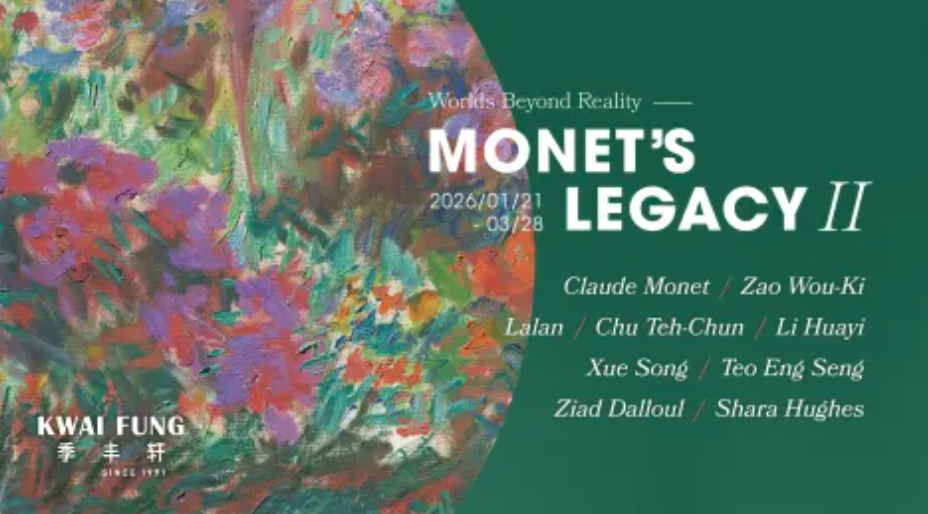
Kwai Fung Hin Art Gallery’s inaugural exhibition in Singapore unfolds with an unhurried confidence. Located along South Beach, Worlds Beyond Reality – Monet’s Legacy II adopts a slower tempo, one that mirrors its central metaphor of cultivation. The exhibition does not simply trace influence from Claude Monet to Asian artists across generations; it examines how landscapes are made, tended, and inhabited, and how artistic vision emerges through prolonged engagement with place, memory, and material.

The highlight of the exhibition is Claude Monet’s Pivoines (1887), one of only three paintings in the series, and the sole example held in a private collection. Yet the painting is not immediately revealed. Visitors encounter its reverberations first, echoes of light, atmosphere, and floral intensity distributed across the gallery, before arriving at the work itself. This curatorial strategy subtly dislodges Monet from the role of origin or endpoint, positioning him instead as a generative force whose ideas circulate, take root, and transform across cultures.
Painted four years after Monet settled in Giverny, Pivoines belongs to a period of decisive transition. Monet had arrived at the abandoned farm in 1883 and quickly began reshaping its grounds, not as a passive refuge but as an active, controlled environment designed for sustained observation. His garden was neither wilderness nor picturesque backdrop; it was a modern construction, meticulously orchestrated to ensure continuous bloom, chromatic variation, and shifting light across seasons. Monet would later call it his “most beautiful work of art.”

This act of cultivation must be understood within the broader transformations of late 19th-century France. As Paris underwent radical urban renovation, its boulevards punctuated by manicured public parks, the private garden emerged as a bourgeois symbol of order, leisure, and ownership. Monet’s Giverny, however, complicates this binary between public park and private retreat. While deeply personal, it was also shaped by global flows: exotic plants made available through international trade, and Japanese woodblock prints whose asymmetrical compositions and flattened planes profoundly influenced his pictorial language. By designing his garden to meet the needs of his painting, Monet collapsed the boundary between art and life. Nature was no longer merely represented; it was constructed, rehearsed, and returned to, again and again, as a site of perceptual inquiry.
In Pivoines, this inquiry is already visible. The vertical thrust of the peonies, the radical cropping that eliminates sky, and the all-over composition destabilise traditional spatial orientation. Viewers are positioned beneath the straw-roofed trellises, immersed rather than distanced. The painting’s seemingly abstract planar space anticipates the Nymphéas, where reflection would dissolve the horizon entirely. Here, Monet’s concern is not botanical accuracy but the sensation of being enveloped by colour and light, an early articulation of his desire to paint what he called “unknown realities.”

That ambition finds powerful resonance in the modern Asian artists brought into dialogue with Monet. Zao Wou-Ki’s 29.05 – 31.10.68 (1968), created during his celebrated Hurricane Period, pulses with elemental intensity. Having trained in both Chinese and Western traditions before arriving in postwar Paris, Zao developed a language that fused calligraphic gesture with the vocabulary of lyrical abstraction. In this work, thinned oil paint flows across the canvas like ink, staging a collision of fire, water, air, and earth. From this turbulence emerges a vortex of luminous force, as if the painting were generating its own atmosphere.
Zao’s oft-cited desire “to paint what is not visible” aligns closely with Monet’s late ambitions. Both artists privilege light and movement as conduits to deeper orders of reality. In Zao’s case, light seems to emanate from within the canvas, resisting containment by form. The painting does not depict a landscape so much as it conjures a cosmic event—nature understood as energy rather than scenery.

Where Zao’s work surges outward, Chu Teh-Chun’s abstractions gather weight through contrast. Painted in 1998, shortly after Chu became the first ethnic Chinese artist elected to the Académie des Beaux-Arts, his untitled work in the exhibition reveals a heightened confidence and compositional freedom. A wide chromatic range, from incandescent oranges and reds to dense blacks and greys—creates a dramatic interplay of light and shadow. Diluted oils produce translucent passages reminiscent of ink-wash painting, while darker zones accumulate like gravitational fields.
Chu’s engagement with chiaroscuro, shaped by his encounter with Rembrandt, lends his abstractions a profound spatial depth. Yet his work is equally grounded in Eastern philosophy, particularly the balance of yin and yang. Within the canvas, light and darkness do not oppose one another; they co-exist, generating tension and harmony. In this sense, Chu’s paintings echo Monet’s late works, where form dissolves into shimmering reflection, but they do so through a synthesis that unmistakably bears the imprint of Chinese calligraphy and poetry.

Lalan’s contribution introduces a quieter, more introspective register. Long overshadowed by her association with Zao Wou-Ki, her works here assert a distinct artistic trajectory. Clear and Obscure (1979), from her landscape period, draws inspiration from Southern Song dynasty “one-corner” compositions and Daoist thought. Two softened mountain forms emerge from a field of white, animated by rhythmic lines that suggest movement and breath. White, for Lalan, is not absence but an active, ambiguous force—“fluid, luminous yet sombre”—from which clarity and obscurity continually arise.
In The Fog Rises (1991–92), painted in her seventies, Lalan moves from equilibrium to transformation. Drips, stains, and fine lines accumulate and disperse across the surface, evoking fog illuminated by sunlight. The work recalls Monet’s fog-bound Thames paintings, where architecture recedes in favour of atmosphere. For both artists, fog becomes a means of revealing colour through concealment, making visible the transient nature of perception itself.

If these modernists articulate Monet’s legacy through abstraction and philosophy, the contemporary artists extend it through material experimentation and embodied experience. Li Huayi’s gilded ink painting responds directly to Monet’s obsession with light, yet approaches it through literati tradition. Gold leaf, applied to silk and interwoven with ink, does not merely depict light; it reflects and produces it. As viewers move, the surface shifts, registering time through changing reflections. The solitary pine—an emblem of endurance and self-cultivation—anchors the work in contemplative practice, transforming landscape into meditation.
This emphasis on bodily perception finds a compelling counterpoint in Singaporean pioneer Teo Eng Seng’s Forest at Dawn (2010). Using his invented “paperdyesculp” technique, Teo builds texture from dyed paper pulp, creating a tactile surface that evokes morning mist. The work draws on a formative memory: waking in a forest during his arduous three-month journey by land and sea to study art in Britain. Unlike Monet’s carefully controlled garden, Teo’s landscape is transient and precarious, shaped by movement, survival, and uncertainty. Yet both artists share an insistence on immediacy, on capturing sensation as it unfolds.

Teo’s presence grounds the exhibition in Singapore’s art history, complicating the metaphor of the garden city. His work emerges from a generation shaped by decolonisation and the search for a postcolonial artistic language, building upon but also departing from the Nanyang School. In this context, Kwai Fung Hin’s arrival in Singapore reads not simply as symbolic alignment with greenery and cultivation, but as a historically situated engagement with a city whose modern identity has been forged through migration, hybridity, and negotiation.
That negotiation continues in Xue Song’s commissioned collage, constructed from burnt fragments of Monet reproductions and ash-drawn lines. His reimagined Giverny—willow branches, water lilies, charred textures, becomes a site of destruction and renewal. Burning, for Xue, is both loss and beginning, a process shaped by personal history and China’s rapid transformation. Monet’s garden here is neither preserved nor replicated; it is dismantled and reconstituted, filtered through Daoist philosophy and contemporary anxiety.

The exhibition’s final movements turn inward, toward psychological and metaphysical space. Shara Hughes’ anthropomorphic flowers push and pull the viewer between immersion and rupture, challenging the flower painting’s traditional association with fragility and prettiness. Ziad Dalloul’s dreamlike interiors: beds, tables, fruit nestled within overgrown landscapes, all suggest human presence through absence, memory through objects. In both practices, light and colour become agents of emotion, extending Monet’s inquiry into perception into the realm of the subconscious.
Worlds Beyond Reality – Monet’s Legacy II succeeds not by monumentalising Monet, but by decentralising him—allowing his ideas to circulate, mutate, and take root across cultures and generations. Like a garden, the exhibition is not about instant bloom, but about patient tending. For Kwai Fung Hin’s first overseas space, this feels like a quietly assured beginning: one that prioritises depth over display, and cultivation over arrival.
Kwai Fung Hin Art Gallery Singapore opens on 20th January, 2026 at 30 Beach Road, #01-01, Singapore 189763. Worlds beyond Reality – Monet’s Legacy II runs from 21st January to 28th March 2026.
 Bakchormeeboy