
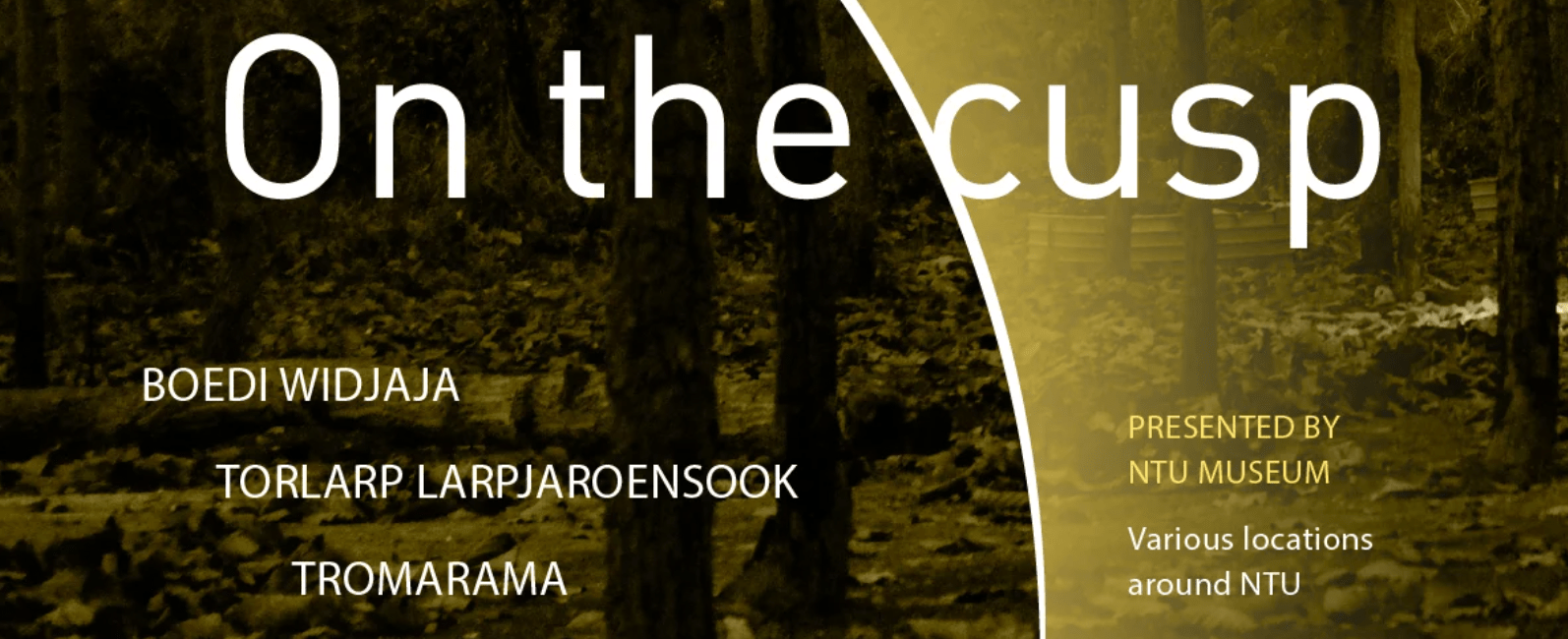
Something about Nanyang Technological University’s campus feels different. By the lake, a pavilion hums with unseen histories. On a grassy lawn nearby, a sculptural capsule seems to have landed from another time. And inside a bustling student plaza, a familiar household object begins to behave in unfamiliar ways.
This is On the cusp, NTU Museum’s latest campus-wide exhibition, where art inhabits everyday spaces and asks big questions about who we are, where we come from, and what we carry forward.
Running until 2 April 2026 and presented as part of Singapore Art Week, the exhibition features newly commissioned works by three Southeast Asian artists, namely Boedi Widjaja, Torlarp Larpjaroensook, and Indonesian collective Tromarama. Spread across three public locations on campus, the show turns a casual walk through NTU into a reflective journey through memory, identity, and transition.

Unlike traditional exhibitions tucked inside gallery walls, On the cusp unfolds outdoors and in public thoroughfares. Students pass through it on their way to class. Visitors encounter it while strolling the grounds. The experience is unforced, almost accidental, and that’s part of the point.
Curated around moments of crossing between past and present, physical and virtual, earthly and spiritual, the exhibition reflects on how identity is shaped at points of change. It’s a theme that feels especially resonant on a university campus, where many are navigating their own in-between moments, but it extends far beyond student life.
As NTU Museum curator Lu Xiaohui puts it, the exhibition invites people to encounter art “within the spaces they move through every day,” and to notice how memory is continually reshaped through lived experience.

At Nanyang Lake Pavilion, artist Boedi Widjaja transforms the modernist structure into something almost alive. Titled 东邪西毒 I Want to Infect You with History, the installation imagines history as something biological: carried, transmitted, and mutated within the body.
Drawing on his own experiences of migration and multilingual identity, Widjaja works across poetry, sculpture, photography, and performance. One of the most striking elements of the work is a poem he composed and then encoded into DNA, developed in collaboration with NTU geneticist Dr Eric Yap. Language, science, and memory converge here in a way that feels both intimate and unsettling. Standing inside the pavilion, visitors are invited to think about the histories they inherit, and those that may have been lost, displaced, or silenced along the way.

A short walk away, on the Chinese Heritage Centre Lawn, Thai artist Torlarp Larpjaroensook presents Cosmos of Nostalgia, a sculptural installation inspired by Chinese cosmology, science fiction, and myth.
Shaped like a capsule from the future, the work invites visitors to step inside and enter a painted universe where time flows in multiple directions. Rivers, mountains, and skies unfold across hand-painted interiors, drawing from traditional Chinese landscapes, temple murals, and ancient poetry. References to legendary figures like Chang’e and Wan Hu, a mythical would-be astronaut, sit alongside influences from Thai science fiction and early science encyclopaedias.
It’s a space for quiet contemplation, imagination, and wonder, a reminder of humanity’s long-standing desire to look beyond the present and understand our place in the cosmos.

Inside North Spine Plaza, where students gather between classes, Tromarama’s Turn On plays across NTU’s digital media wall, INDEX. The moving image work centres on a familiar Southeast Asian staple: the electric fan. As fans of different shapes and colours whirr to life on screen, the digital environment begins to shift. Curtains billow. Objects move. Cause and effect blur. What starts as something ordinary slowly becomes strange.
Known for their exploration of hyperreality and digital perception, Tromarama uses the fan, a symbol of comfort and survival in the region’s climate ,to question how technology mediates our memories and experiences. In a world increasingly lived through screens, Turn On asks what happens when representation starts to feel more real than reality itself.

On the cusp is part of NTU Museum’s broader vision of the campus as a “museum without walls,” where art is woven into daily life rather than separated from it. The exhibition also connects with the evolving NTU Campus Art Trail, which was recently refreshed with new works and an updated map highlighting the university’s architecture and public artworks.
NTU Museum is also extending the exhibition beyond campus with its West Side Art Tour, a guided bus-and-walking experience that traces contemporary art, architecture, and heritage sites across western Singapore. Running on selected Saturdays in January, the tour offers a deeper look at how art intersects with place and lived history in this often-overlooked part of the island.

There’s no single way to experience On the cusp. You might stumble upon it while heading to lunch, linger longer than expected, or return to a work days later with new thoughts. That sense of openness feels intentional.
After all, the exhibition isn’t about arriving at answers. It’s about pausing at thresholds between where we’ve been and where we’re going. and noticing what we carry with us as we cross.
On the cusp runs until 2 April 2026. Admission is free and open to the public.
 Bakchormeeboy