
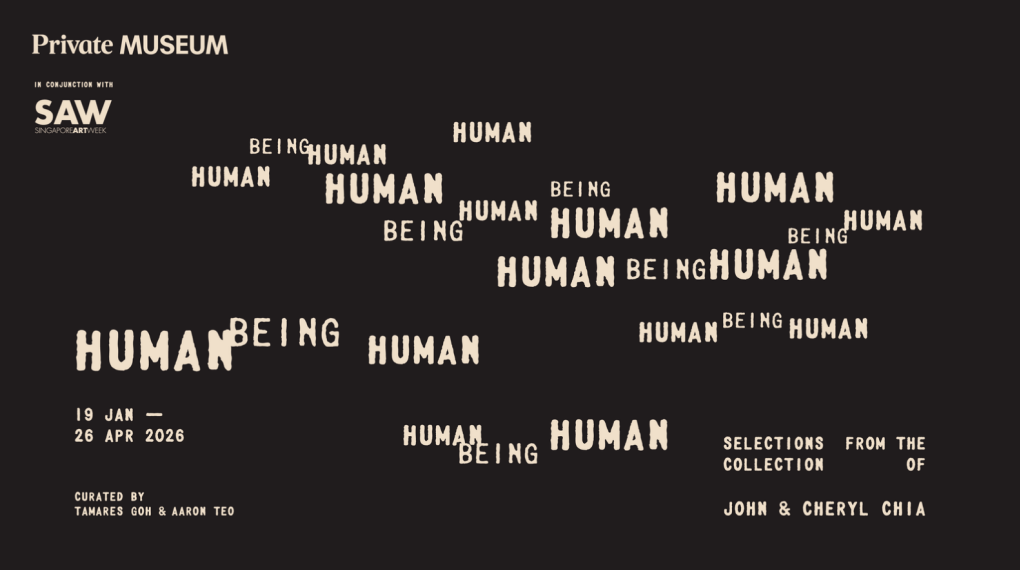
In a world shaped by constant change, fractured identities, and collective uncertainty, one question quietly persists: what does it really mean to be human? This is the starting point of Human Being Human, a major exhibition opening at The Private Museum, Singapore, in conjunction with Singapore Art Week 2026.
Running from 19 January to 26 April 2026, the exhibition offers an intimate yet expansive look at the human condition through more than two decades of collecting by medical professionals and long-time art patrons John and Cheryl Chia. What began as a personal journey has evolved into a public invitation to reflect on vulnerability, belonging, and the body as our most universal point of connection.
John and Cheryl Chia started collecting art around the year 2000, drawn initially to works by artists such as Iskandar Jalil and Chua Ek Kay. Over time, their curiosity grew into a sustained commitment to contemporary art, particularly practices rooted in Southeast Asia. Today, their collection spans approximately 500 works and reflects years of close engagement with artists, curators, and cultural discourse.
For Human Being Human, a selection from this deeply personal collection is brought into the public sphere, transforming private acts of looking and living with art into a shared experience. The exhibition positions collecting not as accumulation, but as a living practice shaped by time, encounters, and evolving understandings of self and society. As Cheryl Chia puts it, art is “an extension of our experiences, our thoughts, our ideas… it reflects the world we live in, here and now.” That sense of immediacy runs throughout the exhibition.
At its heart, Human Being Human is less concerned with art as object than art as condition. The works gathered here circle around the human body in states of emergence, pressure, fracture, endurance, and renewal. What results is a deeply physical exhibition, one that insists on the body as the primary site where history, politics, memory, and identity collide.

John and Cheryl Chia’s background as medical professionals profoundly informs the exhibition. Curated by Tamares Goh together with Aaron Teo, Human Being Human returns repeatedly to the body, not as an abstract symbol, but as lived experience. In an age of global upheaval, the body emerges as the last common ground. The Chias’ collecting practice reveals a sensitivity to suffering that is never sensationalised, paired with an equal attentiveness to resilience. Rather than pursuing grand narratives or stylistic cohesion, the collection gravitates toward works that register the human condition at its most elemental: skin, breath, movement, weight, fatigue, repetition.
This attentiveness explains the prominence of works that carry traces of performance or bodily action. Many pieces are not pristine artefacts but remnants: photographs taken at the edge of action, objects compressed or marked by force, installations assembled from residue and memory. The body is rarely idealised here. Instead, it is exposed as vulnerable, imperfect, and persistently negotiating the world around it.
The exhibition itself is the result of a long gestation. Initial conversations began as early as 2019, allowing the curators time to revisit the collection slowly and with care. That duration matters. Rather than forcing coherence, the curatorial process allowed patterns to surface organically, revealing a collection deeply preoccupied with becoming rather than being.

CHILD WITH INFANTILE PARALYSIS WALKING ON HANDS AND FEET (1887)
The exhibition unfolds across four conceptual chapters: Stateless, State, Statehood, and Rebirth. Rather than a linear narrative, these sections map recurring cycles of identity formation that most people experience, often more than once, across a lifetime.
The exhibition opens with Stateless, a chapter concerned with existence before definition. This is not innocence in the sentimental sense, but a state of raw potential and instability. Works in this section feel elemental and unsettled, asking what it means to be human before identity, nationality, gender, or role is imposed.
The inclusion of Eadweard Muybridge’s motion studies is particularly telling. His sequential photographs, which attempt to scientifically dissect movement, underscore the impossibility of fully capturing life in flux. A child with polio, moving in a way that resists normative bodily expectations, becomes a powerful provocation. The image destabilises easy distinctions between human and animal, ability and disability, normalcy and deviation. It forces an uncomfortable but necessary question: where, exactly, does “the human” begin?
This section establishes a key tension that runs throughout the exhibition. The body is simultaneously knowable and unknowable, observable yet resistant to complete understanding. The curators lean into this ambiguity, allowing the works to remain unresolved rather than explanatory.
Moving upward, State marks the onset of conditioning. Here, identity begins to harden under the pressure of external forces: family, education, culture, social expectation. The works in this chapter feel denser, more constrained. The body is still central, but now it is measured, disciplined, and named.
There is a strong sense of imprinting in this section. Photographic works, drawings, and installations evoke the ways individuals internalise labels long before they have the language to question them. Childhood appears not as nostalgia, but as a site of profound vulnerability, where belonging is learned through repetition and obedience.
Several works quietly register the violence of this process, not through overt confrontation but through accumulation. Uniforms, school objects, and domestic materials become carriers of memory and ideology. They suggest how identity is shaped through daily rituals that feel benign but are deeply formative.

If State is about becoming someone, Statehood is about becoming part of something larger and heavier. This chapter interrogates institutions, nationalism, ideology, and the collective stories that individuals are folded into, often without consent.
Here, political references emerge more clearly, but never as didactic statements. Instead, artists employ metaphor, repetition, and embodied gesture to explore how power operates on the body. The exhibition resists literal readings of history. Rather than anchoring works to specific geopolitical events, it focuses on how artists develop visual and performative languages to navigate power, surveillance, conformity, and resistance.
Installations that draw from industrial histories, family labour, and forgotten manufacturing practices expand the idea of statehood beyond government and borders. They gesture toward economic systems, inherited roles, and the quiet ways individuals are absorbed into structures that predate them.
Performance documentation plays a crucial role here. Walking, standing, enduring, repeating gestures until exhaustion—these actions foreground the body as both subject and witness. The act of simply persisting becomes political. Movement through space becomes a form of resistance.
The final chapter, Rebirth, does not offer resolution so much as possibility. After tracing cycles of formation and constraint, the exhibition opens into speculative space. If identity is constructed, what might be dismantled? What could be rebuilt?
Works in this section are often darker in tone, but also more introspective. Destruction appears as a necessary precursor to renewal. Ego is interrogated, sometimes violently, as artists confront the limits of selfhood and authorship. The body here is not only marked by experience, but actively reshaping itself through ritual, repetition, and sacrifice.
Ancestry and lineage reappear, not as fixed inheritances but as questions. What does it mean to carry history when one cannot—or chooses not to—continue it in conventional ways? How does one honour the past without being bound by it? These questions surface through works that collapse biological, spiritual, and symbolic notions of birth.
Rebirth, in this exhibition, is not a return to origin. It is a forward-facing act of imagination. The body becomes a site where new identities can be tested, however fragile or provisional.

One of the exhibition’s greatest strengths is its refusal to dictate meaning. The curators deliberately leave interpretive space open, trusting visitors to navigate the works through their own experiences. The physical progression through the museum mirrors this openness. As one ascends the building, the themes deepen, overlap, and blur, reinforcing the idea that human experience does not unfold neatly or linearly.
This openness is not ambiguity for its own sake. Rather, it reflects the ethics of the collection itself. The Chias’ approach to collecting privileges attentiveness over authority. The works are allowed to remain complex, even contradictory. Their power lies in their capacity to resonate differently across time and viewers.
In an era saturated with spectacle and certainty, Human Being Human offers something quieter and more demanding. It asks viewers to slow down, to sit with discomfort, and to recognise the body not as an abstract symbol but as the site where everything is felt.
The exhibition succeeds because it is grounded in lived experience. It acknowledges suffering without romanticising it, and resilience without turning it into triumph. It understands identity as something continually negotiated rather than resolved.
Ultimately, Human Being Human reminds us that being human is not a stable condition. It is an ongoing process of negotiation between the self and the world, between inheritance and choice, between fragility and persistence. In bringing a deeply personal collection into public view, the exhibition transforms private reflection into shared inquiry, inviting each visitor to confront not only what they see on the walls, but what they carry within their own bodies.
Human Being Human: Selections from the Collection of John and Cheryl Chia runs from 19th January to 26th April 2026 at The Private Museum, Singapore. More information available here
 Bakchormeeboy