
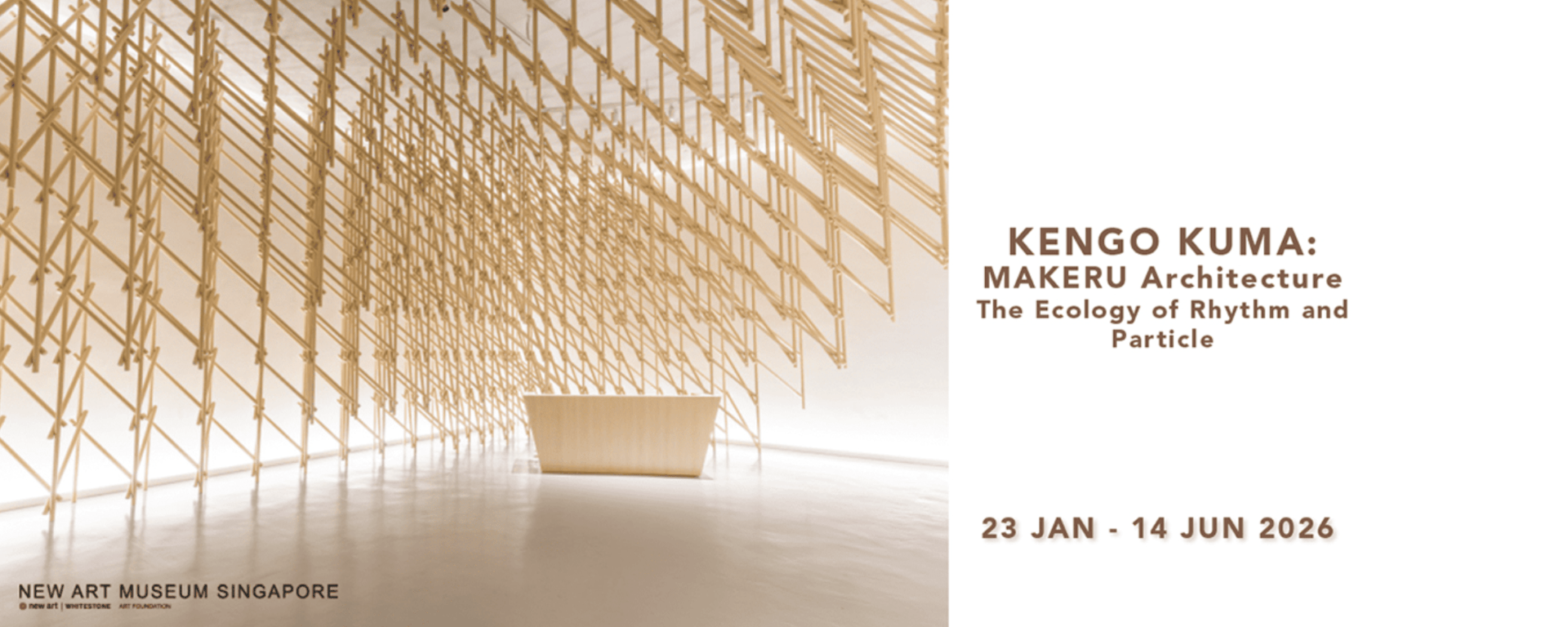
Step inside New Art Museum Singapore’s newest exhibition, and the world begins to shift. Walls breathe, floors whisper, and light drifts through porous layers of wood and bamboo. KENGO KUMA: MAKERU Architecture — The Ecology of Rhythm and Particle presents architecture not as static objects to be admired, but as lived, sensorial experiences — a choreography of material, memory, and environment that unfolds through the body as much as the eye.
Kengo Kuma’s practice invites us to inhabit space, to feel its rhythm, texture, and atmosphere, and to encounter architecture as a collaborator rather than a conqueror. Through large-scale models, photographs, full-scale mockups, inhabitable spaces, and participatory installations, the exhibition foregrounds Kuma’s commitment to sustainability, natural materials, and what he has famously termed “MAKERU Architecture.” Here, yielding is a creative strategy: embracing irregularity, amplifying existing forces such as climate, light, and sound, and allowing architecture to emerge from its context. Visitors encounter works from Japan, Southeast Asia, Europe, and beyond, each demonstrating how Kuma translates ecological awareness, cultural memory, and human presence into spaces that feel alive and porous.

Rather than positioning architecture as an autonomous object, the exhibition emphasises Kuma’s belief in architecture as a mediator: between nature and technology, interior and exterior, memory and matter. The visitor is encouraged to engage with architecture as a process rather than a finished form, deepening an understanding of Kuma’s global influence on contemporary architectural practice while remaining rooted in Asian environmental and cultural contexts.
Kengo Kuma established Kengo Kuma & Associates (KKAA) in 1990 and has since realized projects in more than 30 countries. Alongside his architectural practice, Kuma has played a significant role in architectural education, serving as Professor and later Professor Emeritus at the University of Tokyo, after teaching at Keio University. His extensive body of writing, including Ten Sen Men (Point, Line, Plane), Makeru Kenchiku (Architecture of Defeat), and Shizen na Kenchiku (Natural Architecture), forms a theoretical backbone for the exhibition.
Curated by Yuko Hasegawa, a leading curator, art critic, and former director of both the 21st Century Museum of Contemporary Art, Kanazawa, and the Museum of Contemporary Art Tokyo (MOT), the exhibition benefits from Hasegawa’s deep, long-term engagement with Kuma’s work. Known for her interdisciplinary approach, Hasegawa bridges architecture, contemporary art, design, and ecology, framing Kuma’s practice not merely as architectural production but as a cultural and environmental inquiry.

Key to the exhibition is the concept of “MAKERU Architecture,” often translated as “architecture of defeat.” However, as the exhibition makes clear, this “defeat” is neither passive nor submissive. Yielding here is reframed as an ontological and ecological strategy, one that amplifies existing forces such as humidity, climate, noise, material irregularity, and cultural memory, rather than suppressing them.
In contrast to Western architectural traditions that often emphasize control, dominance, and monumentality, the exhibition situates Kuma’s work within a broader Asian architectural lineage. Historically, architecture in many Asian contexts has evolved as an ecological intervention, responsive, adaptive, and deeply embedded within environmental rhythms. Buildings are not conceived as isolated objects, but as systems that intensify and beautify their surroundings.
Kuma’s architecture allows matter to remain granular, plural, and temporal. Materials are porous, layered, and often deliberately irregular. Rather than eliminating noise or imperfection, Kuma reworks these qualities into rhythm. Walls do not sharply divide inside from outside; instead, they generate fields of resonance where space is experienced as continuous and interactive.

This emphasis on materiality and rhythm is echoed throughout the exhibition design. Visitors encounter full-scale mockups, inhabitable tea rooms, and tactile installations that operate directly on the senses. The exhibition does not rely on abstraction alone; instead, it insists on bodily engagement, allowing visitors to feel how architecture reorganizes the relationship between body and environment.
One of the first immersive works visitors encounter is Tetchan (2014, Tokyo). Here, recycled LAN cables and acrylic byproducts, described as “Mojamoja” for their woolly, floating texture, are draped across the walls, creating a vibrant, tactile environment. Form recedes, and materiality takes center stage, highlighting Kuma’s belief in letting materials generate experience. The interior bursts with color and movement, inviting visitors to engage directly with textures and the sensory richness of materials.
Singapore’s position as an Asian cultural hub lends particular resonance to this approach. The exhibition returns methodologies developed within complex Asian conditions back to an Asian audience, emphasising concreteness over spectacle. Architecture here is not an image to be consumed, but an environment to be inhabited.

During the opening remarks, speakers underscored the exhibition’s significance not only as a survey of Kengo Kuma’s work, but as a platform for dialogue on Asia’s role in shaping the future of architecture and ecological thought. Emphasis was placed on collaboration, exchange, and learning, framing the exhibition as an open, evolving conversation rather than a closed retrospective. Situated in Singapore, the project was repeatedly described as an opportunity to reflect on shared climatic, cultural, and urban conditions, and to consider how architectural practice might respond to them with sensitivity, humility, and imagination.
In his remarks, Kengo Kuma reflected on the philosophical origins of “MAKERU Architecture,” describing it as a critical response to earlier generations of postwar architecture that sought to assert strength through monumentality. Recalling Tokyo in the decades following World War II, a dense yet low-rise city, Kuma explained how architecture once aimed to construct a “strong body” within the urban landscape. His own generation, he noted, moved deliberately in the opposite direction.
For Kuma, to “lose” is not to fail, but to relinquish the desire for domination. This attitude, he suggested, is particularly relevant in Asian contexts, where architecture has long evolved through coexistence rather than assertion. Yielding becomes a necessary stance for the future, a way of allowing architecture to emerge from its environment rather than imposing itself upon it.

Yuko Hasegawa further expanded on this idea by framing architecture as an ecological and material system composed of particles , each with elements with scale, weight, memory, and irregularity. These irregularities are not flaws to be erased, but energies to be received, transformed, and reactivated. Architecture, in this sense, operates not only physically, but conceptually and sensorially, mediating between environment, body, and perception.
The exhibition presents 17 architectural projects, with a strong emphasis on Asia’s diverse climates, materials, and cultural conditions. Rather than proposing a single Asian identity, it highlights pluralism, continuity, and minimalism as operative concepts. These are not stylistic labels, but tools for understanding how architecture behaves, how it moves, resonates, and communicates through structure, sensation, and time.
Language itself becomes a metaphor within the exhibition, particularly through the notion of onomatopoeia: architecture as something that can be “heard,” felt, and interpreted differently by each visitor. This participatory dimension reinforces the exhibition’s central invitation: that architecture is not the exclusive domain of specialists, but a shared process in which everyone can participate.

Rather than defeating the world, Kuma’s architecture collaborates with it. By fragmenting itself, embracing irregularity, and amplifying existing forces, architecture becomes a means of making the world more alive. Essentially, the exhibition positions architecture as a living organism, chemical, material, and social, absorbed into human life rather than standing apart from it. The philosophy underpinning “MAKERU Architecture” is one of interdependence: between materials and memory, humans and environment, Asia and the world.

One of the exhibition’s most quietly affecting sections is Southward — Tropical Contemplation, anchored by the Floating Tea House. Here, Kuma revisits the Japanese tea house not as a formal typology to be reproduced, but as an attitude, one defined by humility, proximity to the ground, and an ethical refusal to dominate nature.
Unlike a traditional tea room grounded in earth and material, this pavilion transforms the tea house into a temporary, drifting device: a “microcosm of reality” in constant movement. Constructed from a huge balloon weighing only 11 grams per meter, the pavilion is enveloped in an extraordinarily delicate structure that allows it to float, sway, and drift with the wind. Here, Kuma distills the tea house to its essence: not as a fixed enclosure, but as a space defined by rhythm, air, and impermanence. Contemplation is achieved through mobility and ephemerality, as visitors encounter architecture that is simultaneously present and transitory, a microcosm that travels with the wind rather than anchoring itself to the earth. The Floating Tea House exemplifies Kuma’s interest in temporal, experiential, and sensorial architectures, where materiality and atmosphere are inseparable from the act of inhabiting space.
This refusal of dominance extends into projects that traditionally demand assertiveness, particularly monuments. The Qatar National Monument (unbuilt, Doha) exemplifies Kuma’s rethinking of monumentality for the environmental age. Rather than presenting a detached visual object, the monument is imagined as a form that rises organically from the ground, recalling Qatar’s Umbrella Rocks and deriving its spiral geometry from traditional Naqsh patterns.

Movement is central: paths weave through and around the structure, integrating landscape, memory, and civic life. Names of national figures shimmer above reflecting pools, while filtered light animates a central forum that symbolically unites past, present, and future. Pride and patriotism are cultivated not through spectacle, but through continuity with land and collective movement.
Other projects extend this philosophy globally. At V&A Dundee (2018, Scotland), Kuma partially opens the building to the River Tay with a cave-like “hole” connecting city and nature, inspired by Japanese Shinto torii gates. The Japan National Stadium (2021 Olympics) similarly translates forest-like monumentality into architecture, using cedar from 47 forests to imbue materiality, order, and life into a large-scale urban project. This approach resonates strongly with the Founders’ Memorial Singapore, another project foregrounded in the exhibition. Conceived as a “living memorial,” the design abandons vertical monumentality in favor of a garden landscape shaped by paths, slopes, and canopies. The memorial emerges as a journey — “The Founders’ Path” — tracing values across generations rather than fixing them in stone.

Several projects foreground architecture’s ecological and symbolic role simultaneously. The Kalimantan Fire Lookout Tower in Indonesia draws inspiration from a bird’s nest — both sanctuary and observatory. Rising 20 meters above peatland forest, its layered envelope of local Ulin wood and recycled materials creates a gradated, nest-like texture that blends into the canopy. Structurally light and spiraling, the tower minimizes bulk while maximizing visibility, embodying a synthesis of environmental awareness, surveillance, and local identity.
In contrast, the Birch Moss Chapel in Nagano achieves near-invisibility. Steel and birch trunks intertwine so convincingly that the structure may be mistaken for trees themselves. Thin, randomly placed “branches” support a glass roof, dissolving the boundary between forest and building. Moss spreads seamlessly across interior and exterior floors, while transparent benches further dematerialize the chapel. Architecture here does not frame nature; it yields to it, allowing quiet empathy between structure, body, and landscape.

In contrast, the Birch Moss Chapel in Nagano achieves near-invisibility. Steel and birch trunks intertwine so convincingly that the structure may be mistaken for trees themselves. Thin, randomly placed “branches” support a glass roof, dissolving the boundary between forest and building. Moss spreads seamlessly across interior and exterior floors, while transparent benches further dematerialize the chapel. Architecture here does not frame nature — it yields to it, allowing quiet empathy between structure, body, and landscape.
A recurring theme throughout the exhibition is sequence: architecture understood not as an object but as a lived progression. Rooted in the Japanese concept of Engawa, these transitional spaces neither separate nor simply connect inside and outside; instead, they remain alongside architecture, fostering closeness and tolerance through proximity.

This logic is powerfully demonstrated in the Calouste Gulbenkian Foundation, Southern Apex in Lisbon. By lowering surrounding walls and opening new pathways, the project dissolves institutional boundaries, allowing the garden to flow into the museum and the city beyond. The museum becomes an integrated environment — not a destination apart, but part of an ongoing urban and ecological dialogue.
At Saint-Denis Pleyel Station in Paris, a major infrastructural hub is transformed into a civic landscape. Continuous ramps, rooftop gardens, and a deep wooden atrium reimagine the station as a public park. Oak-clad surfaces soften what would otherwise be concrete and steel, while movement itself becomes a shared spatial experience. Architecture accompanies the body, guiding rather than commanding it.

In the exhibition’s exploration of continuity and minimalism, reduction is never equated with emptiness. Instead, space is articulated through repetition, interval, and pause. Layered wooden louvers, a recurring motif in Kuma’s work: create fields of continuity interrupted by light, shadow, and movement. These strategies recall Utagawa Hiroshige’s depiction of rain: countless fine lines that activate space rhythmically rather than recede into background.
Projects such as the Great (Bamboo) Wall, Nakagawa-machi Bato Hiroshige Museum of Art, and the Aoi Aso Shrine / National Treasure Memorial Hall exemplify this approach. Bamboo, cedar, stone, and paper are deployed not only for their material performance but for their capacity to register time, weather, and memory. Architecture becomes serene yet animated — calm without ever becoming inert.

Perhaps the exhibition’s most distinctive contribution lies in its treatment of onomatopoeia as an architectural language. Rather than abstract form, Kuma often begins with sensory impressions: zara-zara (roughness), suu-suu (breathing), yura-yura (gentle swaying). These sound-symbolic words describe not shape, but atmosphere and bodily sensation, architecture felt before it is formalised.
This concept is brought vividly to life through Tomonami for KKAA, an interactive virtual platform developed with Sony Computer Science Laboratories. Visitors manipulate particles in real time using onomatopoeic prompts such as para-para, tsun-tsun, suke-suke, and guru-guru, engaging directly with Kuma’s design logic. Onomatopoeia here becomes a shared, intuitive language, bridging material behaviour, architectural intention, and human perception. By embedding this system into the exhibition, architecture is presented not as a finished artifact but as an evolving dialogue. It speaks softly through sensation, and listens closely to those who inhabit it.

This emphasis on process culminates in the documentary film Particle Dance, directed by Hiromoto Oka. Filmed over fifteen years, the documentary captures not only completed buildings but the tensions, revisions, and uncertainties of design and construction. As Kuma reflects, architecture is not an outcome, but a process, one shaped by patience, collaboration, and continual negotiation with the world.
Seen from Singapore, the exhibition gains particular urgency. Shaped by a city defined by density, climate, and environmental ambition, “MAKERU Architecture” resonates not as a distant philosophy but as a lived question: how to build without severing, to create presence without dominance. Rather than monumentalizing Kengo Kuma’s work, the exhibition resists closure, insisting on architecture as process, sequence, and bodily experience.
What lingers is not an image but a heightened sensitivity, to materials that breathe, spaces that yield, and architectures that stay close rather than stand apart. At a moment when sustainability is often reduced to metrics or visual codes, the exhibition proposes a more demanding ethic: architecture as a practice of listening, grounded in attentiveness to place, climate, and the subtle forces that shape how we inhabit the world. In this sense, the exhibition itself begins to behave as “MAKERU Architecture”—porous, unfinished, and collaborative, continuing beyond the gallery as an altered way of sensing ground, material, and atmosphere.
KENGO KUMA: MAKERU Architecture — The Ecology of Rhythm and Particle runs from 24th January to 14th June 2026 at New Art Museum Singapore. More information available here
 Bakchormeeboy