
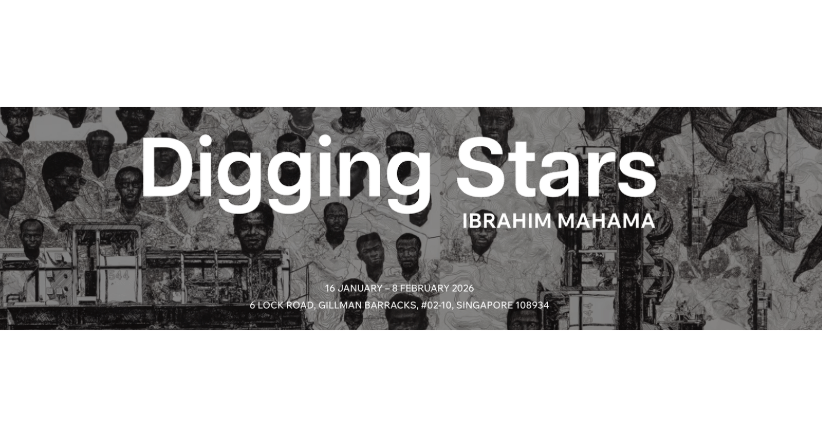

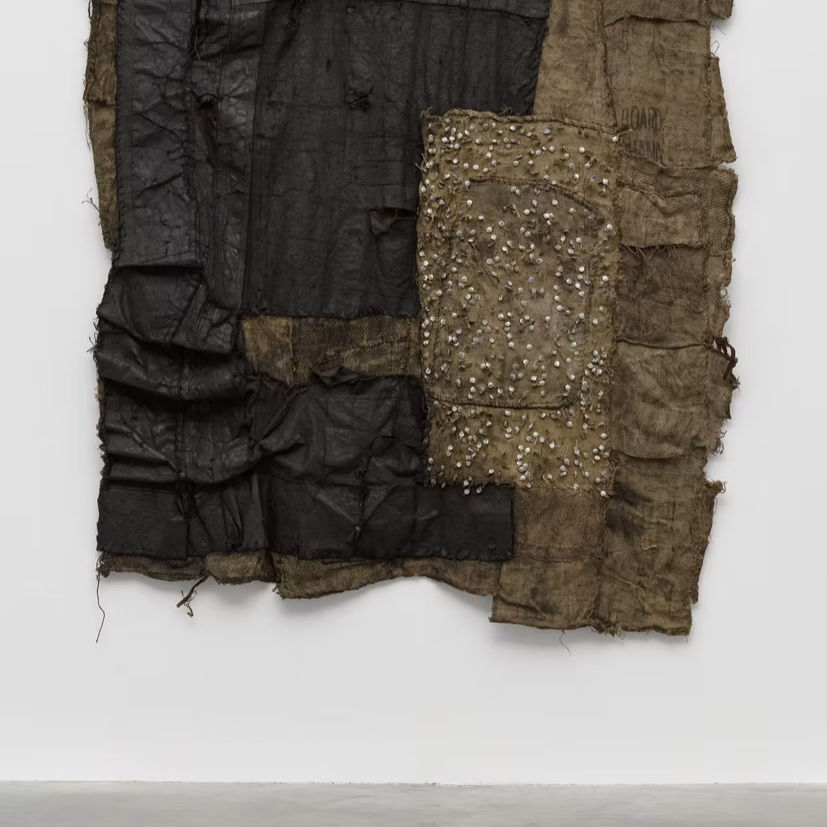
Ibrahim Mahama’s Digging Stars unfolds not only as an exhibition, but as a proposition for how art might be made, shared, and sustained under conditions of structural inequality and scarcity. While the works on view trace material histories of colonialism, trade, and industrial labour, the exhibition also gestures toward a broader set of questions: where does art take place, who is it for, and what systems are required for it to endure?
Running through the exhibition is an insistence on forms of value that sit outside the logics of accumulation and spectacle. Care, proximity, and shared resources emerge as quiet but essential infrastructures of artistic life. Food, for instance, becomes a way of thinking about community and survival: it is often one of the first things to disappear when resources are scarce, yet it remains one of the most fundamental ways people come together. To cook for someone, to eat together, is already to establish trust and a mode of exchange that resists purely transactional relationships.
This understanding is central to how artistic practice is sustained in precarious contexts. Sustaining a practice is not only about money or visibility; it is about whether one can continue to exist as a thinking, feeling person in relation to others. It requires space to talk, to disagree, to rest, and to imagine without the constant pressure of justification. Many institutional systems prioritise outputs, audiences, and deliverables, yet overlook the informal structures that actually keep practices alive: shared labour, shared meals, mutual support, and the collective holding of uncertainty. In many parts of the world, these informal systems are not supplementary. They are the system.
Mahama’s reflections on his formative years as a student in Kumasi reveal how this ethos took shape early on. In the absence of museums or formal exhibition spaces, students were forced to rethink where and how art could exist. Exhibitions took place wherever collective life unfolded: markets, cemeteries, streets, and buses. One student famously rented a public bus—an everyday, gendered space of labourand transformed it into a moving exhibition for a single day. These gestures were not conceived as spectacle, but as necessity.
As Mahama puts it plainly, “Art doesn’t necessarily exist in a white cube. In fact, it doesn’t.” Art, instead, emerges from the contexts that produce it, circulates within them, and speaks back to them.

Crucially, these early experiments were grounded in collaboration rather than competition. Students pooled money, shared labour, and built exhibition infrastructures together. Lecturers worked alongside former pupils; artists became carpenters, installers, and technicians. “We’re not competing,” Mahama recalls. “We’re trying to build a system.” This commitment to system-building—prioritising generativity over individual advancement—would become foundational to his practice.
That logic extends into Mahama’s later institutional projects in Ghana, where studios, libraries, cinemas, and exhibition spaces are conceived not as fixed cultural monuments but as flexible, inhabitable structures. These sites function simultaneously as places of production, reflection, and public engagement. In contexts where even basic infrastructure cannot be assumed, cultural work necessarily expands beyond the symbolic. “We even have to build the power grid. We have to build the pipeline,” Mahama notes. “It’s a very different notion of living.” Here, art becomes inseparable from the conditions of life itself.

Digging Stars also foregrounds the complexities of working with institutions in the Global North. Mahama does not reject collaboration with museums and foundations; instead, he approaches them as sites of negotiation. Invitations to produce exhibitions become opportunities to ask how resources might be redistribute, materially, intellectually, and ethically, rather than simply mobilised toward spectacle.
As he asks pointedly, “How do you redistribute the resource in such a way that it’s not just about creating a spectacle?” If art is often described as a site of freedom, the exhibition challenges institutions to consider what that freedom actually entails when artworks, audiences, and artists remain unevenly distributed across the world.
Redistribution, in this context, extends beyond the return of objects. It encompasses human capital, knowledge, time, and training. Sustained dialogue, shared research, and long-term collaboration are positioned as equally vital forms of restitution. The exhibition aligns itself with artist-led and non-collecting institutions that prioritise process over product, and research over accumulation. Rather than extracting finished works, such spaces function as platforms for shared inquiry, accepting uncertainty and even failure as integral to artistic development.

Precarity, throughout the exhibition, is not framed as an obstacle to be overcome but as a condition to be worked with. As Mahama insists, “Precarity doesn’t mean paralysis.” Cultural ecosystems, like living organisms, expand and contract in response to available resources without collapsing entirely. While funding fluctuations shape what is possible, the persistence of relationships, shared knowledge, and mutual support ensures continuity beyond moments of abundance.
Importantly, Digging Stars resists the romanticisation of scarcity. It maintains a clear-eyed recognition of inequality, acknowledging that not all artists have the same capacity to absorb risk, to fail, or even to choose an artistic life. Against this backdrop, sustaining a practice becomes a collective concern. Support may take the form of financial resources, but it may also manifest as access to networks, mentorship, shared meals, or simply time and space to think.

In bringing these concerns into the exhibition space, Digging Stars reframes what an exhibition can be. It is not merely a presentation of objects, but a visible trace of relationships, negotiations, and commitments that extend well beyond the gallery. The works on view carry not only the weight of material history, but also the possibility of imagining art as a shared infrastructure, one that is built slowly, held collectively, and sustained through trust.
Digging Stars runs from 16th January to 8th February 2026 at 6 Lock Road, Gillman Barracks #02-10, Singapore 108934. More information available here
 Bakchormeeboy