
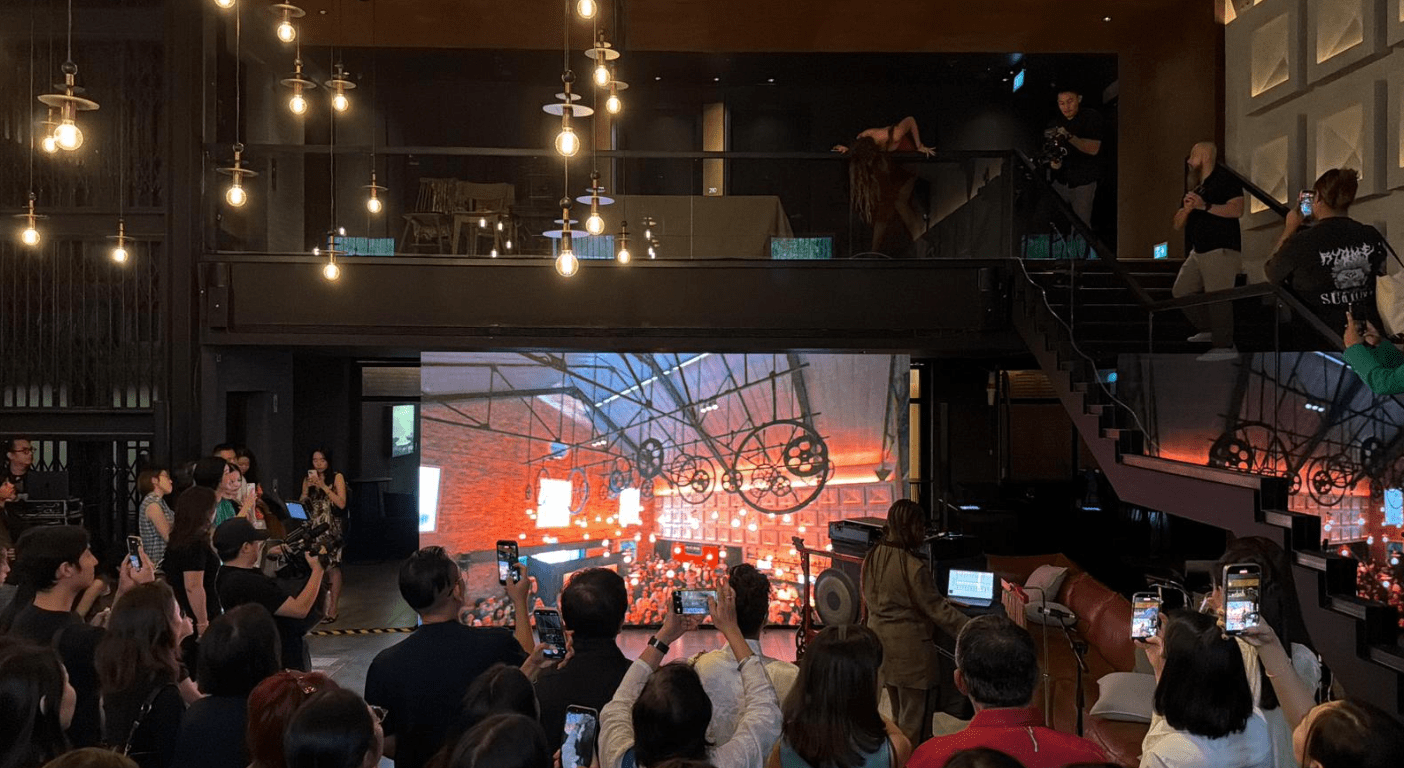

For twelve days in January, The Warehouse Hotel ceases to function merely as a site of transit and hospitality. Instead, it becomes something more porous, more unstable, and more alive. As part of Singapore Art Week 2026, Wan Hai Hotel: Singapore Strait transforms the hotel lobby into a speculative maritime commons, one in which performance, sound, moving image, and object-based works unfolded not as static displays, but as overlapping rehearsals of movement, memory, and relation.

From its opening moments, the exhibition refused the neutrality of the white cube. Bodies descended staircases, voices echoed through the atrium, images spilled across screens, and the architecture itself appeared to be recruited into performance. Rather than cordoning off art from daily circulation, Wan Hai Hotel absorbed the rhythms of the hotel: check-ins, cocktails, waiting, lingering. The result was an exhibition that did not simply occupy space, but actively reorganised it.

Curated by X Zhu-Nowell, Executive Director and Chief Curator of Rockbund Art Museum, the project is the Singapore iteration of a para-fictional hotel first staged at RAM in Shanghai in 2024. Yet this is not a touring exhibition in the conventional sense. As Zhu-Nowell has emphasised, Wan Hai Hotel is a mutable structure, one that reconstitutes itself in relation to each site’s specific histories, economies, and maritime conditions. In Singapore, that meant engaging the Strait not merely as a geopolitical passage, but as a dense zone of logistics, labour, surveillance, extraction, and desire.

The Warehouse Hotel, situated along the Singapore River in a district historically shaped by boat workers, informal economies, and red-light trades, proved an especially charged host. What is usually a carefully regulated architecture of hospitality was reactivated as a space of friction: where institutional polish met the unruliness of performance, sound, and collective gathering.

Speaking at the opening, ART SG Director Shuyin Yang framed the project as both a gift and a risk. “We started this vision with a dream to bring the art that inspired us from different countries to Singapore,” she said, thanking partners for supporting what had initially existed only “as a vision in our heads.”

Acknowledging the unpredictability of the process, she added candidly that the venue’s collaborators “didn’t always understand what we were trying to do. That’s okay; it’s art.” Her remarks underscored one of the exhibition’s central tensions: the challenge of staging experimental, time-based practices within spaces shaped by commercial and logistical imperatives.

That tension became a productive one. Across the lobby, lounge, bar, study, restaurant, and stairwells, more than twenty artists from Singapore, Southeast Asia, and the wider Asia-Pacific activated the hotel as a vessel rather than a container. Installations by Ho Tzu Nyen, Taloi Havini, Dawn Ng, Robert Zhao Renhui, Tan Jing, and others transformed familiar architectural zones into sites of reflection, with both video and installation work. Meanwhile performances by Joshua Serafin and Bhenji Ra assert the body as a critical medium through which maritime histories and queer genealogies could be felt rather than merely observed.

The opening performances, in particular, announced the exhibition’s refusal of passivity. Rather than being confined to a stage, they unfolded across levels and thresholds, pulling viewers into shifting orientations of attention. Screens, staircases, and circulation routes became active participants, dissolving the boundary between audience and artwork. What emerged was a sense that the exhibition was less something to be viewed than something to be inhabited, temporarily, incompletely, and always in flux.

Audrey Ou of Rockbund Art Museum situated the project within a longer institutional and regional dialogue. Describing the Singapore Strait as “not only a passageway, but a space of relation,” she framed Wan Hai Hotel as part of an ongoing exchange between Shanghai and Singapore, shaped by “shared maritime histories, trade, labour and cultural movements.” Her emphasis on circulation, of people, ideas, and histories, mirrored the exhibition’s conceptual grounding in Epeli Hauʻofa’s notion of the Pacific as a “sea of islands,” where connection precedes division.

This oceanic thinking permeated the works on view. Films tracing boat cultures, diasporic routes, and ecological entanglements sat alongside archival materials and speculative gestures that refused linear history. Sound works and performances pulsed through the space at different times of day, ensuring that no two visits were quite the same. As Zhu-Nowell noted, the exhibition “changes every hour,” with nighttime bringing a different register: louder, more playful, more socially charged.

The exhibition’s attention to hospitality extended even to taste. At the Warehouse Lobby Bar, Art SG partnered with The Warehouse Hotel to serve A Liquid Atlas, a curated cocktail menu that echoed the themes of the show. Each drink functioned as a micro-performance, translating the exhibition’s oceanic, diasporic, and mythic sensibilities into liquid form. Ming Wong’s “Bloody Marys, Song of the South Seas” inspired the Mary of Many, a rich, spiced umami blend of Belvedere vodka, clarified tomato water, tamarind cordial, pickled chili, fish sauce, roasted pepper tincture, white pepper, and a whisper of sesame oil: a savoury chorus in a glass.
Speaking about the Mary of Many, Joseph Haywood, Director of Food & Beverage, The Warehouse Hotel, explained that the drink reworks the Bloody Mary through both technique and geography. “Instead of a heavy tomato base, we’re using clarified tomato water, so it’s clean and translucent rather than viscous. There’s a chilli tincture, pickled chilli brine, and a bit of oil, it’s savoury, but precise.”
The cocktail was directly inspired by Ming Wong’s Bloody Marys, Song of the South Seas, and by the musical South Pacific. “That work is about an American voice performing in the Asia-Pacific, about intimacy and displacement,” Haywood adds. “So the idea was to bring a Bloody Mary into Southeast Asia, not just stylistically, but culturally.”

Bhenji Ra’s mythic “Siren” informed the Siren of the Strait, a clean, spirit-forward tequila cocktail infused with kombu, lemongrass distillate, kaffir lime saltwater, and white grapefruit cordial, evoking the unmooring of borders and identities. Other creations, from the low-ABV, citrus-botanical Sea of Islands to the aromatic, tropical Chinatown Constellation and the medium-bodied, floral Tidal Assemblage, each mirrored the exhibition’s layered geographies, histories, and oceanic flows. Even a non-alcoholic option, Pacific Drift, distilled the currents of identity into barley tea, lemongrass-ginger hydrosol, and citrus oils. These cocktails made tangible the exhibition’s ambition to blur art and life, providing visitors with a sensory experience that lingered long after they left the exhibition.
While Lobby Bar is known for drawing on historical references, the Wan Hai Hotel menu required a different approach. “We kept asking ourselves what the exhibition was really doing,” explains Haywood. “It’s about oceans, movement, and regions rather than borders. So every drink carries some kind of marine note, salinity, savouriness, but still within classical cocktail structures. You still have your boozy, your bitter, your citrus, your light and refreshing.”

The collaboration involved months of discussion with the Art SG team. “It was a lot of back-and-forth about what would fit with both the exhibition and what represents the hotel as well. In the end, it felt right because the whole project is sectional. There are different experiences happening at once, at the bar, in the restaurant, in the performances, but they all sit within one larger narrative.”
For the bartenders, the goal was to essentially extend the exhibition through drink. “You can look at art, you can hear it, or you can taste an interpretation of it,” Haywood concludes. “That’s what we’re trying to do here, to create a more complete experience.”

Crucially, Wan Hai Hotel resisted the temptation to aestheticise the ocean as metaphor alone. Instead, it foregrounded the material conditions through which maritime worlds are continuously produced: shipping routes, labour regimes, extractive economies, and infrastructures of control. By staging these concerns within the social architecture of a hotel, a place defined by temporary stays, service, and regulated intimacy, the exhibition asked pointed questions about who is welcomed, who labours unseen, and who is permitted to linger.

In this sense, Wan Hai Hotel: Singapore Strait functioned more as a collective rehearsal. A rehearsal for interruption, for alternative forms of hospitality, and for thinking with water rather than against it – fluid and changeable.

Visitors and guests were both invited to look, and to stay, return, overhear, and participate. As Shuiyin remarked at the opening, “You will probably overstay.” That act of being so drawn in that one overstays raises ideas of the temporal, social, and conceptual, and may be the exhibition’s most radical gesture.

Rather than offering resolution, Wan Hai Hotel leaves its questions suspended, like tides in motion. How do bodies traverse not only water, but power? How do kinship and endurance persist amid forces of enclosure? In occupying the hotel lobby so completely, and so temporarily, the exhibition reminds us that spaces, like oceans, are never neutral. They are lived, contested, and continually remade through movement.
Wan Hai Hotel runs from 20th to 31st January 2026 at The Warehouse Hotel, Singapore. More information available here
ART SG 2026 runs from 23rd to 25th January 2026 at Marina Bay Sands Singapore. Tickets and more information available here
 Bakchormeeboy