
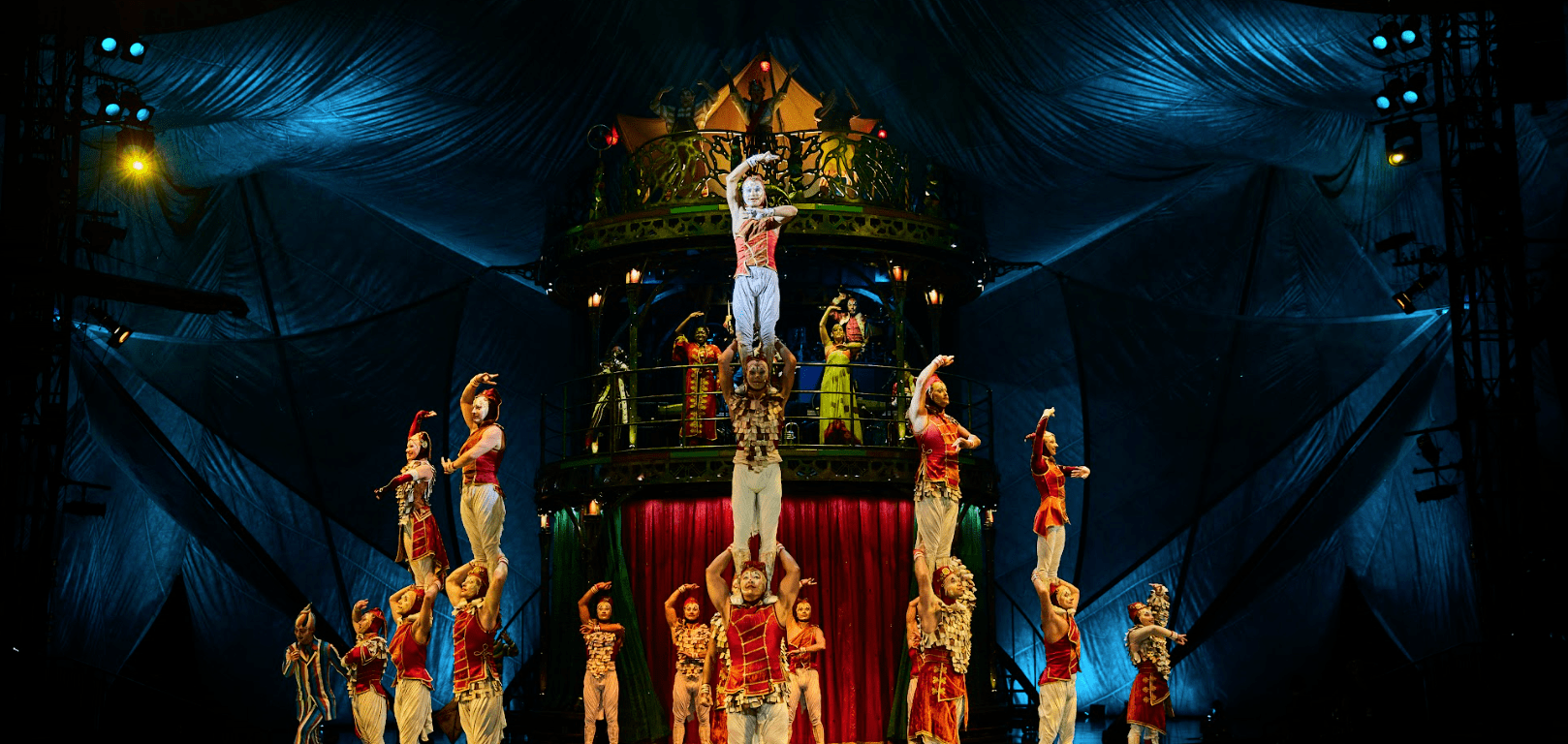
Cirque du Soleil remains the gold standard for modern circus entertainment as Kooza makes a spellbinding return to Singapore.
Nine years is a long time in theatre. Long enough for tastes to change, for spectacles to age, for audiences to become harder to impress. And yet, as Cirque du Soleil’s KOOZA returns to Singapore in 2026, once again unfurling its Big Top at Bayfront Event Space, and it becomes immediately, almost startlingly clear that some experiences don’t diminish with time, but become deeper, etched into canon.
Last here in 2017, for those who remember it, there’s a particular thrill in returning: the question of whether the magic will still hold. The answer, emphatically, is yes. Perhaps even more so. In an era dominated by screens, algorithms, and carefully curated digital thrills, KOOZA feels vital a reminder of what live performance can still do when executed at the highest possible level.
Anytime you get a chance to be under a Big Top, your mind and body have already entered a different world. Before a single acrobat takes flight, before the lights dim or the music swells, Cirque du Soleil’s KOOZA already begins its seduction. The audience settles in, popcorn in hand, and then chaos breaks loose.

Mischievous, anarchic, and gleefully out of control, the clowns spill into the aisles, stealing phones to snap illicit selfies, snatching hats, pelting the crowd with buckets of popcorn, and provoking mock outrage from uniformed “policemen” who give chase around the tent. It’s playful anarchy at its best, disarming, inclusive, and immediately human. Laughter ripples through the Big Top as the fourth wall dissolves. We’re no longer just spectators, and we’re already part of the circus.
From this carnivalesque disorder emerges the Innocent, dressed simply, almost awkwardly, waving a kite that somehow magically takes flight beneath the towering canopy. There’s a hush as the kite glides overhead, a visual metaphor so pure it barely needs explanation. Then comes the inciting moment: a massive, ornate parcel is delivered. Inside it, an intricate box.
And from that box springs the Trickster. Impossibly elastic and otherworldly, the Trickster explodes onto the stage in a riot of colour and motion, flipping, bending, contorting his body in ways that feel almost unnatural. Clad in a perfectly aligned, vertically striped suit, he radiates control, mischief, and power. With a flick of his baton, dull costumes burst into colour. With a flourish, he conjures the Charivari, a monumental, multi-tiered structure that rolls in from the wings like a living thing, reminiscent of Howl’s Moving Castle. Glistening with gold, adorned with ornate staircases, it houses the live band and singers perched across its levels, performing with operatic grandeur. It’s a breathtaking reveal, theatrical and awe-inducing, and it signals that the world of KOOZA has fully opened.
As the Charivari advances, the ensemble pours forth. Mini acts unfurl: trampoline bursts, diabolo sequences, warming the crowd, sharpening our anticipation. Then the show settles into its rhythm, and the acrobatics take centre stage. The contortionist trio is the first true display of controlled elegance. Three performers fold, stack, and weave themselves into sculptural forms, balancing atop one another with serene focus. Their movements are fluid yet precise, their impossible shapes executed so effortlessly that you almost forget the physical strain involved, until a sudden transition reminds you that what you’re witnessing defies anatomy itself.
Next comes the unicycle duet, framed as a love story in motion. As the male acrobat cycles steadily around the stage, his partner leaps onto his shoulders, then balances upside down on her hands, her strength and poise breathtaking. The act becomes a meditation on trust, not just between performers, but between motion and stillness, and it earns a wave of awe-struck applause.

The night’s first major showstopper arrives in the form of the aerial silks. A lone performer in crimson, her bodysuit emblazoned with a heart motif, ascends into the air. What follows is a masterclass in agility and fearlessness: rapid spins, free-falls, lightning-fast wraps and releases. The speed at which she resets mid-air is astonishing, blink and you’ll miss it. Gasps punctuate the tent as gravity seems to momentarily loosen its grip. When she lands, the applause is thunderous and well-earned.
We’re given a breather, though hardly a lull, with the return of the clowns. A king and his two assistants stage an extended audience interaction, complete with trials that must be passed before knighthood is bestowed. The volunteer is game, the crowd supportive, and the comic timing impeccable. Just as order is restored, it’s shattered again by a shocking interruption: a mad, oversized dog erupts from a trapdoor, stealing the crown and plunging the tent back into delighted chaos.
The first act closes with one of KOOZA’s most nerve-racking sequences: the high wire. Indian-coded in costume and musical texture, the performers traverse the wire with astonishing ease hopping, skipping rope, cycling forwards and backwards. Then the stakes rise: a second layer, another performer balancing precariously between two cyclists. Smiling confidently, they radiate calm where panic might be expected. The audience erupts as Act One draws to a close, adrenaline still humming.

After intermission, the mood shifts. A skeleton dance ushers us into an underworld that’s equal parts gothic and glamorous. Burlesque-inflected costumes, feathers, bodysuits, bone motifs, shimmer under moody lighting. The lead skeleton performer in white, masked yet deeply charismatic, commands attention with every movement, drawing us willingly into this darker, seductive realm.
It’s the perfect prelude to the Wheel of Death, and one of the night’s most unforgettable acts. Two performers manipulate the massive apparatus with breathtaking precision, running inside and atop the rotating wheels, leaping across gaps, skipping rope while the structure spins relentlessly beneath them. There are moments of genuine fear, collective gasps ripple through the audience, followed by disbelief as they recover and push the danger even further. It’s raw, visceral, and impossible to forget.
From this intensity emerges a burst of colour: hoop manipulation. A confident soloist enters draped in a vibrant feathered cape before revealing her bodysuit, launching into a hypnotic display of control. Hoops whirl around her arms, legs, and torso, creating shimmering patterns of light, until she’s spinning an astonishing number of hoops simultaneously. It’s joyful, dazzling, and technically sublime.
Then comes one of the most unexpectedly moving acts of the night, the chair balancing act. Stripped of spectacle, the performer builds his tower slowly, deliberately, revealing extraordinary back strength as he ascends. What elevates the act is his presence, the way he looks directly at the audience, inviting us into the moment. Every breath feels shared. When he reaches the summit, holding his stance, the applause is not just loud but grateful, connected.

The finale arrives with the teeterboard: pure, escalating exhilaration. Acrobats catapult one another into the air, each flip more complex than the last. The tension peaks with a single performer whose legs are strapped to a wooden pole, forcing him to hop rather than run. When he’s launched skyward, there’s a beat of stunned silence, then a collective intake of breath. Somehow, impossibly, he flips, rotates, and lands cleanly. The tent explodes in cheers.
Visually, KOOZA is a triumph. Costume designer Marie-Chantale Vaillancourt’s palette of red, white, and gold honours traditional circus and burlesque, filtered through the Innocent’s childlike imagination. Horizontal stripes mark the Innocent’s ill-fitting naïveté; the Trickster’s immaculate vertical stripes radiate mastery and control. Inspired by graphic novels, Klimt, and Indian and Eastern European art, the costumes frequently metamorphose, shifting from gold to red in an instant, reinforcing the show’s sense of magic and transformation.
The lighting is equally masterful: moody, illusionistic, and precise. Shadows dance, focus snaps instantly from one act to another, and performers are illuminated with near-photographic perfection. It’s sleight of hand through light. And Jean-François Côté’s score, drawing from Indian music, 1970s funk, orchestral swells, and classic film scores ,binds everything together. Performed live atop the Charivari, the singers bring theatricality and operatic emotion, amplifying every risk and release.

In the final moments, the Charivari returns. The Innocent, now transformed, seems imbued with the power to find joy and wonder everywhere. The performers emerge to take their bows, and then vanish once more into the wings. What lingers long after, you sense it all around the tent, especially among first-time circus-goers. That moment when scepticism gives way to awe, when doubt turns into wonder. KOOZA is a showcase of extraordinary skill, and theatrics that remind us of what it feels like to be moved by real people, in real time, risking everything in front of us.
This is circus as a living art form: meticulously safe, impossibly daring, and profoundly human. Watching KOOZA up close is exhausting in the best way: a rush of fear, joy, laughter, and release that leaves you feeling more alive than when you entered. Catch KOOZA while you can, with family, with friends, or with someone who’s never believed in the circus before. Few experiences so completely capture the power of live performance, or so beautifully remind us that wonder is still very much within reach.
Photo Credit: Cirque du Soleil
Cirque du Soleil: Kooza runs at the Bayfront Event Space from 6th February to 29th March 2026. Tickets available from SISTIC
 Bakchormeeboy
One thought on “★★★★★ Review: Cirque du Soleil – Kooza (2026) by Mast Entertainment and Lushington Entertainments”