
HONG KONG – In the fast-moving world of global art fairs, where blue-chip names often dominate the conversation, there’s something quietly radical about a presentation that insists on nuance, memory, and regional voice. This March, Gajah Gallery returns to Art Basel Hong Kong 2026 with Moving Lines: Cartographies of Southeast Asia, a showcase that feels less like an exhibition and more like a living, breathing map of the region.
Held at the iconic Hong Kong Convention and Exhibition Centre, the presentation gathers 17 artists across generations, mediums, and geographies. The result? A layered, sensorial journey through Southeast Asia’s evolving identity, where history, mythology, and contemporary life collide.

Southeast Asia has always resisted easy definition. It’s a region shaped by migration, colonial histories, and rapid urban transformation and Moving Lines embraces that complexity. Instead of presenting a single narrative, the exhibition unfolds like a constellation of perspectives.
At its core are artists such as Rodel Tapaya, Leslie de Chavez, Rudi Mantofani, and Mangu Putra, whose works navigate national memory and cultural mythology. Their practices bridge the classical and the contemporary, weaving folklore, politics, and personal history into richly textured visual languages. Meanwhile, the late I Gusti Ayu Kadek Murniasih offers something more intimate and subversive. Her vivid, otherworldly figures reclaim the female body as a site of agency, humour, and defiance.
One of the exhibition’s standout threads is its exploration of material—particularly bronze. In collaboration with Yogya Art Lab, several artists debut sculptural works that push their practices into new territory.

Mark Justiniani presents Vault, a piece that plays with perception and illusion, while Yunizar reimagines the everyday through Teko II (Teapot II). Charlie Co introduces The Time Walker, and Jemana Murti debuts Future Relic: Vakrasana—a work that feels both ancient and speculative, like an artifact from a future past.
Adding to this sculptural dialogue are pieces by Benedicto Cabrera—better known as BenCab—and Indonesian ceramist Dzikra Afifah, both of whom bring a tactile sensitivity to form that grounds the exhibition in material reality.

Not all the works look backward. A younger generation of artists, including Uji Handoko, Eko Saputro, Rosit Mulyadi, and Kayleigh Goh, draw from pop culture, digital aesthetics, and architectural forms. Their works hum with the tension of contemporary life: hyper-connected yet rooted, global yet local. It’s in this friction that Southeast Asia’s future begins to take shape—not as a fixed destination, but as an open-ended question.
Painters Erizal As and Ridho Rizki further expand this conversation through abstraction and optical play. Where Erizal’s gestural canvases channel raw emotional energy, Ridho’s works invite viewers to question how we see—and what we think we know.

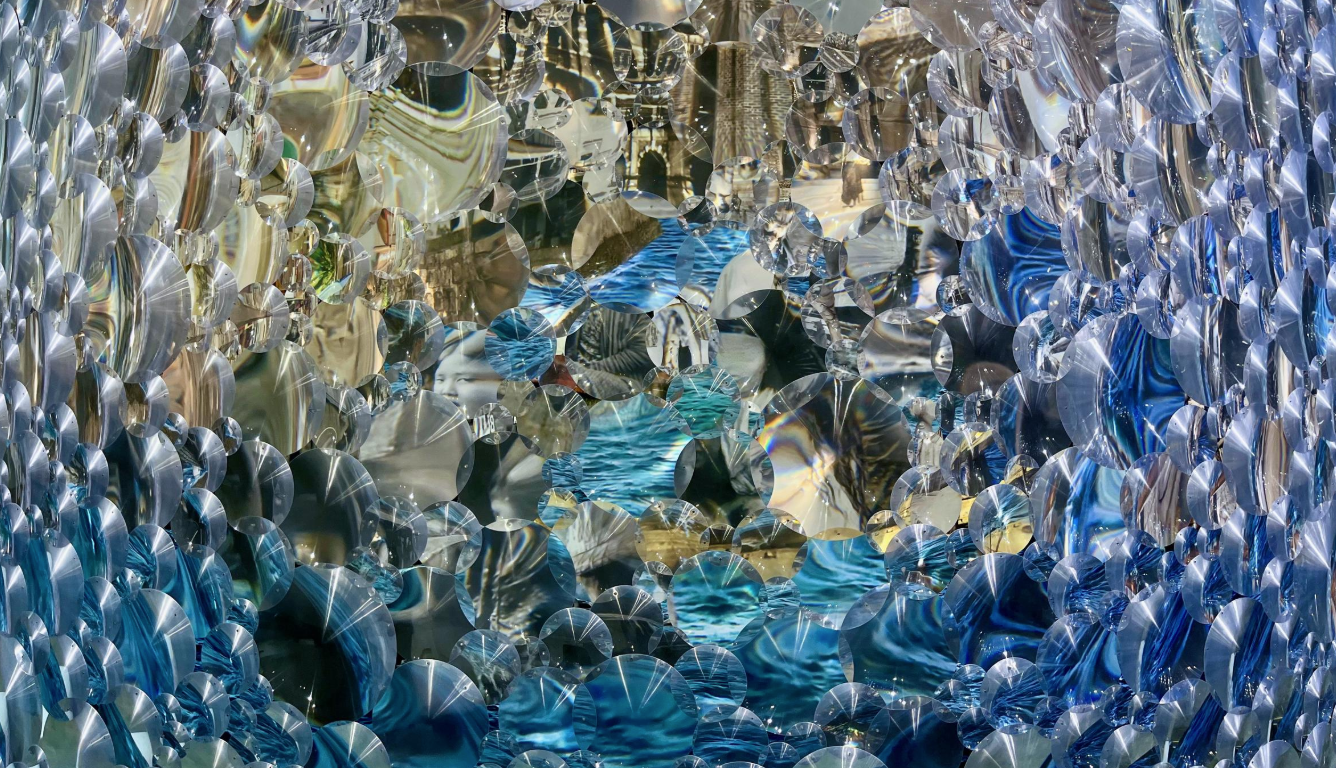
Beyond the main booth, Singaporean artist Suzann Victor takes center stage in the Encounters sector with City Lantern, a monumental kinetic installation presented by Gajah Gallery at Art Basel Hong Kong 2026. Installed at Booth EN12 within the Hong Kong Convention and Exhibition Centre, City Lantern is impossible to take in all at once—and that’s precisely the point. Measuring 3.6 metres in diameter, the work unfolds as a slow-moving panorama: a ten-metre photographic mural rotates behind a ring of nearly 2,700 Fresnel lenses, transforming the act of looking into something fluid, unstable, and deeply embodied.
At first glance, it reads as a luminous cityscape. Look closer, and the image fractures. Colonial-era photographs dissolve into contemporary scenes; buildings surface, overlap, and disappear. Across this shifting field, fragments of Southeast Asia emerge—Hong Kong’s General Post Office and Tian Tan Buddha, Manila’s Binondo Church and informal settlements, Singapore’s Golden Mile Complex and Roxy Theatre—alongside sites from across the region. Together, they form a visual geography shaped by empire, migration, and the ongoing pursuit of modernity.

Victor draws heavily from early 20th-century photographic archives—studio portraits and postcards that once circulated as tools of representation and control. Refracted through the installation’s lenses, these images lose their authority. Hierarchies blur. Narratives loosen. What was once fixed becomes contingent, dependent on the viewer’s position and movement.
This is where City Lantern reveals its deeper charge. The work doesn’t simply depict history—it destabilises it. Larger lenses trace the mural’s clockwise rotation, while smaller ones generate counter-rotations, creating the uncanny sensation of motion in opposing directions. No single vantage point offers clarity. No image can be fully possessed.

Victor, long known for probing the politics of perception—from her landmark presentation at the Venice Biennale 2001 to her participation in the Havana Biennale—extends her lens-based practice here to an architectural scale, in collaboration with Yogya Art Lab. The result is both optical and emotional: a work that operates as image, environment, and experience all at once.
More than a spectacle, City Lantern becomes a space of encounter—true to the spirit of its Encounters setting. It invites viewers to navigate histories of visibility and invisibility, to confront how images have shaped understandings of Southeast Asia, and to consider what remains unseen. In doing so, it transforms the lantern into something more than an object: a living archive in motion.
And perhaps that’s what lingers most. That seeing is never neutral. That history is never singular. And that Southeast Asia, like Victor’s shifting panorama, cannot be fixed into a single frame—but must be experienced as a dynamic, ever-evolving story.

At a glance, Moving Lines is an exhibition. But spend time with it, and it becomes something else: a meditation on belonging, transformation, and the stories we carry forward. In the context of Art Basel Hong Kong, where market forces often dictate attention, Gajah Gallery’s presentation stands out for its depth and intentionality. It doesn’t just showcase Southeast Asian art; it insists on its complexity, a conceptual monsoon which becomes immersive, unpredictable, and charged with possibility.
Photo Credit: Gajah Gallery
Moving Lines: Cartographies of Southeast Asia is on view at Booth 1B39 and EN12 from 27th – 29th March 2026. More information available here
 Bakchormeeboy