
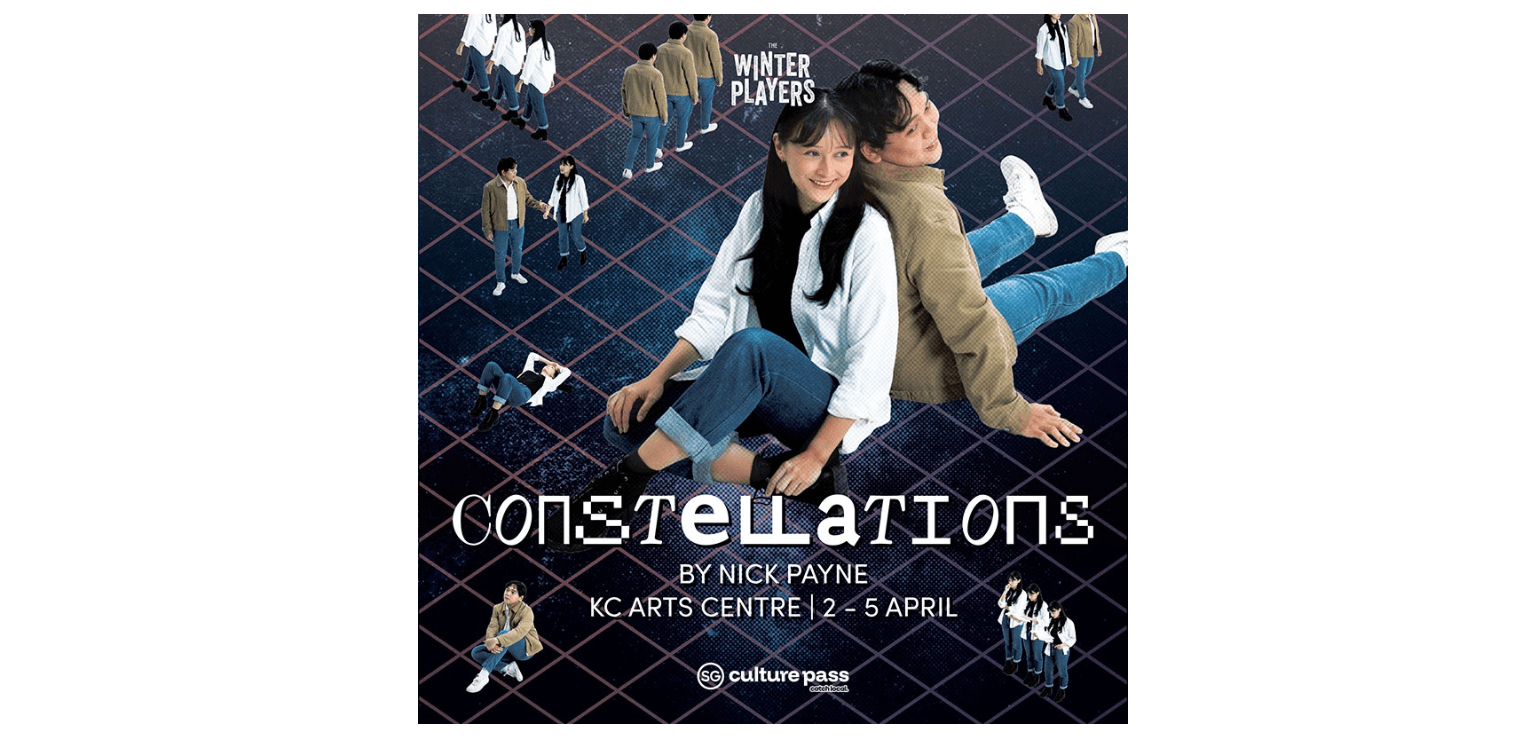
Fresh off a string of sold-out productions, The Winter Players are charting new territory with Constellations, their first contemporary work and the opening production of their 2026 season. Known for staging classics like Hedda Gabler and Shakespearean comedies, the youth-led collective now turns to Constellations, a modern theatrical favourite that bends time, space, and emotion into a meditation on love’s infinite possibilities.
At the helm is Marwyn Ho, who takes on the dual role of co-director and performer in this intimate, structurally daring two-hander. In our interview with him, Marwyn reflects on why this “modern classic” felt like the right next step for the company, how his team is reimagining the play’s multiverse through a distinctly Singaporean lens, and the challenges of navigating both director and actor roles. He also shares insights into The Winter Players’ evolving artistic identity, their residency with Singapore Repertory Theatre, and what lies ahead for the collective as they continue to push the boundaries of contemporary theatre-making. Read the interview in full below:
Bakchormeeboy: Constellations seems to mark a shift from The Winter Players’ previous repertoire of classics like Hedda Gabler and Shakespeare—what drew you to this contemporary piece at this point in your journey? Has that then affected the way you read it, or approach direction?
Marwyn Ho: Constellations will be the first play in our 2026 season. Due to grant cycles and the unpredictability of funding, we aren’t able to announce seasons in advance. But we hadn’t planned to withhold this information, so now’s as good a time as any to tell someone!
In the coming year we are staging Agatha Christie’s magnum opus, And Then There Were None, and another of Shakespeare’s finest comedies, Twelfth Night. This year, I wanted to expand the breadth of what we present, so we begin with what I would consider a modern classic. “Classic” is, of course, a subjective term. What defines a ‘modern’ classic? I would define it in my own terms as: the best plays from our time.
Every theatre student and director anywhere knows Constellations. I was once on exchange in Romania while I was a LASALLE student in 2023, and Constellations was the thesis piece chosen by a directing student there. A lecturer who was giving us a tour of Romania performs in a recurring production of Constellations in Bucharest every two years. I first encountered it as a student at SRT’s Young Company in 2018, and I was also told recently that it is the practice text used at NYU’s TISCH, for directing students. Unfortunately, I was a little too young to catch SRT’s staging of Constellations, and I couldn’t afford it on my paltry polytechnic allowance!
Constellations is one of the most innovative plays in the genre of ‘scientific theory meets theatre’. (Others include but are not limited to: Tom Stoppard’s Arcadia and Jean Tay’s Everything But The Brain). In every interaction I have had with the play, I was moved and shaken by the sheer beauty and genius of the writing. For me, it is a landmark in playwriting history. So when I decided that we were going to do a modern classic, Constellations was the only choice for me.
With Constellations being a very contemporary play, I wanted as much as possible to push the theatre and my design team to their limit. For this production, we focused very much on how we could make this extremely irregular play living, breathing, and exciting. We are working with multimedia for the first time, with multimedia artist Maximilian Liang, who has been an absolute joy to work with. Our lighting designer Andrew Wijaya designs not only theatre lights, but also for clubs as well. They work in tandem with electronic music composer Elliott Tan, and sound engineer Usaid Abdul Rashid. This is also my first collaboration with Vagabond Design Studio’s Reyn and Tong, who have fleshed out a beautiful set for me. The ultimate instruction for my team with this production was: “Go crazy.” And they have. I’m looking forward to presenting Constellations in a universe that is volatile, reactive, and constantly shifting.
Bakchormeeboy: This is a play that’s been widely staged internationally, and even previously produced by Singapore Repertory Theatre themselves; did you consciously engage with or watch past versions, or did you make a deliberate choice to approach it from a completely fresh perspective? Is it even possible to make something completely original without subconscious influence?
Marwyn: For many directors and actors, engaging with previous productions while working on a play is almost a cardinal sin—for good reason. It can lead to subconscious imitation, lock actors into choices made by others (especially those they admire), and create doubt within the team about their own originality. I have fallen victim to this many times before as well!
But to address your question directly first, I don’t think it is possible to create a completely original production of Constellations anymore, unless that was a production team’s explicit goal. There are simply too many stagings of Constellations that exist.
That, however, isn’t a deterrent. Every staging of a play, unless the intention is to make a replica version, such as touring productions from Broadway, has to start from the basics, from interpretation. By virtue of the TWP production team being young Singaporeans, we already interpret the script differently from all the productions that have come before us. Our cultural and social sensibilities inevitably shape how we understand the text.
Without spoiling too much, our version reimagines how the multiverse is experienced, and will be something audiences may not have seen before, especially if they’ve watched the play in London or Singapore. Together with my designers, we will build a multiverse that pulses, reacts, and evolves, one that you don’t just watch, but feel. Whether it works is for the audience to decide—but it has freed us from comparison.
Bakchormeeboy: You’re both directing and acting in this production; how do you navigate wearing both hats, especially in a play as emotionally and structurally intricate as Constellations, and how do you shift between the director and actor hat, especially when interacting with Juliana?
Marwyn: At any given time, I would always prefer to do just one thing at a time. It is an exceedingly difficult task to navigate acting and directing at the same time, and not something I’d recommend to anyone. I only do it out of necessity, and only when I have a firm enough directorial vision.
Much Ado About Nothing, although twice the length of Constellations, was a far easier task because of the differences in writing styles. You will find that in Shakespeare’s plays, intentions and how a character feels about another character are often explicitly expressed to the audience via dialogue or, even more clearly, a soliloquy. You don’t have to work too hard at trying to figure out what a character is thinking in a Shakespeare piece, because Shakespeare tells you. Constellations, on the other hand, is very much a modern play, with much more analysis of scenes before we can determine intent and tone.
Thankfully, this time, I am not alone! Working on this production with me are my co-director Michaela Leong, dramaturg Stephen Rowland, and intimacy coordinator Namrata Juneja. My team has been instrumental in supporting the acting process for Juliana and me. For this production, I took the lead more in establishing big-picture questions like how the play will be presented, how the production design will play out, while Michaela has focused on making sure I’m not rubbish on stage!
I also cannot understate how vital an intimacy coordinator has been for this project. I’ve worked with Juliana before on Much Ado About Nothing, so we thankfully already had a strong working relationship. But navigating (if I remember correctly) seven different instances of “Marianne kisses Roland” and “Roland kisses Marianne” would have been painfully awkward without the guidance of our intimacy coordinator, Nam. Physical intimacy is one thing; the act of kissing is straightforward, but the emotional intimacy required to make it feel real is another layer entirely. Nam has been instrumental in helping us navigate the often intense emotional journeys the characters go through in this play.
Bakchormeeboy: Constellations explores love through the lens of infinite possibilities and parallel universes. How did you approach portraying love in this production, and how does it differ from more conventional love stories on stage? Do you have any personal favourite love stories, whether in theatre, film, or literature, that influenced or contrast with your approach to Constellations?
Marwyn: On first glance, one of the main themes of Constellations is the concept of infinite possibilities and the randomness associated with that. While working on the play, however, I’ve come to realise that the story is actually a highly curated experience. One way to present the play is to construct as many different versions of Marianne and Roland as possible, in search of how vastly different the same lines can be played by the same person. This, of course, is an absolute delight, and a director’s playground in how creative they can be.
Our goal for this production, however, after realising that the sequence of scenes isn’t random, but a curated series of successful and unsuccessful attempts at connection, was then to search instead for how a single person can change on a given day due to a set of variables that include “What time is it?”, “How is the weather?”, or “What has just happened before this?” So the exciting part has now become: How consistent can we make the characters, while having the story unfold in scenes that are vastly different?
One of my favourite romance films by far is Wong Kar Wai’s In The Mood For Love, an entire 100-minute meditation of ‘will they, won’t they.’ Unfortunately, Roland is a little too awkward for me to draw any inspiration from smokey Tony Leung as an actor. A film that I did draw inspiration from is Everything Everywhere All At Once, which also coincidentally explores the concept of the multiverse. What I loved in particular was not about how they handled parallel universes, impressive as it was. My main inspiration is how one of the central themes of the movie is the importance of communication. Something as simple as communication, regardless of the information delivered, can become the catalyst for destruction or success in any given relationship. Ke Huy Quan’s words as Waymond Wang: “Please, be kind. Especially when we don’t know what’s going on,” are at the heart of my directorial thinking, for determining which universes see Marianne and Roland having a future together, and which don’t.
Bakchormeeboy: Audiences today have so many entertainment options, and Constellations plays for just one weekend. What do you think makes Constellations a particularly compelling theatre experience right now?
Marwyn: It is wonderful to see the arts and entertainment flourishing in Singapore. This is the way it should be. What Constellations offers is contemporary, cutting-edge theatre. The Winter Players are a group of young theatre-makers driven by a love for the craft, but also relatively unburdened by tradition. What you will get when attending Constellations is some of the best writing the world has to offer, presented by a vibrant team exploding with innovation and excitement. We’ve really only just started in our journey—still learning, and testing boundaries—and Constellations is an invitation to audiences to be part of that process, to explore the depths of love and grief with us in 80 loaded minutes of live, raucous theatre.
Bakchormeeboy: As a Company-in-Residence with Singapore Repertory Theatre, what opportunities has that support opened up for you, and how do you see the rest of your residency unfolding? Is there such a thing as too many theatre companies in Singapore?
Marwyn: SRT has been a nurturing force for us. Beyond the invaluable material sponsorship like access to their rehearsal space and theatre, what they have also provided is levels of apprenticeship that I don’t believe can be found anywhere else in Singapore, or even Asia, as far as I’m aware. They have effectively shown us the ropes for how a professional company is run, answering every query we have had, and allowing us access and insights into their network, programmes, and practices. Our final production in-residence with SRT will be Agatha Christie’s And Then There Were None, which will play at the KC Arts Centre.
We are certainly in interesting times right now, with the oncoming departure of one of Singapore’s leading theatre companies. I don’t really have an opinion on whether the theatre market is saturated, but what I do know is that theatre will continue to thrive. The next generation will continue to fall in love with the work of the people who came before them and will continue to want to create work of their own.
Bakchormeeboy: Looking beyond this production, what’s next for The Winter Players, and how do you envision the company evolving after your residency ends?
Marwyn: We hope to continue staging the works we love for as long as it’s possible for us to do so, and we remain deeply grateful for every bit of support from our audiences and collaborators that allows us to keep going.
When we get the chance to, there is a series of plays we would love to bring to life in the future — works my dear friend and founding Co-Artistic Director, Shahid Nasheer, left with me before he passed. They include works by the playwrights Sophie Treadwell, Molière, Alexander Ostrovsky, and Nikolai Gogol. I won’t spoil which ones, but if you know, you know! In the meantime, we hope to build meaningful relationships and partnerships with people and institutions who are interested in celebrating plays, literary arts and masterworks of literature from across the world.
Constellations plays from 2nd to 5th April 2026 at the KC Arts Centre. Tickets available from BookMyShow
 Bakchormeeboy