
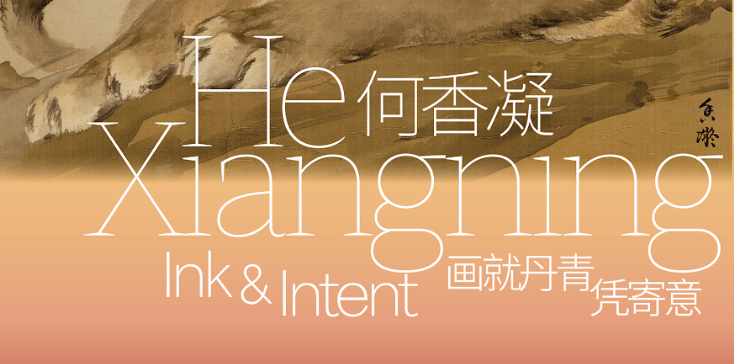
Before she became a name in art history, He Xiangning was already living an extraordinary life. Born in 1878, she was not only a painter but also a revolutionary, a political figure, and a fierce advocate for women’s rights. She was among the first women to join the revolutionary alliance led by Sun Yat-sen, and later organised one of China’s earliest International Women’s Day rallies.
But perhaps what makes her story so compelling is this: she never saw art and activism as separate pursuits. For He Xiangning, painting was a way to shape the world—just as much as politics was. National Gallery Singapore, in collaboration with the He Xiangning Art Museum, presents He Xiangning: Ink and Intent, the first retrospective in Southeast Asia dedicated to the pioneering 20th-century Chinese woman ink artist.

Opening on 1st April 2026, the bilingual exhibition features over 50 artworks presented across four chronological sections, tracing He Xiangning’s (何香凝) remarkable life and artistic practice over seven decades. Specially adapted for its presentation in Singapore, the exhibition highlights the artist’s historical connections with Southeast Asia, inclsuding her visits to Singapore and the Philippines in 1929, where she staged charity art exhibitions with the support of local and overseas Chinese communities. At Ink and Intent, now showing at National Gallery Singapore, her life unfolds not as a timeline on a wall, but as a journey you can walk through, room by room, idea by idea.
Dr Eugene Tan, CEO and Director of National Gallery Singapore says, “Ink has always been a key research and curatorial focus for the Gallery. We have had the privilege of presenting in-depth exhibitions on ink masters such as Wu Guangzhong and Liu Kuo-Sung. Presenting Southeast Asia’s first retrospective dedicated to He Xiangning is therefore a deeply significant milestone. We hope visitors will gain a deeper appreciation of her pivotal contributions to modern Chinese ink painting and her enduring legacy as a pioneering woman artist of the twentieth century. This collaboration with He Xiangning Art Museum also reflects the Gallery’s continued commitment to advancing ink scholarship and fostering meaningful dialogue between Singapore, Southeast Asia, and the wider world through collaborative research and exhibitions.”

The exhibition begins with He Xiangning’s early years, when she travelled to Japan to study art, an uncommon path for a woman at the time. In 1903, He Xiangning travelled to Japan with her husband, Liao Zhongkai, an early member of the Kuomintang. Recognising the potential of art as a tool for the revolutionary cause, Sun Yatsen – who would later become the first president of the Provisional Government of the Republic of China – encouraged He to pursue artistic training. She first studied animal painting under Japanese imperial court painter Tanaka Raishō before enrolling at the Private Women’s School of Fine Arts in 1909, becoming one of the earliest Chinese female artists to study art in Japan. He’s artistic practice was largely influenced by her career. Her depictions of lions and tigers served as an expression of national strength and revival and are finely detailed and attentive to visual modulation and atmosphere, a departure from the classical literati painting, which would later influence the naturalism and realism styles of the early 20th century.

The exhibition opens with In Remembrance of Shuangqing Studio (1878-1925), which pays homage to the first marital home shared by the artist and her husband, known as Shuangqinglou. This name reflects moral integrity and purity often associated with the moon. The section introduces visitors to He’s time living with her husband in Japan, including her early paintings and archival materials that highlight her involvement in Tongmenghui, a society aimed at the overthrow of the Qing dynasty. She was among the first women to join the movement. Her paintings of lions and tigers feel strikingly different from traditional Chinese ink works. Their fur is rendered with unusual realism, their bodies grounded in space. This wasn’t accidental. Exposure to Japanese and Western techniques introduced her to a new visual language, one that would become central to her practice.
Tiger (1910) and Lion (1914) exemplify He’s early artistic practice, which was influenced by the naturalistic and realistic styles prevalent in Japan during that period. However, He also incorporated her own artistic expression, combining the techniques of xieyi – the freehand brush tradition in Chinese painting – with elements of Western realism to create vivid and lifelike depictions of the animals. The seal impression on Lion reads Shuangqinglou, referencing her first marital home as well as a line from one of her early poems that read “May this night return year after year, with both people and the moon in purity and clarity.” At a time when China was in political upheaval, even these early works hint at her dual identity as artist and revolutionary.

As you move into the next space, the tone becomes more introspective. After the death of her husband, Liao Zhongkai, He Xiangning stepped fully into her own identity, not just as a political figure, but as an independent artist. Disillusioned by factional strife within the Kuomintang, He Xiangning retreated from politics and moved to Shanghai, where she joined several literary and artistic groups, including the Friends of Winter Society and the Chinese Women’s Calligraphy and Painting Society. The Friends of Winter by the Shores of Baima Lake explores her practice during this time, when she made an important shift, moving away from her meticulous silk-painting style to ink on paper.
Here, familiar motifs begin to appear: pine trees, plum blossoms, chrysanthemums. Known in Chinese tradition as symbols of resilience and virtue, they become her vocabulary—subtle, but deeply intentional. One highlight is a serene moonlit landscape. Look closer, and it feels almost autobiographical. The clarity of the moon, the stillness of the scene, these echo her personal ideals of integrity and moral strength. In this room, painting becomes reflection.

Pine and Chrysanthemums (1931), the largest artwork in Ink and Intent, spans over 2.5 metres and was created in Paris, France. Within the artwork is an inscription by He Xiangning’s close friend and poet, Liu Yazi, that reflects on the people, the nation, and revolutionary heroes from 1911 to 1931. The dense pine and lightly rendered chrysanthemums are set in contrast, balancing strength with softness.
Known as the “Three Friends of Winter”, the pine, bamboo, and plum blossom are admired for their resilience in the cold, as well as their purity and steadfastness. For literati painters like He, this motif often served as a means of self-expression and encouragement when portrayed in an unrestrained and spontaneous style. Between 1928 and 1936, artists Jing Hengyi, Chen Shuren, Yu Youren, and He collaborated on this subject on several occasions but only four such works are known to survive – two of which are on display at Ink and Intent.

Then comes a turn that feels surprisingly close to home. In 1929, He Xiangning travelled through Southeast Asia, including Singapore, Manila, Penang, and Johor Bahru. In 1929, He Xiangning brought over 300 artworks to Singapore and the Philippines for fundraising art exhibitions in support of the Zhongkai Agricultural and Industrial School. Ink and Intent presents original works from the 1929 exhibitions alongside archival materials, connecting past events with present-day encounters of He Xiangning’s activities in Southeast Asia.
Among the works featured are her celebrated paintings of plum blossoms, which exemplify her distinctive artistic approach. She often began by rendering the aged trunk in dense ink with deliberate, weighty strokes, before extending new branches in lighter ink and adding blossoms at their tips. This pairing of old trunks with new growth recurs throughout her plum blossom works across her career.

Following the Manchurian Incident in 1931, He returned to China and actively participated in national civic efforts, organising the Calligraphy and Painting Exhibition for the Relief of National Crisis and mobilising artists to raise funds in support of resistance against Japanese aggression and aid refugees. The exhibition also features archival sections that provide visitors with more information about He’s practice, deepening their understanding of Chinese ink works. One of these stations is dedicated to He’s visit to Singapore in October 1929, where she attended large welcome gatherings with prominent Chinese community leaders hosted by Aw Boon Haw and Chinese Consul-General Tang Liu. Aw and Tang expressed strong recognition and appreciation for the revolutionary contributions of He and her husband and extended their support for He’s exhibition and fundraising efforts.
This section of the exhibition is really where past and present meet. Archival photographs and surviving works reveal her connections with overseas Chinese communities and cultural figures such as Khoo Seok Wan, one of Singapore’s pioneer ink artists and a prolific literary figure, reflecting her connections with prominent culture figures from Singapore’s Chinese community. One small but striking piece is an inscription she gifted during her visit. It reads simply: “Press on.” Nearly a century later, it still resonates.

The next section is heavier both emotionally and visually. War and Frontiers at Dusk shines a light on He Xiangning’s resilience, expressed through both her art and activism during wartime. Following the outbreak of the Second Sino-Japanese War after the Marco Polo Bridge Incident in 1937, He turned to art to rally morale and foster solidarity. Her paintings from 1938 to 1948 bore the symbolism of literati paintings, which were majestic and bold. As war breaks out, He Xiangning’s works take on a new urgency. Large-scale paintings are paired with inscriptions that read less like poetry and more like historical testimony, tracing the struggles of a nation in crisis.
Even when she stepped back from direct political involvement, her art continued to carry her convictions. Her recurring motifs of pine, bamboo, plum blossom become even more charged. They stand not just for beauty, but for endurance, humility, and resistance. In these rooms, you begin to see how she used symbolism to say what could not always be spoken outright.
Painted while He was living in temporary lodgings in Guangxi during the Second Sino-Japanese War, Green Plum Blossoms (1943) reflects a plain and unadorned quality shaped by harsh conditions and a scarcity of materials, which led her to improvise. Even so, she remained optimistic and relied on the sale of paintings to support herself. Reproductions of He Xiangning’s heartfelt letters to her daughter are also displayed in this section, giving visitors an intimate look at the hardships she faced and how she continued to pursue art and to rally activists.

The final section feels quieter, but no less powerful. In her later years, He Xiangning continued to paint, collaborate, and shape the direction of modern Chinese ink art. Her works from this period are confident and expansive, often created alongside other artists. Titled Longevity in Art and Life, this section looks at the later years of He Xiangning’s life and career after the founding of the People’s Republic of China in 1949. Described by He as the most contented and stable period of her life, this period saw He create artworks that explored motifs related to moral integrity and virtues, as well as landscape paintings that increasingly incorporated elements inspired by antiquity.
He also collaborated with renowned artists such as the Chinese painters Fu Baoshi, Xu Beihong and Pan Tianshou, helping to shape modern Chinese art. Here, visitors will get a glimpse of the evolution of Chinese art and the new form of literati exchange from 1949 to 1972. One story shared lingers: He and her son would sometimes “collaborate” without being in the same room. One would begin a painting, the other would complete it later. It was less about authorship, and more about connection. It’s a fitting metaphor for her life: art as dialogue, across time, across people.

The Tall Pine Stands at the Sea’s Edge (1960) demonstrates He’s mastery in capturing the purity of trees and the uniqueness of flowers within a single composition. At the request of the then 82- year-old artist, the painting was inscribed by Chen Yi, then Vice-Premier of China. Depicting the endurance of horticulture even in winter, the work is often seen as reflecting He’s own resilience and longevity. Other works in the exhibition also bear inscriptions by national leaders, including Liu Shaoqi and Shen Junru, attesting to the respect and esteem she commanded. In the same year, He was elected Chairperson of the Chinese Artists Association, becoming the first and only woman to date to hold the position since the founding of the People’s Republic of China.
Appreciating the Snow (1962) is a figure painting jointly created by He Xiangning and Fu Baoshi. Playing on each of their strengths, He adopts the willow as her motif, setting slender branches diagonally across the composition, while Fu deftly renders a lady in red who glances back amid falling snow, showcasing a natural and unified collaboration that depicts a mood of hesitation and parting. The painting is reflective of He’s continued collaboration with friends, fellow activists and artists, which continued even in the later years of her practice

By the time you exit the exhibition, He Xiangning no longer feels like a distant historical figure. She feels present all around, in the quiet strength of a pine tree, in the defiance of a tiger, in the simplicity of a handwritten “press on.” And perhaps that’s what Ink and Intent does best. It doesn’t just tell you who she was. It shows you how she thought, how she endured, and how she turned ink into something far more lasting than image.
Cheng Bin, Deputy Director of He Xiangning Art Museum says, “We are honoured to collaborate with National Gallery Singapore to present He Xiangning: Ink and Intent to audiences in Singapore and Southeast Asia. Our institutions share a commitment to fostering cross-cultural dialogue through exhibitions and scholarly exchange. Last year, we had the opportunity to present Georgette Chen: At Home in the World in Shenzhen, an exhibition that introduced visitors to the works and practices of one of Singapore’s pioneering women artists. The exhibition was extremely well-received, and we are delighted to continue our partnership with the Gallery to expand perspectives and deepen understanding of the influential women artists from the 20th century with the presentation of He Xiangning: Ink and Intent in Singapore.”
Photo Credit: National Gallery Singapore
He Xiangning: Ink & Intent runs from 1st to 23rd April 2026 at City Hall Wing, Level 4, Wu Guanzhong Gallery, at National Gallery Singapore. More information available here
 Bakchormeeboy