
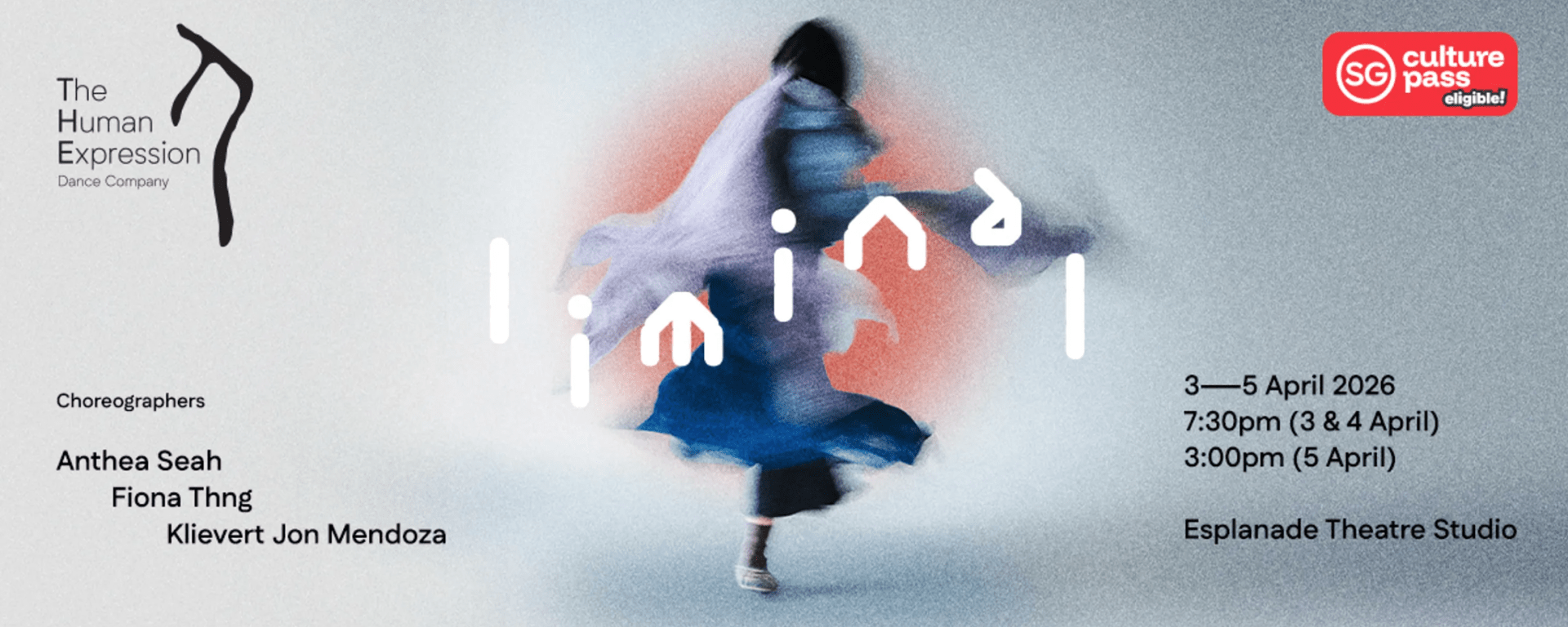
In T.H.E Dance Company newest platform, mid-career dancers explore what it means to exist in the in-between, and the movements it inspires.
With liminal, T.H.E Dance Company turns its attention to the in-between, not the polished arrival of mastery, nor the raw urgency of emergence, but the textured, often complicated terrain of mid-career artistry. As a new platform dedicated to choreographic voices in this phase, liminal brings together new works by mid-career artists. Its inaugural edition takes the form of a triple bill featuring resident choreographer Anthea Seah alongside main company dance artists Fiona Thng and Klievert Jon Mendoza. Each presents a work shaped by experiences many of us recognise: care, desire, responsibility, longing and choice.
Conceived by Founding Artistic Director Kuik Swee Boon, the platform extends the company’s long-standing commitment to nurturing choreographers beyond early development, offering artists the rare opportunity to create with a professional ensemble at a pivotal stage in their lives. These are artists in transition navigating parenthood, identity shifts, and evolving personal philosophies. In liminal, those lived experiences are not just backdrops; they are the work itself. What unfolds across the evening is not a set of neatly resolved ideas, but something far more compelling: three deeply human encounters with change.
The Rooms Inside – Fiona Thng

From the very first moment, Fiona Thng’s The Rooms Inside draws us into a world that feels at once intimate and unsettling. A beam of light reveals a body low to the ground, not quite crawling, but inching forward with an almost worm-like precision. Every movement is deliberate and controlled. When a second dancer enters, the dynamic shifts immediately: one moves with urgency, the other with restraint. The contrast is jarring, even slightly disorienting, yet it begins to form a strange logic of its own.
What we are witnessing is not meant to be literal. As dancers Klievert Jon Mendoza and Chang En come into contact, their bodies fold and blur into one another, punctuated by audible grunts that make the encounter feel raw, almost intrusive. Their shadows later stretch across the space, introducing a second layer of perception, a reminder that what we see is only one version of reality.
There is something quietly masterful in the restraint here. The choreography never rushes. Instead, it lingers, allowing us to notice the curvature of a spine, the tension in a held position, the effort required to sustain closeness, evident from their revealed legs, muscles tensed and working overtime. The physical proximity between the two dancers is striking, not just for its difficulty but for its emotional weight. It looks easy but takes so much effort, an immense amount of work that goes into a programme like this.

The soundscape shifts between ominous and strangely futuristic, yet remains oddly comforting. Within this evolving environment, the dancers carve out a world of their own, one that feels both expansive and deeply internal. Moments of unexpected humour surprise us, subtle but effective, drawing gentle reactions from the audience. It mirrors the choreographer’s own reflections on motherhood: confusing, tender, exhausting, and occasionally absurd.
When Chang En is left alone, panting, breathing in sync with the sound, the emotional core of the work becomes undeniable. There is grief here, and fatigue, but also perseverance. Even as one body seems to resist or overwhelm the other, there is an awareness, a negotiation, a gradual coming together. The ending arrives abruptly, unresolved. But perhaps that is the point. Motherhood, as choreographer Fiona Thng suggests, is not something that concludes; it is something constantly unfolding.
Laya – Klievert Jon Mendoza

If The Rooms Inside is internal and intimate, Laya expands outward into something more abstract, almost philosophical, though not always with the same clarity of emotional grip. Lighting plays a defining role from the outset. A single illuminated hand emerges from darkness, drawing focus to gesture before form. As the stage opens up, scattered globes like futuristic baubles create a surreal landscape, suggesting a world that is at once dreamlike and disorienting. Visually, the work is striking, immediately establishing a distinct atmosphere.
At the edge of this world, a figure (Michail Logothetis Alafragkis) watches. This sense of observation, of being seen, or perhaps judged, lingers throughout the piece, but remains somewhat elusive in intention. As dancers Chang En and Carmelita Nuelle Buay interact, relationships shift subtly: a bauble is passed, a transformation begins. When the central figure dons a costume under stark lighting, her presence alters dramatically, almost monstrously, as though desire itself has taken shape.
There is no shortage of ideas here. The spilling of globes from the body suggests excess, consumption, even consequence, and come together to form compelling images that hint at a deeper inquiry into longing and control. Yet at times, these visual metaphors feel more suggestive than fully developed, accumulating rather than converging into a clear choreographic argument.

The score is both cinematic and original, and lends the work a sensual, immersive quality. It creates space for reflection, allowing the audience to sit with ambiguity. However, this openness can also create a sense of distance. Where the piece invites contemplation, it occasionally withholds emotional access, making it harder to fully invest in the dancers’ journey.
There is intention in the restraint, and ambition in the scope. Laya resists easy resolution, positioning itself as a meditation on desire, choice and surrender. But while it asks compelling questions, it does not always sustain the tension needed to carry them through. Still, there are moments where the work lingers, whether in an image, a shift, or a sensation, suggesting a choreographic voice that is searching, and on the cusp of something more sharply defined.
Ma – Anthea Seah

Closing the evening was Anthea Seah’s Ma, which shifts the tone inward once more, this time with striking emotional clarity. The stage begins in darkness. Performed by Fiona Thng, she begins by rocking gently, whispering. When she sits, a rectangle of light frames her space, contained, almost restrictive. As she begins to move, there is an immediate sense of tension, as though her body is bound, struggling against invisible constraints.
The imagery is visceral. At moments, her movements resemble someone trying to break free from a straitjacket, controlled yet desperate. The soundscape weaves together the ominous with the familiar, grounding the piece in everyday experience even as it explores more abstract emotional states.

A particularly compelling element is the use of projection. Her shadow takes on a life of its own, extending and transforming her presence. It becomes another self, perhaps past, perhaps future, perhaps inherited. This duality adds depth to the narrative, offering multiple ways of seeing the same body.
As the piece progresses, emotion surfaces more directly. Frustration, exhaustion, and release move through her in waves. And then, a shift. After the intensity comes stillness, as the sound of a baby murmuring emerges, and it feels tentative and searching. It is deeply personal, almost disarming in its intimacy. In that moment, the work crystallises, turning lived experience translated into movement. By the time she lies still, absorbed in her own space, the journey feels complete, not in resolution, but in honesty. It is raw, reflective, and unmistakably human, and dovetails well with Fiona’s earlier The Rooms Inside and her own experience of motherhood.
What liminal ultimately offers is not spectacle, but presence. Across all three works, there is a shared commitment to lived experience and individual perspective, to bodies that carry memory, tension, and transformation. These are choreographies that ask us to look closer, to sit with discomfort, and to recognise ourselves in the in-between. In creating this platform, Kuik Swee Boon and T.H.E Dance Company have opened up a vital space within Singapore’s dance landscape, one that acknowledges that artistic growth does not end with emergence; it is consistently evolving through the complexities of adulthood. If anything, liminal reminds us that the middle is where the real work happens. Not the beginning nor the end, but the quiet, shifting space where we are still becoming.
Photos Courtesy of T.H.E Dance Company
liminal played from 3rd to 5th April 2026 at the Esplanade Theatre Studio. More information available here
Production Credits:
| The Rooms Inside Choreographer Fiona Thng Sound Artist/Composer Vick Low Performers Klievert Jon Mendoza, Chang En Laya Choreographer Klievert Jon Mendoza Performers Chang En, Carmelita Nuelle Buay, Michail Logothetis Alafragkis Ma Choreographer Anthea Seah Composer Hee Suhui/Anise Multimedia Content Artist Artania Raharso Performer Fiona Thng Production Manager Victoria Wong (The Backstage Affair) Costume Designer Angeline Oei Lighting Designer Adrian Tan Stage Manager Lee Xinzhi |
 Bakchormeeboy