
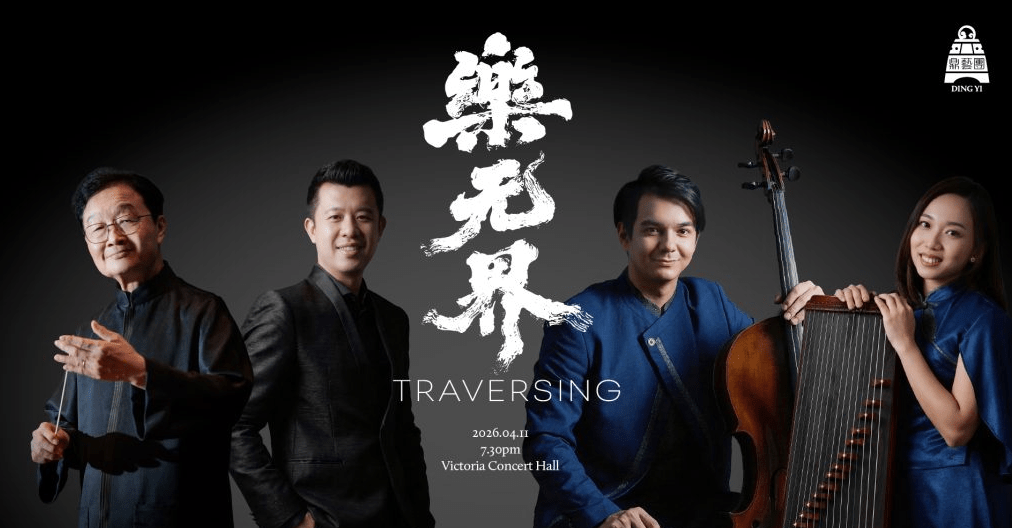
Ding Yi opens their 2026/27 season with a bold, celebratory selection of works that shows off the chamber ensemble’s capabilities and global vision.
Opening its 2026/27 season, Traversing by Ding Yi Music Company makes an ambitious artistic claim: that a Chinese chamber ensemble can be not only rooted in tradition, but also be expansive, borderless, and globally resonant. Under the direction of maestro Tsung Yeh, the concert unfolds as both a statement of identity and an invitation, to hear familiar histories refracted through new cultural lenses.
Primarily, the programme focused on growth of sound, of collaboration, and of what a chamber ensemble can be. The result goes beyond a showcase of repertoire, becoming a living demonstration of how a collective can develop a distinct voice while remaining open to the world.
The evening opened with Sing a Pura by Su Xiao, a work that feels almost mythic in scope. Drawing inspiration from Singapore’s symbolic Merlion, the piece evokes storms, seas, and origin stories. It unfolds with an epic sensibility, like the dawning of a new day, or even the rise of a nation, yet never loses its introspective core. There is a quiet elegance here, mirroring the city itself: layered, reflective, and deeply aware of its place in time. It sets the tone for the concert’s central idea, where music is an ongoing dialogue between past and future.
If Sing a Pura establishes scale, Tang: Moonlit Fragrance by Koh Cheng Jin brings narrative vitality. The work moves with striking clarity between contrasting scenes: from the poised lyricism inspired by Li He to a vibrant, almost unruly court banquet. The music is jaunty and kinetic, propelled by percussion and strings that conjure dance, motion, and ritual. One can almost see the Sogdian Whirl, inspired by dancers spinning at the speed of wind, rendered in sound. It is storytelling at its most immediate and visceral, capturing both refinement and abandon in equal measure.
The first half of Traversing culminates in Goddess of the Luo River by Tang Jianping, featuring guzheng soloist Yvonne Tay. Visually and musically, Tay is a star who embodies the work’s fluidity, her outfit and presence as shimmering and continuous as the river itself. Her command of the instrument is striking – she displays mastery over the guzheng, and gives it a voice that is at once plaintive and luminous, showcasing a range of techniques that showcases all the emotions the instrument can produce. Inspired by Cao Zhi’s rhapsody, the concerto unfolds like a dream: ten interconnected sections that move between fantasy and emotional intensity. The result is a tapestry of fleeting beauty, where the boundary between the human and divine feels tantalisingly close, yet ultimately unreachable.
After the intermission, the programme shifts in tone. If the first half is concerned with epic narrative and myth-making, the second becomes celebratory, but no less demanding, just more outwardly exuberant. This is immediately apparent in Hungarian Rhapsody, Op. 68 by David Popper, featuring cellist Bekhzod Oblayorov in an arrangement by Jon Lin Chua. Oblayorov shows off deft skills, able to keep up with the ever-increasing pace and intensity of the piece, his bow moving rapidly and confidently. The work is a tour de force of technical brilliance, filled with rapid passages, sharp articulations, and escalating intensity. Yet what makes this performance compelling is not only its virtuosity, but also the act of transformation: the Chinese chamber ensemble reframes the piece’s Romani and Hungarian roots through its own timbral palette, revealing unexpected affinities between musical traditions.
That cross-cultural dialogue continues in Celtic Knots by Eric Watson, one of the evening’s most immediately enjoyable works. Drawing parallels between Celtic and Chinese knot patterns, the piece weaves together folk melodies into an intricate, interlocking whole. Familiar echoes, at times clearly using parts of the celestial You Raise Me Up or even heavier In the Hall of the Mountain King, surface and recede, creating a sense of playful recognition. It is celebratory and deeply human, a reminder of how cultures, like melodies, can intertwine without losing their identity.
The concert closes with Piano Concerto: Youth by Liu Shikun and collaborators, featuring pianist Ning An. Here, the energy is unmistakable. Ning An plays with intensity and precision, each strike of the keys lifting the ensemble with renewed momentum. The work’s fusion of folk material and Western concerto form feels emblematic of the entire programme: a synthesis that generates new colours rather than diluting either source, and the concert ends with warm, appreciative applause.
And throughout the evening, one figure stands out quietly but unmistakably: Tsung Yeh himself, whose sprightly, nimble presence on the podium belies his years. His direction is both assured and generous, allowing the ensemble and its collaborators to shine while maintaining a cohesive artistic vision.
Ultimately, Traversing is a statement of possibility. It demonstrates Ding Yi Music Company’s remarkable versatility in repertoire, and its ability to bring together composers, soloists, and traditions into a unified artistic experience. This is what gives the ensemble its unique identity: not a fixed sound, but a capacity for limitless collaboration. This is perhaps more important than ever in a world that feels increasingly fragmented. Traversing then offers a different perspective: that there is still immense beauty in connection, in exchange, and in the act of making something together.
Traversing 《“樂”无界》 played on 11th April 2026 at Victoria Concert Hall. More information available here
 Bakchormeeboy