
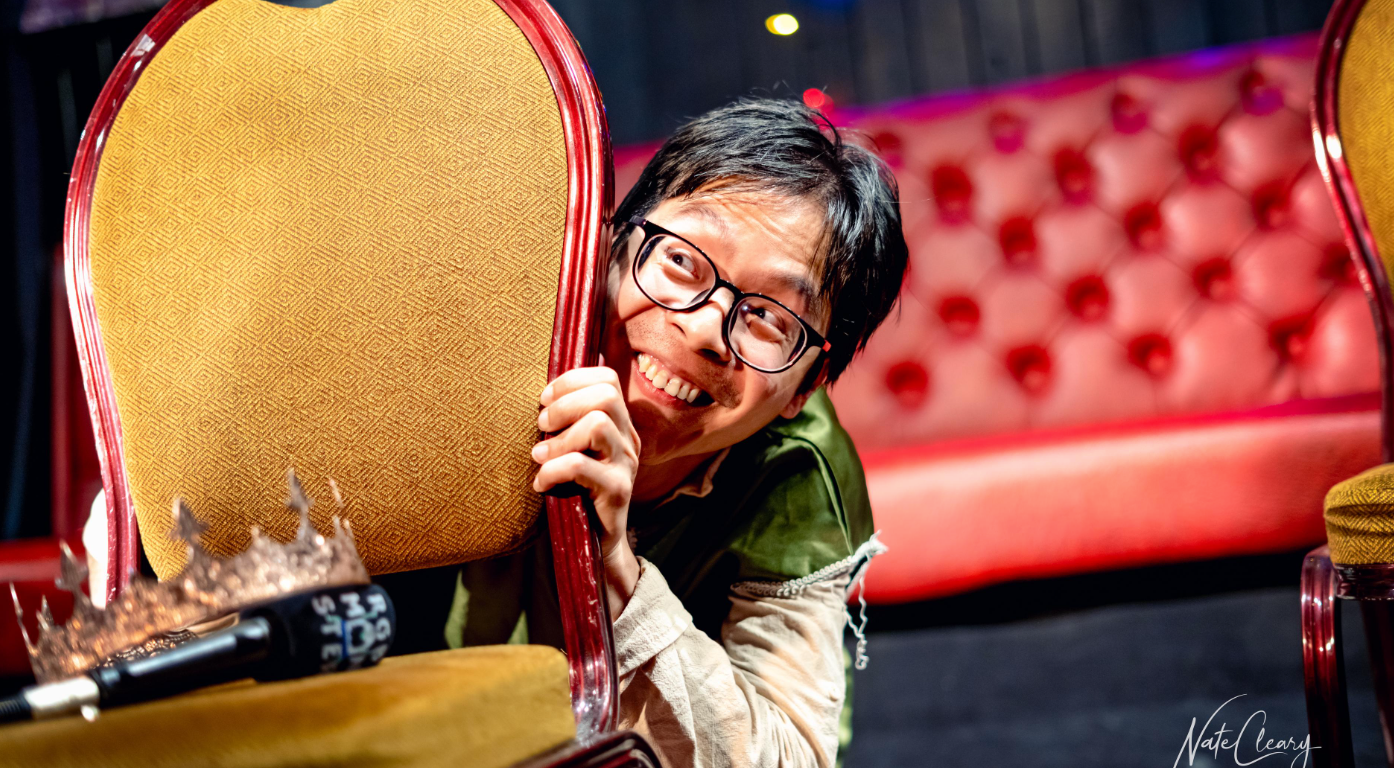
Who lives? Who dies? You decide, as Sam See’s Off With Your Head turns comedy into a full-scale medieval uprising.
From the moment Off With Your Head begins, there is already a sense that this is not going to be a conventional comedy show. The room feels light, easy-going and strangely intimate despite the scale of audience participation required throughout the night. Hosted by Sam See, alongside visuals by Benedict Lim and royal advisors Daisy Mitchell and Jayden Lim, the show immediately throws the audience into its medieval fantasy world, and from there, control belongs entirely to the crowd.
Before it even properly starts, Sam See establishes a playful atmosphere that encourages the audience to relax into the absurdity ahead. It is welcoming without ever feeling passive. Part improvised comedy show, part tabletop role-playing game, part game show, Off With Your Head feels unmistakably like a Sam See production. The humour is conversational, current, and reactive. One moment the audience is discussing colonisation, the next it shifts into consent jokes or absurd fantasy politics. It is constantly evolving depending on who speaks, who rolls the dice, and who survives. Everyone in the room quickly understands that this isn’t the kind of show you sit around idly. Instead, we are participants, decision makers, executioners and supporters in a live piece of improvisational theatre disguised as chaotic comedy. The production immediately succeeds because it creates trust between performer and audience, allowing complete strangers to throw themselves into improvised medieval chaos without hesitation.

Framed within a fictional 12th-century throne room, the production combines improvisational comedy with tabletop role-playing mechanics, constantly evolving performance system rather than a traditional game structure. Yet despite the fantasy setting, the humour is deeply contemporary. Conversations move fluidly from colonisation to consent, from political satire to complete nonsense, all without losing momentum. The unpredictability of the format becomes the central appeal of the show. No one fully knows where the story is heading, not the audience, not the players, and seemingly not even the performers themselves. Every roll of the die creates a new crisis, a new narrative branch and another opportunity for the room to collectively descend further into chaos.
What makes the structure compelling is its deceptive simplicity. Rulers must maintain favour while navigating increasingly surreal scenarios. A score dropping to zero results in death, but becoming too popular can also be dangerous. This constant instability creates a rhythm of tension and release that sustains the improvisation throughout the night. The audience becomes an active dramaturgical force, shaping tone, stakes and direction through reaction alone. In practice, this is more akin to a live experiment in collective storytelling, where audience behaviour directly functions as narrative authorship. Every roll of the die functions less as a game mechanic and more as a catalyst for spontaneous theatrical invention.
The first ruler’s downfall, played by the esteemed Jayden Lim establishes the rhythm of the evening. One moment a king appears secure, and the next the audience has turned against him completely. As new rulers are selected from the crowd, the atmosphere continuously reshapes itself depending on the personality of whoever ascends the throne. When Queen Alphaba rises, the room immediately leans into the theatricality of his reign. Much of the humour emerges not simply from scripted prompts, but from watching ordinary audience members attempt to navigate impossible leadership situations under intense public scrutiny. The production understands that embarrassment alone is not enough to sustain comedy; instead, it builds scenarios that encourage collaboration between performer and participant, allowing improvisation to feel playful rather than cruel.

After intermission, the show returns with a recap that only further emphasises how wildly the narrative has spiralled. Following the death of Queen Alphaba, Daisy Mitchell steps forward as Queen Babes, bringing a completely different energy into the room. Complaints from peasants escalate, scenarios become increasingly absurd, and the pressure placed on the rulers intensifies dramatically. Those chosen to lead are forced to think quickly, react constantly and maintain favour while navigating situations designed to overwhelm them. The audience remains central throughout this process. Their approval or rejection dictates survival. Every boo carries weight. Every cheer changes momentum. The production cleverly turns audience reaction into a live scoring system, providing a real-time feedback loop that actively writes the performance in front of us.
One particularly effective aspect of the production is how the mechanics evolve alongside the dramatic escalation. As the game progresses from six-sided dice to eight-sided and eventually twelve-sided dice, the sense of danger and unpredictability increases with it. Even though the entire premise is intentionally ridiculous, the rising complexity creates genuine suspense. The audience begins anticipating disaster before each roll. The format continuously refreshes itself before repetition can set in, allowing the show to sustain energy across its runtime without feeling structurally exhausted. What appears effortless is in fact a tightly held improvisational structure that demands exceptional timing, awareness and audience reading from everyone on stage.
What ultimately anchors the production is Sam See himself. Improvised interactive theatre requires a performer capable of simultaneously managing pacing, audience psychology and comedic timing, and Sam demonstrates a strong command of all three. He understands how to guide audience participation without over-controlling it, allowing the room to feel spontaneous while quietly maintaining structure underneath the chaos. More importantly, he understands how to build camaraderie. The audience gradually transforms from individual spectators into a temporary community united by shared jokes, collective decisions and mutual investment in the unfolding nonsense, having built a sense of shared ownership, turning what could have been passive spectatorship into a collective act of co-creation.

The production also reflects Sam See’s evolution as a performer. Having spent recent years challenging himself internationally, particularly in the UK comedy circuit, there is now a noticeable confidence and elasticity to his stage presence. He appears increasingly comfortable allowing uncertainty to become part of the performance rather than something to avoid. That willingness to embrace unpredictability gives Off With Your Head much of its charm. The show does not aim for polished perfection; instead, it thrives on the disciplined management of chaos through improvisational skill.
Staging the production at Avant-Garde Art Space also feels significant. As an independent arts space that encourages experimentation and alternative performance formats, it provides exactly the kind of environment this production thrives within. There is a sense of openness within the venue that complements the show’s participatory nature. Under the stewardship of founder Mario, spaces like Avant-Garde Art Space continue to offer artists room to take creative risks while fostering genuine community engagement within Singapore’s arts scene.
Off With Your Head succeeds in spite of its unpredictability; it is carefully structured chaos executed through high-level improvisational theatre and comedy craft. It is loud, unexpected, interactive and deeply silly, yet beneath all the absurdity is a production carefully built around trust, collaboration and performance instinct. In a comedy landscape increasingly reliant on polished stand-up formats, this production stands out by reminding audiences how thrilling live unpredictability can still be.
Photo Credit: @nate_cleary
Find out more about Sam See’s upcoming dates and venues here, and follow him on Instagram here


One thought on “★★★★☆ Comedy Review: Off With Your Head by Sam See”