
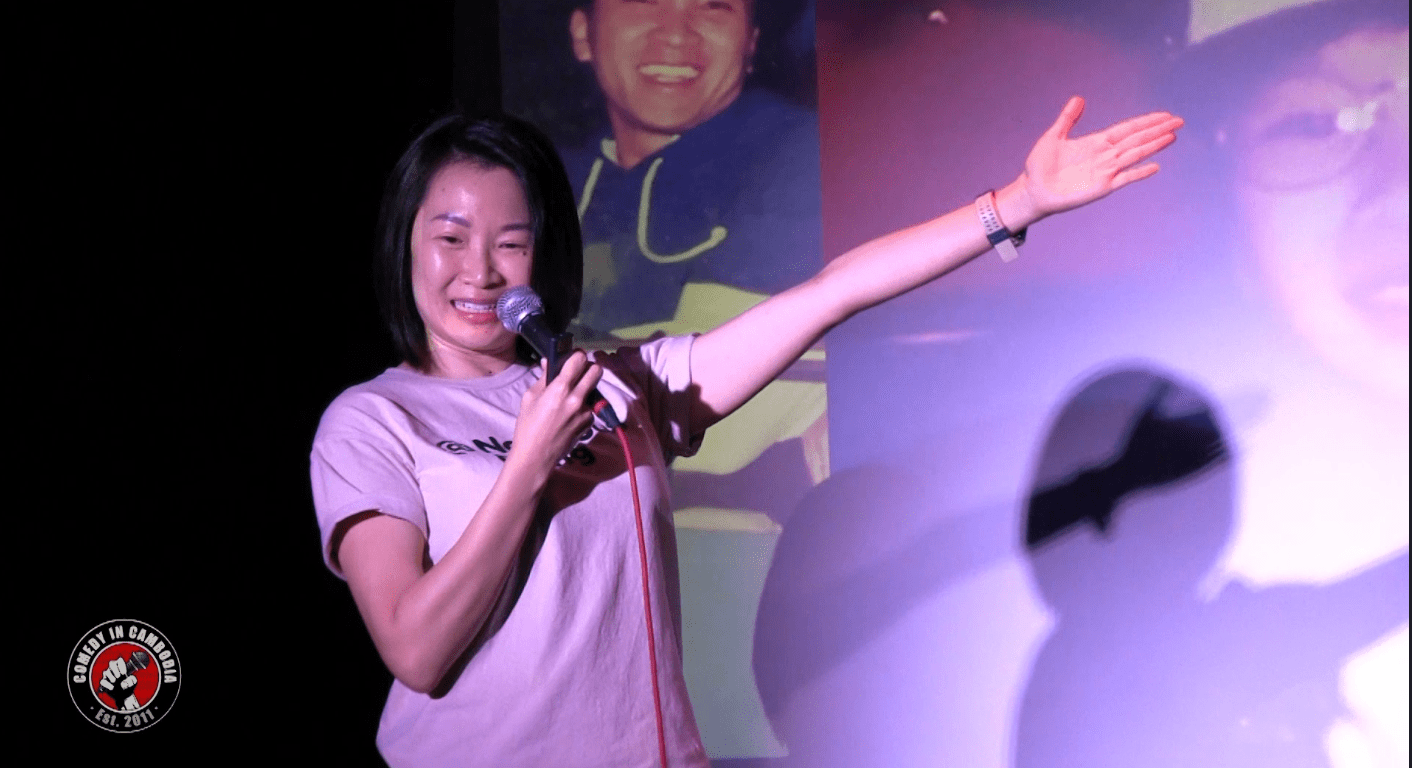

Awkward, overflowing, and deeply sincere, Slomosexual feels less like a polished comedy special than a late-blooming queer life finally given space to be told out loud
Less a tightly engineered standup special than an open diary performed live, Nebulous Niang’s Slomosexual arrives fresh from the Edinburgh Fringe Festival and the Saigon International Comedy Festival to Blu Jazz Clarke Quay. In the autobiographical stand-up power hour, the 42-year old Niang traces her journey from unhappily married Chinese mother to late-blooming lesbian comic, a story she tells with an awkwardness and sincerity that ultimately becomes the show’s greatest strength.
The premise itself is compelling: a woman who spent decades suppressing her sexuality finally allowing herself, at 33, to pursue the life she actually wanted. The show moves through childhood signs, university denial, marriage, divorce, motherhood, and eventually queer self-discovery and joy. Structurally, however, Slomosexual often feels like it is trying to hold too many ideas at once. Malay-Chinese slang, dating app disasters, Channel 8 melodrama logic, television references, cultural observations, lesbian awakening memoir, Niang’s story drifts in many directions and has a tendency to sprawl rather than build, held together by the chronological timeline of her life.

What gives Slomosexual its emotional gravity, however, is the section devoted to Niang’s marriage and eventual divorce. The show briefly leaves behind the rhythm of conventional standup altogether as she recounts the experience of living with an emotionally abusive husband who never physically harmed her, yet continuously eroded her sense of self. There are few punchlines here because how do you joke about something that’s so real, so painful? Niang speaks plainly about the cumulative exhaustion of being told she was too much, too emotional, too difficult, and carrying years of quiet diminishment that eventually made her own desires feel illegitimate. The shift into darker territory can be genuinely uncomfortable, but productively so. It reframes her eventual queer awakening not simply as sexual self-discovery, but as the slow rebuilding of a person who had spent years learning to disappear.
Most of all, the audience always remains firmly on her side. A large part of that comes from Niang’s stage persona. She has the energy of an excitable aunty telling stories at a family gathering rather than a comedian aggressively chasing punchlines. The audience takes a while to warm up, but once they do, the room settles into something surprisingly intimate. It feels less like attending a polished comedy special and more like listening to a friend slowly confess the strange architecture of her life, and that in itself is something so rare.

The comedy works best when Niang leans into the specificity and absurdity of her experiences. One particularly memorable anecdote involves discussing the pains of exploring lesbian dating apps and the stereotypical profiles on them. Another standout centres on a disastrous date with a 21-year-old woman who speaks uncannily like SpongeBob SquarePants and believes the Taj Mahal is a hotel. These moments succeed because they cover both familiar coming-out narratives and genuinely peculiar territory, evidence of how Niang has a strong instinct for finding details that are both bizarre and emotionally revealing.
Her cultural observations can be similarly sharp. A recurring thread throughout the show is the emotional awkwardness of Chinese family dynamics: love expressed not through vulnerability but through physiological maintenance. “Have you eaten?” becomes, in her telling, the highest form of affection available. Likewise, her joke about Chinese people being exceptionally skilled at dissociation lands because of how recognisable it feels to a local audience. One suspects these moments may have registered differently in Edinburgh as anthropological curiosity with far fewer Asians in the audience; but in Singapore, they feel almost uncomfortably familiar, and strangely comforting in their resonance.

Slomosexual is a work that reveals a performer whose emotional sincerity currently outweighs her comedic precision. Many of the show’s ideas arrive once and disappear before they can evolve into stronger recurring motifs or callbacks. Her references to Channel 8 dramas, where sex consists largely of fumbling under blankets before a woman immediately wakes up pregnant the next morning, feel especially rich with untapped comedic potential. There are the beginnings of connective tissue here, but not yet the tightness needed to transform these observations into a fully cohesive standup hour.
At the same time, Slomosexual rarely feels underwritten. If anything, Niang’s problem is the opposite: she is almost too rife with material. The show moves at the speed of someone who has spent decades accumulating stories and is finally allowing herself to tell them all at once. Rather than dead air, the performance could benefit from more pauses; moments to let both the audience and the jokes breathe, and callbacks to other ideas previously raised. The irony is that despite branding herself a “Slomosexual,” Niang often rushes ahead of her own punchlines, occasionally even skipping slides in her presentation through sheer excitement. But there is something revealing in that eagerness, and something that can be cleaned up with time and practice. The show does not feel careless so much as overflowing in a good way.

The slideshow element reflects this same tension. In theory, it is integral to the show’s confessional style, especially when childhood photographs and visual references become part of the storytelling. In practice, the slides occasionally function as a crutch, particularly during television references that would benefit from stronger verbal framing. Some of the show’s funniest moments actually do emerge directly from these visual aids, including Niang’s attempts to identify her latent homosexuality through old family photos. Even when the joke itself overstays its welcome, the audience remains invested because of how fully she commits to the bit, how these are actual photos, and how it is from being so fully, totally raw and real with us, that we cannot help but admire her bravery.
What ultimately carries Slomosexual is Niang’s extraordinarily clear sense of self. Her stories about her Malay girlfriend, disastrous dates, awkward spirituality, and late-in-life queer awakening gradually assemble into something emotionally coherent even when the comedy itself remains uneven. By the end of the show, audiences do not necessarily feel like they have witnessed a perfected hour of standup; they feel like they know her. That warmth becomes especially apparent during the no-holds-barred Q&A session that closes the evening. Asked everything from which MP she wishes were lesbian to how spirituality shaped her leap into comedy and queerness alike, Niang appears completely at ease. It is perhaps the most relaxed portion of the night, not because the material is scripted better, but because the audience has fully settled into her rhythm by then. The conversational intimacy that initially makes the show feel loose eventually becomes its defining appeal.

In many ways, Slomosexual resembles a dramatic comedic monologue more than a conventional standup special. It is densely autobiographical, emotionally exposed, and filled with more ideas than it can currently contain. But it is also difficult not to be moved by the sight of a new queer Singaporean comic stepping so openly into public space, especially in a cultural landscape where such stories still feel radical. Niang closes the show by sharing her ambition to become a world-renowned standup comedian. She is someone still growing into the technical demands of the form: the pauses, the callbacks, the sculpting of narrative momentum. But Slomosexual suggests she already understands something arguably more important: how to make an audience feel safe enough to follow her. For a performer who spent much of her life moving too slowly toward herself, there is something fitting about watching her comedic voice arrive in bursts, stumbles, and sudden accelerations, all at her own pace.
Photo Credit: Nebulous Niang
Find out more about Nebulous Niang on her website http://www.nebulousniang.com/ and Instagram here

