
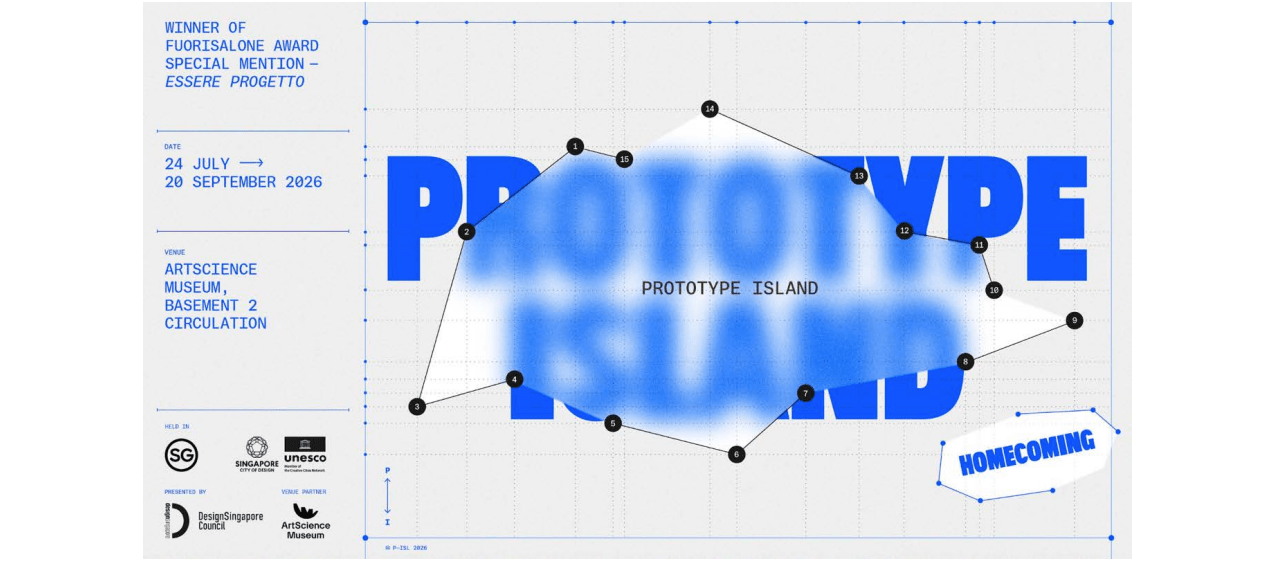
The award-winning exhibition returns from Milan Design Week, revealing that Singapore’s greatest design export isn’t an aesthetic but a relentless culture of questioning, prototyping and care.
If you walk into Prototype Island expecting just another typical national design showcase, often stereotyped to a parade of beautifully crafted furniture, sleek consumer products or impeccably finished objects, you’ll probably miss the point. “My curatorial intent was not to show products again,” curator Hunn Wai says on an exhibition walkthrough.”It’s to show innovation and new ways of thinking from Singapore.”
That distinction changes everything. The fifteen projects gathered in Prototype Island are certainly objects. There are garments, ceramic tiles, medical devices, interactive installations, children’s books and pieces of furniture. But none of them are really about what they are. Each begins with a question rather than an answer, becoming evidence of a distinctly Singaporean habit of approaching problems: prototype first, test relentlessly, refine constantly.
That philosophy earned the exhibition international recognition when it debuted at Milan Design Week earlier this year, receiving the Fuorisalone Award Special Mention for Essere Progetto (“Be the Project”), an award celebrating design as an evolving process rather than a finished outcome. Competing against heavyweight international exhibitors with budgets and resources many times larger, the Singapore pavilion was recognised not because it presented the most spectacular objects, but because it proposed perhaps the clearest curatorial argument.

“We often think of Singapore as something complete; efficient, planned, finished,” Hunn reflected during the exhibition’s opening. “But perhaps Singapore is better understood as a living prototype. A place where ideas are continually tested, refined and translated into systems, rituals and infrastructures that shape everyday life.”
It is a compelling reframe of Singapore itself. We often describe ourselves as pragmatic problem-solvers, yet pragmatism alone doesn’t explain the country’s willingness to continually iterate on everything from housing estates and healthcare to digital services and public transport. Prototype Island argues that experimentation has become our national language.
“The 15 projects standing downstairs are not simply finished products,” Hunn continued. “They are propositions. Each begins with a question rather than an answer, and together, they form a small microcosm of global transformation that starts here, pushes out, and scales globally.”
That framing is immediately reflected in the exhibition’s design. Bathed almost entirely in electric blue, a colour Hunn describes as representing both “hyper-digitality” and, in some belief systems, enlightenment, the space feels intentionally detached from nature. “Blue is a non-natural colour,” he says during the walkthrough, “and I think that reflects the non-natural awesomeness of Singapore.”

The irony lands. Singapore has always been an engineered place: reclaimed coastlines, imported water, vertical forests, carefully planned neighbourhoods. The exhibition embraces that artificiality, suggesting that what defines the country is not untouched authenticity but our willingness to continuously remake ourselves.
DesignSingapore Council Executive Director Dawn Lim believes that philosophy needs to reach beyond the design industry itself. “One of the important parts [of our Design 2035 Masterplan] is we want to make sure that design is accessible to everyone,” she said at the exhibition’s opening. “Showcases like Prototype Island, and partners like ArtScience Museum, play a really important role in helping us bring this vision to life… We want people to interact with the exhibits. We want you to touch and feel as much as possible, so that you can really value the process of creating.”
The exhibition’s homecoming is also the opening chapter of a year-long collaboration between DesignSingapore Council and ArtScience Museum, with further exhibitions, including the upcoming More than Human from London’s Design Museum, leading into the inaugural Singapore Design Biennale next year. For Angelita Teo, Vice President of Attractions at Marina Bay Sands, the partnership reflects something broader than simply hosting design exhibitions. “We are really here to try to present to Singapore and to the world the amazing power of humanity,” she said. “Without humans, there’s no art, there’s no science.”
That sentiment is what fundamentally underpins Prototype Island. Although the exhibition is organised around themes of culture, technology and infrastructure, every project ultimately circles back to people. Perhaps that is why Hunn insists visitors resist seeing fifteen separate exhibits. “I hope you won’t see fifteen individual projects,” he said. “I hope you see fifteen different ways of imagining the future.”

Much of Singapore’s design narrative abroad has traditionally revolved around innovation, smart cities and technological sophistication, and one might begin one’s exploration of Prototype Island at the heritage section, which argues that the country’s most interesting experiments are taking place in the uncomfortable space between preservation and reinvention.
These projects share a common anxiety: what happens when traditions disappear faster than they can be documented? The answer, the exhibition suggests, is that documentation alone is no longer enough. Culture survives only if it continues to evolve.

One of the exhibition’s strongest examples is Threads of Becoming, a collaboration between industrial designers Melvin Ong and Shervon Ong with master craftsman Andy Yeo, one of only a handful of practitioners in Singapore still proficient in the 1,500-year-old art of lacquer threading (qi xian diao).
Rather than preserving the craft behind museum glass, the designers built 3D-printed vessel forms that become foundations for Yeo’s painstaking hand-applied lacquer work. Machine precision and human imperfection exist together within the same object.
During the walkthrough, Hunn gestured between the digitally fabricated core and the intricate hand-laid threads covering its surface. “What you see is this nice mocha colour that’s 3D printed,” he explained. “And what you see in warm grey; that’s done by Master Andy. By hand. So it’s kind of 3D printed by hand, and another one is 3D printed by machine.”

The point isn’t technological novelty. It is succession. If traditional techniques cannot enter contemporary workflows, they risk disappearing alongside the shrinking number of practitioners who still possess them. That same urgency runs through Of Curves and Hands by Aditi Neti.
Kolam is the intricate flour patterns drawn outside South Asian homes, and has always been an ephemeral practice, renewed each morning before disappearing by day’s end. Increasingly, however, the ritual itself is fading, interrupted by changing lifestyles and generational shifts. Hunn recalls Neti telling him how she “doesn’t do it anymore, my mum doesn’t do it anymore. My grandma does it. It just stops at my grandma.”
Rather than lamenting that loss, Neti built a robotic drawing apparatus that captures visitors’ gestures and translates them into mechanically drawn kolams. The machine doesn’t replace the ritual; it records and extends it, creating an archive of bodily movement while inviting new participants into the practice. Visitors leave not simply having observed tradition but having contributed to its next iteration.

Elsewhere, designer Serina Lee approaches cultural continuity through fashion. Language System begins with Chinese calligraphy, oddly enough, not as decorative motif, but as structural grammar. Stroke directions, pressure and brush movements become the basis for garment construction itself. Sleeves emerge from the geometry of Chinese characters; seams follow the logic of written language rather than conventional tailoring.
Hunn is visibly excited describing the project because its ambition extends far beyond clothing. “She’s world-building,” he says. “It’s beyond just the painting. The ink painting, the language, how she maps the Chinese character, and then it links back to the way the clothes are being created as well.”
Identity here isn’t printed onto fabric. It is embedded into the architecture of the garment itself. Back in Milan, Serina had also transposed that same idea and language into ink paintings she did as a form of performance art, doing live painting onsite onto a beautiful scroll, and has also developed a game world online that draws from that same language.

Roger Ng Wei Lun similarly rejects nostalgia in Lustre Series and Earth Deity Altar, where Peranakan furniture and vernacular religious iconography are reconstructed through digital fabrication, brushed aluminium and pixelated ornament. Traditional mother-of-pearl inlay becomes UV-printed surfaces; shrines become modular systems open to reinterpretation. Rather than freezing heritage at a particular historical moment, Roger asks what these symbols might become if they continued evolving alongside the societies that created them.

One of the section’s most visually-striking works, however, is People of the World by weareSuper/supermama At first glance, it appears to be a charming collection of porcelain plates bearing expressive illustrated faces. The innovation, however, isn’t ceramic, but economic.
Developed with creators with disabilities, the project challenges the uncomfortable dynamics of many social enterprises, where products are often purchased less because of their quality than because buyers feel they ought to support a worthy cause. Hunn is refreshingly blunt about that problem. “Normally you buy something they make out of guilt,” he says. “That’s actually quite disrespectful.”

Instead, the project redesigns the business model itself. Participants become genuine co-creators whose work enters commercial production, with authorship and economic value remaining attached to their contributions. Inclusion is no longer charitable; it becomes structural.
That subtle shift perhaps captures Prototype Island’s larger philosophy better than any individual object. The exhibition is not interested in preserving traditions exactly as they are, nor in celebrating technology simply because it is new, but something deeper: how do we keep the things that matter alive by designing them to survive change?

If the exhibition’s first chapter argues that culture survives through adaptation, its second asks a parallel question of technology: what kind of innovation is actually worth pursuing? Prototype Island is more restrained in its treatment of emerging technologies. There are no grand declarations about artificial intelligence replacing creativity, nor breathless promises about quantum computing transforming civilisation overnight. Instead, each project positions technology as one component within a much larger system of human judgement, craft and lived experience.
“We prototype, we learn, we iterate, we innovate,” Hunn observed during his opening speech, listing housing, healthcare, mobility and manufacturing in the same breath. Technology, in that formulation, is never an end in itself. It is simply another tool for solving problems.

Across the five works gathered under Technological & Material Ecologies then, the question is therefore less “What can technology do?” than “How might technology deepen human capability without replacing it?” The distinction becomes immediately apparent in FORMAS.AI, developed by Carlos Bañón and Yiping Goh. At a time when generative AI is often framed as a force capable of replacing architects and designers, FORMAS.AI deliberately resists that narrative.
The platform integrates sketches, photographs, point clouds, videos and three-dimensional models into a unified design environment where multiple AI engines operate simultaneously. Yet the intelligence driving the work remains fundamentally human. Architects still determine context, atmosphere, lighting, materiality and intent, with artificial intelligence accelerating exploration rather than dictating outcomes.
As the exhibition notes explain, machine intelligence is “guided by architectural judgement.” Throughout Prototype Island, AI repeatedly appears not as an autonomous creator but as an assistant that extends existing expertise. It is perhaps the exhibition’s rebuttal to prevailing anxieties surrounding automation: technology is most powerful when it augments human thinking instead of displacing it.

A similar impulse underpins 1 Qubit, although here the ambition is educational rather than professional. Quantum computing has rapidly become one of those technological buzzwords everyone recognises but few truly understand. Rather than attempting to explain its mathematics through text panels or diagrams, designers Jake Tan, Ezequiel Ignacio Rodríguez Chiacchio and Bao Songyu translate abstract concepts into physical interaction.
During the walkthrough, Hunn laughs before attempting his own explanation. “People who get it, get it,” he jokes. “I still don’t get it sometimes.” His honesty is refreshing. Quantum mechanics has long resisted easy explanation, but 1 Qubit succeeds precisely because it avoids pretending otherwise. Visitors manipulate gate-like controls that alter probability distributions before triggering a measurement that collapses multiple possible states into one visible outcome. Complex principles such as superposition become tactile experiences rather than theoretical abstractions.
Hunn compares it to the hands-on demonstrations found in science museums. “If you go to the Science Centre and they want to help you understand Bernoulli’s principle,” he says, “they’ll have something you can play with. That’s the intent of this. It’s how to understand the basic principles of quantum computing.”
It is a reminder that design’s role often lies not in producing new technologies but in making unfamiliar ideas publicly accessible.

The exhibition’s strongest material investigation, however, is perhaps Iris, created by local design studio Parable. At first glance, the modular ceramic system appears understated, especially when placed beside more visibly technological works. Yet embedded within each tile is a story about time itself.
The clay used to produce Iris comes from one of the last remaining repositories of locally sourced Singapore clay, preserved for over forty years by a family-run ceramics studio. That geological memory becomes part of an adaptable architectural system designed not for permanence but for continuous repair, replacement and reconfiguration. During the walkthrough, Hunn describes it as “cultural impact embodied in the form of materials. This is from one of the institutions in Singapore that still has clay from Singapore,” he explains. “It’s made from old clay. Forty years old.”

Singapore is often criticised for erasing traces of its physical past in pursuit of redevelopment. Iris offers an elegant counterpoint. Instead of treating heritage as ornament, it embeds history directly into construction itself. Buildings literally become repositories of local material memory.
The project also speaks to one of the exhibition’s recurring themes: permanence is increasingly less valuable than adaptability. Rather than producing flawless surfaces intended to remain unchanged, Iris anticipates maintenance. Individual ceramic modules can be replaced as spaces evolve, acknowledging that buildings, like societies, are living systems rather than finished products.

That philosophy reaches its most immediate and practical expression in TessaCast, developed by A*STAR Innovation Factory@SIMTech in collaboration with Castomize. Conventional plaster casts have remained largely unchanged for generations. Heavy, uncomfortable, susceptible to water damage and ultimately disposable, they exemplify a medical technology that works adequately enough to discourage further innovation.
TessaCast asks why that should be acceptable. Fabricated using smart polymers through four-dimensional printing, the orthopaedic cast gradually adapts to a patient’s anatomy over time. Dense lattice structures provide support where necessary while more flexible regions allow movement and comfort elsewhere. Unlike traditional plaster casts, patients can shower, experience better ventilation and potentially reduce both discomfort and material waste.

During the walkthrough, Hunn delights in explaining the misconception surrounding four-dimensional printing. “You might ask, what is 4D?” he says. “The fourth dimension is actually smart materials.”
He compresses two seemingly identical printed structures in his hands. Each deforms differently according to its internal geometry. “These two things look the same,” he says. “But they collapse differently because of the way they’re printed.”
The demonstration lasts only seconds, yet it encapsulates Prototype Island’s broader philosophy. Innovation here isn’t spectacular because it looks futuristic. It matters because it quite simply improves someone’s lived experience.

The same could be said of Fragility to Permanence by ODD M., which transforms discarded eggshells into durable composite vessels. Waste materials have become a familiar theme within contemporary design, but ODD M. avoids romanticising sustainability. Rather than disguising the eggshells beneath immaculate finishes, the objects deliberately retain their speckled textures and imperfections.
Their previous lives remain visible. It is a subtle but meaningful decision. Much like Iris preserves geological memory, Fragility to Permanence insists that transformation need not erase origins. New materials carry old stories with them. Taken together, these projects reveal perhaps the exhibition’s clearest departure from more conventional technology showcases.

Prototype Island is ultimately not interested in disruption, but continuity. Artificial intelligence extends architectural judgement. Smart polymers improve existing medical treatments. Ancient clay finds new architectural applications. Waste becomes infrastructure instead of landfill. Quantum mechanics becomes something a child can begin to grasp through play. Technology repeatedly enters into conversation with culture rather than attempting to replace it.
That relationship also explains why Prototype Island avoids presenting innovation as a finished achievement. “The projects differ greatly in scale, discipline and opinions,” Hunn observed during his opening speech. “But they share one belief. Design is not only about making things. It’s a way of thinking. It’s a way of turning ideas into something we can test, question and improve.”

Improvement, rather than invention, emerges as the exhibition’s central value. In a global design culture often obsessed with breakthrough moments and disruptive technologies, Prototype Island proposes that progress is rarely a leap forward. More often, it is the patient accumulation of better questions.
One of Prototype Island’s observations is that good design often disappears. We rarely think about the barcode printed on every grocery item. We don’t pay attention to the joints holding temporary structures together. These systems work precisely because they become invisible.

The exhibition’s Everyday Infrastructures section asks visitors to notice them again. Interactive Materials Lab’s Scan to Play is perhaps the most immediately joyful work in the exhibition. The barcode, an invention that has organised global logistics since the mid-twentieth century, is stripped from its commercial purpose and transformed into a playground. Visitors scan oversized distorted barcodes to trigger sounds, animations and mini-games, suddenly realising that the same technology governing supermarkets and warehouses can become an interface for delight.
During the walkthrough, Hunn described it simply. “They try to use new applications, new ways to look at the technology.” It is an almost childlike proposition, but an important one. Design innovation does not always require inventing new technologies. Sometimes it means asking different questions of technologies we already possess.

If Scan to Play reimagines information systems, Reynard Seah’s Noda rethinks something even more fundamental: the humble joint. Most temporary structures depend upon screws, bolts, adhesives or specialised tools. Noda instead borrows from biology.
Inspired by the turgidity of plant cells, silicone spheres expand inside interlocking printed loops to create strong but entirely reversible joints. Structures can be assembled, dismantled and rebuilt repeatedly without damaging the components.

It sounds deceptively simple, yet it addresses one of contemporary design’s biggest questions: how do we build cities that are flexible enough to change? Temporary shelters. Exhibition architecture. Emergency housing. Community installations. Instead of assuming permanence, Noda designs for adaptation. Like much of Prototype Island, it replaces certainty with possibility.
Together these projects reveal infrastructures that shape our behaviour every day. They remind us that innovation is often less about spectacular inventions than about questioning assumptions we have stopped noticing altogether. And perhaps that observation prepares visitors for the exhibition’s most compelling chapter.

Because if infrastructure determines how societies function, then care itself may be the most important infrastructure of all. Across its final projects, the exhibition argues that Singapore’s greatest design contribution may not be efficiency after all. It may be empathy. Among the most affecting works is TUSITALA’s 3D-printed tactile picture book, which reimagines the familiar Timmy & Tammy children’s series for visually impaired readers.
Rather than producing a separate edition exclusively for blind children, the designers imagine something far more inclusive. Each page combines tactile illustrations, Braille and conventional text within a modular system that grows alongside the child’s literacy. Different plates can be swapped in as reading ability develops, allowing one physical book to evolve instead of being replaced.

During the walkthrough, Hunn highlighted exactly this quality. “The great thing about it is it’s modular,” he said. “You can’t really upgrade physical books. But this one you can.”
Accessibility is often framed as accommodation after exclusion has already occurred, but Tusitala instead designs inclusion into the object from the beginning. Sighted and visually impaired children can read together, each encountering the same story through different forms of perception. The project refuses the assumption that accessibility must exist separately from mainstream experience.

A similar generosity underpins Rememo, designed by Celeste Seah. Reminiscence therapy is widely used in dementia care, encouraging patients to recall meaningful memories through photographs and conversation. Yet personal photographs are not always available, particularly when memories become fragmented or families cannot provide suitable images.
Rememo introduces generative AI into this deeply human interaction. Therapists describe remembered moments—a childhood picnic, a familiar market, a favourite family outing, and the system generates visual prompts in real time, which are printed onto Polaroid-style cards to support conversation.
Importantly, the AI is never presented as replacing memory, but instead extends the therapist’s ability to sustain dialogue. During the walkthrough, Hunn explained how the generated images become “memory cards” that help conversations continue when photographs alone cannot.

Prototype Island consistently refuses technological solutionism. Here, artificial intelligence functions not as an autonomous intelligence but as another therapeutic tool, guided entirely by human judgement. And the most personal project in the exhibition may also be one of its smallest. Designer Zoey Chan’s Nido emerged directly from her own experience living with Type 1 diabetes.
Insulin injections are routine, repetitive and often inconvenient. Used needles must be stored safely, separated from fresh ones and disposed of responsibly, all while fitting seamlessly into daily life. Nido condenses those micro-actions into a single object.

The holder allows one-handed needle ejection, separates clean and used components and avoids the harsh visual language associated with medical devices. Its muted colours and rounded forms feel intentionally domestic rather than clinical.
Instead of asking users to adapt to medical equipment, the object adapts itself to users. It is a reminder that some of the most meaningful design interventions happen not at the scale of cities but in the repeated routines of the everyday.

Taken together, these projects reveal care as something that can be designed. They are not sentimental gestures but practical systems, shaped through observation, testing and collaboration. As DesignSingapore Council Executive Director Dawn Lim put it during the opening, the ambition is “to make design accessible to everyone.” “We want people to interact with the exhibits,” she said. “We want you to be able to touch and feel as much as possible… so that you can really value the process of creating.”
That emphasis on process lies at the heart of Prototype Island. Rather than celebrating finished products, the exhibition celebrates design as an ongoing conversation—one that explains why it resonated so strongly in Milan, where it received the Fuorisalone Award Special Mention for Essere Progetto (“Be the Project”), recognising design as an evolving process.
More importantly, it reframes what Singapore design actually is. There is no singular Singaporean aesthetic running through the 15 works. A Braille picture book has little in common visually with a quantum computing installation, a modular ceramic wall system or a reimagined Peranakan table. What connects them is not form, but mindset.
“We often think of Singapore as something complete. Efficient. Planned. Finished,” curator Hunn Wai said. “But perhaps Singapore is better understood as a living prototype. A place where ideas are continually tested, refined and translated into systems, rituals and infrastructures that shape everyday life.”
That idea echoes throughout the exhibition. Tradition is carried forward rather than preserved in amber. Technology supports human judgement rather than replacing it. Innovation is measured less by novelty than by whether it improves how we live, learn and care for one another. “The 15 projects standing downstairs are not simply finished products,” Hunn said. “They are propositions. Each begins with a question rather than an answer.”
That may be Prototype Island’s greatest achievement. Instead of presenting Singapore as a nation with all the answers, it presents one that is willing to keep asking better questions. In doing so, it argues that Singapore’s most distinctive design language isn’t an aesthetic at all; it’s a way of thinking.
Photo Credit: Eian Siew
Prototype Island runs at B2 Circulation, ArtScience Museum from 24th July to 20th September 2026. Admission is free. More information available here

