
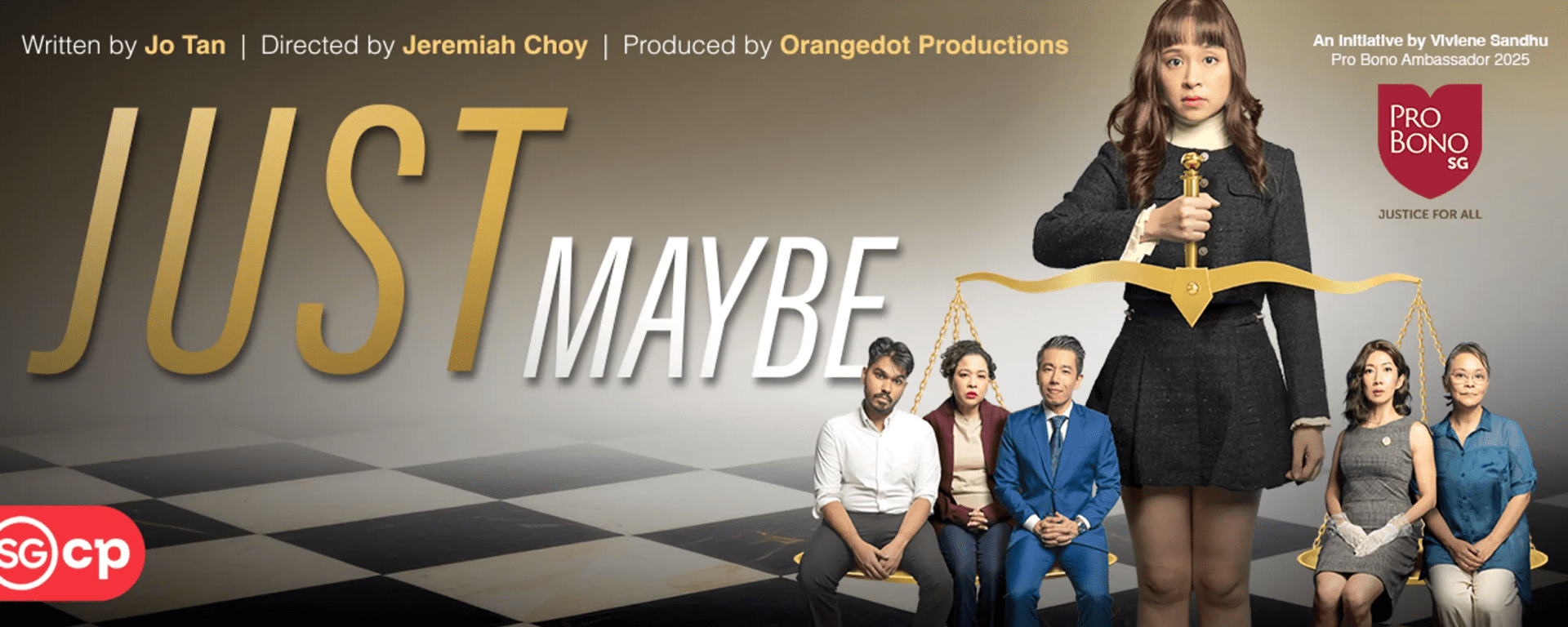
A production that seeks to challenge our assumptions about privilege, fairness and access to justice, with too many unresolved storylines.
What does justice look like when life is not lived in black and white? Just Maybe follows Kayleigh, an ambitious law student who believes she has earned everything through hard work. When she is required to complete 20 hours at Pro Bono SG before graduating, she sees the placement as an inconvenience, and the people seeking legal aid as irresponsible freeloaders. But encounters with people whose lives fall outside her privileged understanding of Singapore gradually challenge her assumptions about fairness, empathy and what it means to serve others.
Played by Xuan Ong, Kayleigh begins as polished, privileged and confidently self-absorbed. Her distinctly atas manner and faith in meritocracy make her difficult to warm to, but Ong gives the character enough vulnerability to suggest that there is more beneath the surface. The play’s early observations about academic success and the lucrative ambitions of Singapore’s legal industry are among its more engaging ideas.
The move to Pro Bono SG gives the production its clearest sense of purpose. Kayleigh is there only to fulfil her graduation requirements, reflecting an uncomfortable reality: for some, pro bono work may begin as a box to tick rather than a commitment to access to justice.
Her encounters with Lilah and Deena (both played by Alecia Kim Chua), two young women facing difficult circumstances, expose the limits of her empathy. Kayleigh’s formal manner and unmistakable privilege immediately create distance between them. Gloria’s (Bridget Fernandez) reminder that not everyone begins life with the same advantages becomes an important turning point.
Faris (Fahim Murshed), an overworked lawyer who continues to volunteer his time, offers Kayleigh another model of legal practice. His work suggests that being a good lawyer is not only about academic achievement or winning cases. It is also about listening, understanding and meeting people where they are.
This idea comes through most clearly in Faris’s defence of Erwin. At first, Erwin appears difficult to sympathise with: privileged, entitled and still financially dependent on his parents. Yet Faris fights for him regardless. The courtroom sequence allows Kayleigh to see that helping someone does not require approving of them. Ong handles this shift effectively, showing Kayleigh’s growing awareness that she, too, may be capable of making a difference.
These are the moments when playwright Jo Tan’s writing is at its strongest. The script is warm and perceptive when it focuses on the work of understanding another person’s language, circumstances and worldview. It does not always make us love its characters, but it occasionally helps us see them more clearly.
The difficulty is that Just Maybe tries to tell too many stories at once. Jun, also played by Edward Choy, is introduced as an ambitious lawyer desperate to earn his father’s approval. His anger, need for control and determination to succeed hint at a compelling story about inherited power and emotional pressure. Choy gives Jun a convincing volatility, but these ideas are not developed enough to shape the play’s larger narrative.
The same is true of Kayleigh’s family history. Her distance from her parents and the insecurity beneath her confident exterior offer useful context, but these revelations arrive late and remain only loosely connected to her transformation.
The introduction of Natsuko, also played by Jo Tan, further expands the production at a point when it needs greater focus. Her history, alongside Gloria’s family background and experiences of domestic labour, contains potentially rich material. However, these stories receive limited development and do not meaningfully converge with Kayleigh’s journey.
Now, the production begins to feel less like a collection of interconnected perspectives and more like a series of backstories competing for attention. The occasional breaks of the fourth wall also feel overly eager to draw a response from the audience.
Just Maybe touches on privilege, meritocracy, class, migration, domestic labour, family expectations, ambition and access to justice. But the play’s breadth becomes its weakness. Several storylines are introduced, expanded and then left unresolved.
Kayleigh’s transformation remains the most coherent thread. By her final day at Pro Bono SG, she begins to understand that legal aid is about more than cases and courtrooms. It is about standing beside people who may have fallen through the gaps and recognising the humanity behind circumstances that are not always easy to understand.
When a new law student arrives, Kayleigh sees a reflection of her former self. The reversal is simple but effective, as she now recognises the privilege and impatience she once carried into the space.
The final scenes return to Kayleigh in a KTV booth, where she begins to confront her relationship with Jun. As their dynamic turns threatening and controlling, she cuts him off and appears ready to begin again.
But has she really changed? The play leaves that question unanswered. Ambiguity can be powerful, but after so many unresolved storylines, the ending feels less like a deliberate uncertainty and more like another thread left hanging.
Directed and produced by Jeremiah Choy, Just Maybe is a well-intentioned production with an important message. At its best, it reminds us that access to justice is not only about laws and legal outcomes. It is about listening to people whose lives may be difficult to understand and recognising that fairness should not depend on how sympathetic someone appears.
Its strongest moments show the value of empathy in action. Yet its many subplots, late revelations and underdeveloped characters dilute the impact of Kayleigh’s journey. The play asks whether people can change, whether lawyers can look beyond the cases before them, and whether empathy can begin simply by listening. Those are worthwhile questions, but the answers, however, remain unfinished.
Just Maybe played from 17th to 19th July 2026 at the Play Den at the Arts House.
Production Credits
| Playwright Jo Tan Director and Producer Jeremiah Choy Cast Xuan Ong, Edward Choy, Bridget Fernandez, Fahim Murshed, Alecia Kim Chua, Jo Tan Lighting Designer Alberta Wileo Sound Designer Jing Ng Set and Multimedia Designer Joanne Ho Set Designer Maria Clare Khoo |

