
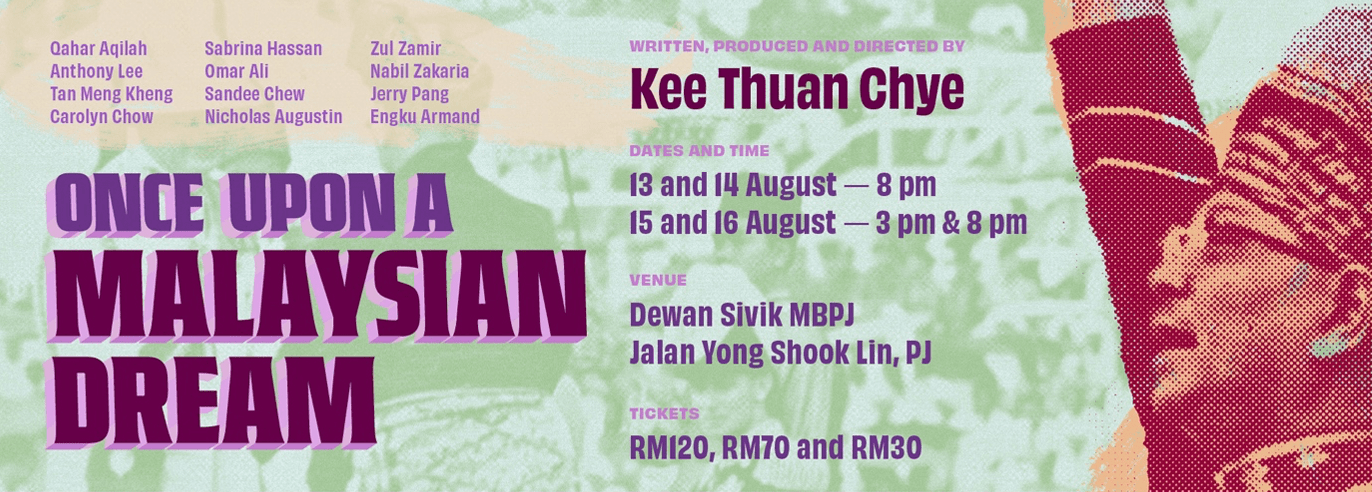
What does the Malaysian Dream mean today? As Merdeka approaches, Kee Thuan Chye returns to the stage with an ambitious new play about race, identity, history and the hope of a more united Malaysia.
What if the Malaysia we dreamed of in 1957 is not quite the Malaysia we ended up with And what if that dream is still worth fighting for?
Those are some of the questions at the heart of Once Upon a Malaysian Dream, a new theatre production by veteran Malaysian writer, producer and director Kee Thuan Chye, coming to Petaling Jaya this August—appropriately, during the country’s Merdeka month.
Rather than offering a straightforward history lesson, the play looks at Malaysia’s past, present and possible future through a theatrical mix of drama, comedy, music, traditional cultural forms, martial arts and unexpected surprises. The play essentially asks a deceptively simple question: Do Malaysians still believe in the dream of a united, multiracial Malaysia—and do they still want that dream to come true?
August carries particular significance for a production like this. When Malaya achieved independence in August 1957, the promise of Merdeka was rooted in ideals of justice, liberty and the welfare and happiness of its people.
Nearly seven decades later, Once Upon a Malaysian Dream asks what happened between that original promise and the Malaysia we know today.
But don’t expect a dry political treatise. Kee Thuan Chye, who has been writing and staging plays since the 1970s, has built the production as an entertaining and eclectic theatrical experience that explores some of the defining questions of Malaysian life without losing its sense of humour, warmth and playfulness.
“The Malaysian Dream is something that’s very close to my heart,” says Thuan Chye. With Malaysians increasingly divided along racial lines and across issues affecting everyday life, he hopes the production can serve as a reminder of the need to “reboot” and perhaps return to the fundamentals of what Merdeka was meant to represent.
The intention, however, isn’t to preach. The play, he says, is designed to appeal to a broad audience, with younger and older Malaysians alike able to find something in its look at the past, and its glimpse towards the future. “On the whole,” he says, “I think the audience should find it to be a thoroughly Malaysian experience.”
One of the production’s most intriguing theatrical challenges is also one of its biggest hooks. Just 12 actors will take on around 200 roles.
The cast features Qahar Aqilah, Sabrina Hassan, Zul Zamir, Anthony Lee, Omar Ali, Nabil Zakaria, Sandee Chew, Tan Meng Kheng, Jerry Chew, Carolyn Chow, Engku Armand and Nicholas Augustin. Among them, Qahar Aqilah and Zul Zamir take on the roles of two titans of Malaysia’s modern history, while Sabrina Hassan plays the Storyteller, a central presence who remains on stage for much of the production while transforming into numerous other characters.
It is a format that puts the performers—and their ability to move rapidly between identities, eras and worlds—at the centre of the experience. And with a story spanning 70 years of Malaysian history, there is plenty of ground to cover.
If the idea of watching a historical Malaysian drama sounds solemn, Once Upon a Malaysian Dream has a few surprises in store. The production brings together traditional Malaysian cultural forms, music, comedy and physical theatre, while incorporating unexpected elements including boxing and martial arts.
Qahar Aqilah and Zul Zamir have been undergoing boxing training for their roles. They will also join Sandee Chew and Omar Ali for Wushu swordfighting training. The physicality adds another layer to a production that is already attempting something ambitious: compressing decades of Malaysian history, personalities and social questions into one theatrical experience.
Live music will also be performed on stage using both traditional and modern instruments by Zyee Leow, Boyz Chew, Aaru8 and Wai Kei. The result promises to be less conventional historical drama and instead one where Malaysian cultural references can sit alongside music, movement, humour and spectacle.
For Malaysian theatre followers, the production also marks the return of a familiar name. Kee Thuan Chye has been writing and staging plays since the 1970s and began focusing more closely on Malaysian themes in the 1980s, starting with 1984 Here and Now.
His previous production, Swordfish + Concubine, was staged in 2017. Now, nine years later, he is back with another work that places Malaysia firmly at its centre.
The timing is deliberate. After years of political, social and cultural change, a Merdeka-season production feels like an opportunity to look backwards while asking what comes next. Rather than providing an easy answer to whether the Malaysian Dream has been fulfilled, the play leaves that question with its audience.
Perhaps that is the most interesting question to take into the theatre. Is the Malaysian Dream about racial harmony? Equality? A shared national identity? The freedom to live differently while still belonging to the same country? Or is it simply the promise that Malaysians of different backgrounds can imagine a future together?
Once Upon a Malaysian Dream doesn’t appear interested in reducing those questions to a single answer. Instead, it uses 70 years of Malaysian history as its canvas, touching on some of the central issues that have shaped the country’s national conversation. And because it is being staged during Merdeka month, audiences are invited to consider not only how far Malaysia has come, but also where it might go from here.
There is something fitting about bringing a play like this to the stage in August. Merdeka celebrations often look backwards, to independence, national milestones and the people who shaped the country.
Once Upon a Malaysian Dream takes a slightly different route, and looks at the dream behind the history. It asks whether the aspirations of 1957 still resonate, what may have been lost along the way, and whether Malaysians are prepared to imagine that dream again.
And it does so not through a lecture, but through 12 actors playing 200 characters, live music, comedy, storytelling, traditional forms, boxing, Wushu and seven decades of Malaysian history. The question is ultimately left to the audience: Will the Malaysian Dream ever be fulfilled? You can watch the play, and decide for yourself.
Once Upon a Malaysian Dream runs from 13th to 16th August 2026 at Dewan Sivik MBPJ, Jalan Yong Shook Lin, Petaling Jaya Tickets are available via CloudJoi.

