
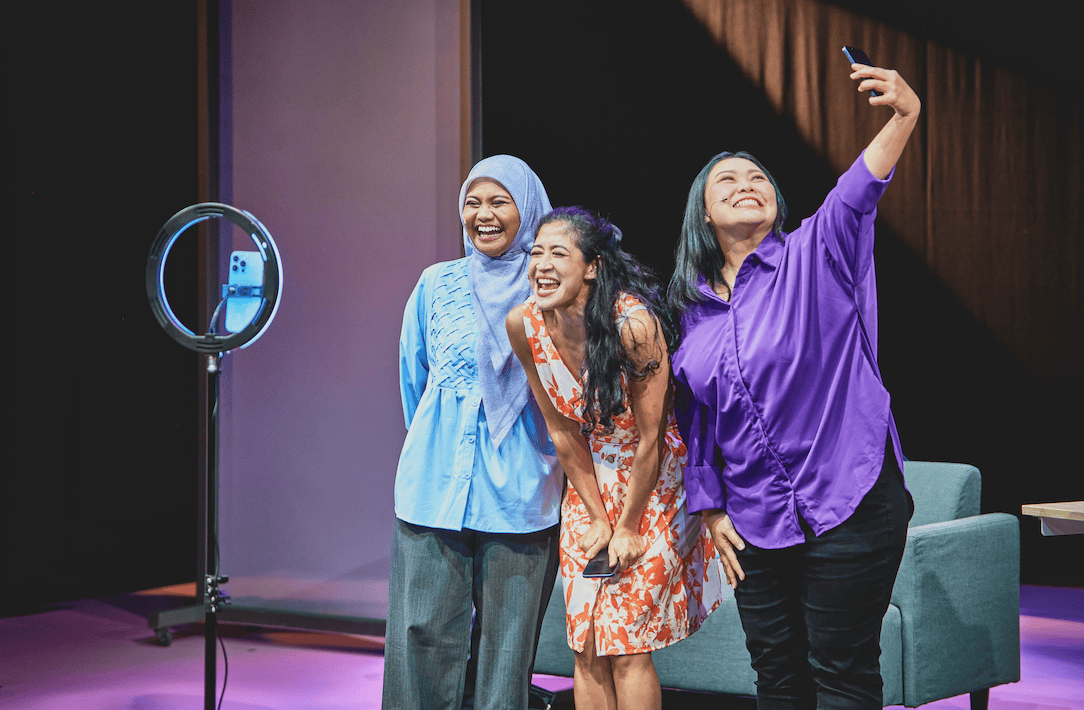

A wistful, deeply human portrait of female friendship that grows apart, and a strong return to form for Haresh Sharma’s writing.
Duration: 90 minutes
3 Queens, The Necessary Stage’s new production, is the type of everyday tragedy that plays out across households all around the world. Written by Haresh Sharma, and co-directed by Haresh and Adib Kosnan, the play does not find its tragedy from some grand catastrophe, but how from the very beginning, you can sense how difficult it will be for them to maintain the close bonds they once held with each other. The play follows sisters Bedah and Zeina, and close friend Aida have known each other for years, long enough to have shared jokes, ambitions, disappointments and the intimate knowledge that comes from growing up alongside someone. Yet as the years pass, their lives take increasingly divergent paths, and the friendship that once seemed immovable begins to strain under the weight of money, pride, family, politics, faith, illness, disappointment and the accumulated grievances that close relationships are particularly good at collecting.
Over its 90 minute runtime, 3 Queens unfolds in a series of encounters around Hari Raya, each taking place several years apart and in a different woman’s home. It almost gives the play the quality of a family album in which some photographs have been left out. We meet Bedah (Siti Hajar Gani), Zeina (Munah Bagharib) and Aida (Siti Khalijah Zainal) at different points in their lives, and each time there is the tantalising sense of a larger story happening just outside the frame. What happened between the last time we saw them and now? What was said? What was left unsaid? Which small hurt became a lasting resentment? The structure is one of the production’s greatest strengths, but also its greatest frustration: there is so much life in these women that at times you wish the play would stay with them longer.

That abundance is characteristic of Haresh’s writing and of The Necessary Stage’s devising tradition, in which performers contribute material that is shaped and reshaped collaboratively. Here, the three women we finally see are all amalgamations of different characters explored. That sense of accumulated lives is palpable, and all the characters seen feel like people with histories, contradictions and private versions of themselves that we only occasionally get to glimpse. This is almost to a fault, where 3 Queens is so rich that is probably has enough material for a considerably longer play, where several segments feel as though they could have expanded into entire plays of their own, leaving some of the characters’ transformations more suggested than fully explored.
And yet the brevity also contributes to the play’s melancholy. Time keeps moving whether these women are ready for it or not. One scene ends, another begins years later, and the friendship has shifted again. There is no dramatic announcement that they have grown apart; it happens in increments. Someone has a new job. Someone has become successful. Someone has fallen behind. The women keep returning to one another, but they no longer necessarily arrive at the same place. It is this gradual drifting apart that makes the eventual fractures so painful. You begin to wonder whether their falling-out could ever really have been avoided.

The play is particularly compelling when it refuses to make any of them entirely right or wrong. Bedah, Zeina and Aida each carry their own sense of righteousness and morality, and each is capable of generosity as well as cruelty. Their arguments are rarely about just the thing they are arguing about. Money becomes a question of dignity; politics becomes a question of empathy; family becomes a question of obligation; success becomes a question of whether one has left the others behind. Haresh is interested in the uncomfortable contradictions of people who can love someone deeply and still hurt them, and repeatedly returns to the discomfort we hold of people who are so close and frank with each other, they could cut you with a knife and not realise it.
The Malay-Muslim community is likewise presented not as a single, fixed identity but as a spectrum of women with different aspirations, beliefs and relationships to the world around them. Zeina’s idealism and activism sit very differently beside Aida’s professional success and Bedah’s more grounded domestic and working life. The production touches on Palestine, radicalisation, detention, capitalism, artificial intelligence, caregiving, mortality and faith, but often in passing, as fragments of the larger lives these women are living. There are moments when one wishes some of these subjects had been allowed to breathe more fully, particularly because Haresh has previously demonstrated such an ability to turn such contemporary social anxieties into the substance of a drama, while here, they often function more as shadows cast across the central friendship.

The performances, however, is what gives those fragments weight. Munah’s Zeina has a bright, almost infectious energy, even as her convictions become increasingly complicated. There is something disarming about the sincerity of her zeal: she believes in what she is doing, and that makes her later struggles all the more difficult to watch. Siti Hajar’s Bedah is more staunchly grounded, a woman who seems determined to hold herself and everyone around her together. Her most affecting moments come when that certainty finally gives way and something much more vulnerable emerges beneath it. Siti K, meanwhile, has perhaps the most visibly demanding transformation as Aida moves through radically different circumstances. She changes both in appearance and in rhythm, authority and physicality, while retaining the recognisable core of the woman we first meet. Her comic yet empathetic turn in another minor role also demonstrates a lovely versatility, showcasing her ability to breathe life into what could have been a one-dimensional character.
The design is similarly economical. Elizabeth Mak’s pared-down set uses only a few pieces of furniture to establish different homes, allowing the space to shift quickly as the years pass. Emanorwatty Saleh’s lighting is mostly naturalistic but becomes more expressive during the intercut sequences, while Safuan Johari’s music, heard primarily before and between scenes, gives the production a wistful, more orchestral quality, bringing to the fore unspoken tensions and emotions of the scenes we had just or are about to experience. Theresa Chan’s colour-coded costumes are particularly effective: Bedah’s blues, Zeina’s oranges and Aida’s purples become visual shorthand for their personalities, while their changing clothes subtly register the lives they have lived between encounters.

For all the arguments, accusations and difficult truths, 3 Queens remains less interested in the moment friendships break than in the buildup from everything that came before it. The women have histories together that cannot simply be erased, even when they seem determined to erase one another from their lives. You never know who is going to be with you throughout the journey of life, something that the production continually emphasises. We do not know who will leave or stay. We do not know which version of ourselves the people who know us best will remember.
The final flashback, returning the women to their younger selves, is therefore devastating precisely because it is so uncomplicated. There they are before all the disappointments have accumulated, talking about the future, laughing, dreaming and being silly together. It is not a sentimental rewriting of their friendship; it is a reminder of what was once possible. Watching those women together makes everything that came before ache a little more. They do not yet know what we do: that the distance between them will become harder to cross, that the people they are becoming will sometimes be strangers to one another, and that love alone may not always be enough to prevent a friendship from changing beyond recognition.

That sense of inevitability is what stays. 3 Queens does not try to pretend that every relationship can be repaired if people simply communicate better. Sometimes people grow in different directions, or life puts too much between them. Sometimes we hurt the people closest to us precisely because we know where the softest places are. The women have a bond that ties them to one another, and they cannot help but remain in each other’s lives. The tragedy then lies in how caring does not necessarily stop them from causing one another pain because of their ow insecurities or inability to see past their own egos or histories.
And perhaps that is why the play leaves you with an unexpectedly tender impulse. You leave thinking about your own clan; the friend you have not called in months, the sibling you keep meaning to check on, the family member whose opinions you find exhausting, the person who has disappointed you and whom you have nevertheless loved for years. 3 Queens makes you feel the preciousness of those relationships by showing how easily they can become casualties of time. By curtain call, you may find yourself wanting to pick up the phone, start a conversation, sit beside someone, or simply embrace them for no particular reason other than the fact that they are still here.

It is a very strong return to form for Haresh and TNS, and a production that understands the particular ache of looking backwards at relationships that once felt permanent. Its greatest weakness is also its greatest generosity: there is simply too much life packed into these three women, and sometimes 3 Queens can only give us glimpses where we want whole chapters. But those glimpses are often enough. What remains is a lovingly rendered portrait of Malay-Muslim womanhood, friendship and the painful business of growing older together, and, sometimes, growing apart.

Photo Credit: Tuckys Photography
3 Queens runs from 3rd to 13th September 2026 at The Ngee Ann Kongsi Theatre, Wild Rice @ Funan. Tickets available from BookMyShow
Production Credits
| Written by Haresh Sharma Directed by Haresh Sharma, Adib Kosnan Performed by Munah Bagharib, Siti Hajar Gani, Siti Khalijah Zainal Lighting Designer Emanorwatty Saleh Set Designer Elizabeth Mak Sound Designer Safuan Johari Translator Zulfadli Rashid Production Manager Celestine Wong Stage Manager (Phases 2&3) Georgia Sim Rehearsal Stage Manager (Phase 1) Jessy Choo Assistant Stage Manager Saffron Teng Costume Coordinator Theresa Chan Captions Designer Shai Captions Operator Natalie Linn Titus Audio Describer Nina Sabrina M Crew Azina, Yeo Zhen Zhen Project Manager Nicole Lim Hair Stylist Ashley Salon Make-Up Artist The Make Up Room Publicity and Production Photography and Videography Tuckys Photography Marketing Videography Juup Media Graphic Design Currency Design |

