
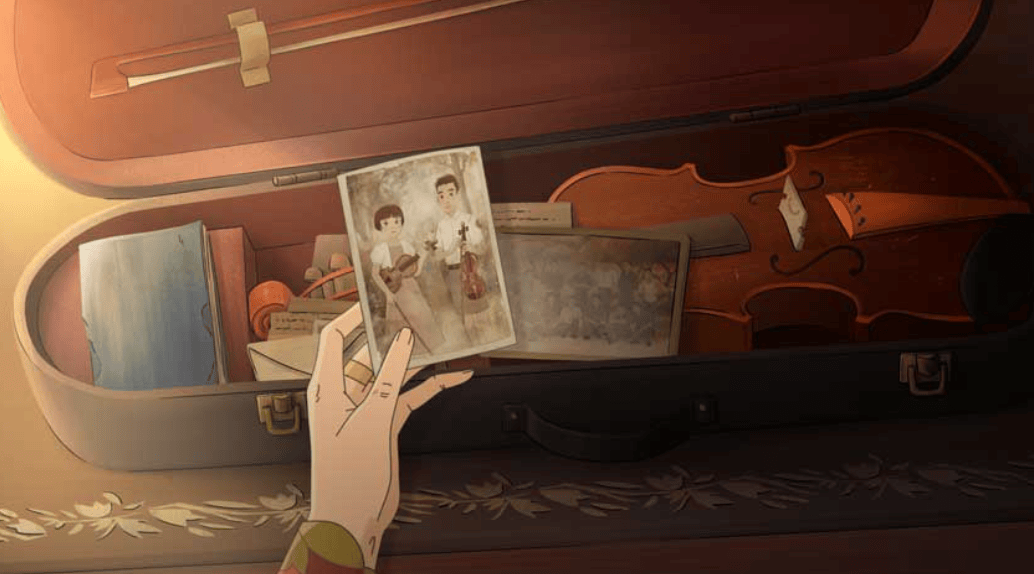
For Ervin Han, The Violinist was never intended to be simply a film about Singapore. It was, more specifically, an attempt to tell a story that could travel beyond Singapore without losing the place that gave it meaning.
That balance was something Han was conscious of from the beginning. The Singapore-Spain-Italy co-production, which he co-directed with Spanish animation veteran Raúl García, had to work for audiences who might know very little about Singapore, while also giving Singaporean viewers something more intimate to recognise in it.
“I was quite cautious about this, making it for two sets of audiences, especially for local films,” Han says. “I was very mindful of making it for two sets of audiences. For sure, international audiences—the film had to work in a global marketplace because of the budget. But it also meant a lot for Singaporeans to see the film, for obvious reasons.

“For international audiences, it was important that they didn’t need to know anything about Singapore to connect with the story and characters. But for Singaporean audiences, seeing it had to mean much more as well, for the people here.”
That dual purpose is visible from the opening moments of The Violinist. The film begins with recognisable contemporary Singapore, seeing a journalist speed away from the Esplanade with the Marina Bay skyline, postcard version of the city in the background, before a flashback has us travelling backwards into an earlier Singapore, where the story of childhood friends Fei and Kai unfolds against the upheaval of the Japanese Occupation.
Han says the decision was deliberate, although he resists the idea that Singapore itself was meant to function as a character. “I wouldn’t say I set out to make Singapore a character. It was more a case of giving Singapore a visual identity within this world,” he says. “What you see on the postcards is Singapore from the audience’s point of view. Even for locals, you see Marina Bay Sands and think, ‘Okay, this is Singapore,’ before we transport the viewer into a different time and place.
“In that regard, it’s quite intentional. We wanted to establish that this is present-day Singapore, in 2018, and establish a timeline to it. But we wanted to open with a contemporary look before time-travelling back.”

The contrast is important due to how The Violinist is concerned with how quickly a place can change, and how easily the past can become something that exists only in fragments. Han and his team were unusually meticulous about reconstructing the Singapore of the film’s historical period, down to details that audiences might never consciously notice. “The landscape of Singapore was very crucial. It’s a period piece, and we took very little liberty when it came to depicting old Singapore,” he says. “The exteriors, interiors, the width of the streets.”
There were exceptions, particularly when reconstructing areas such as old Chinatown, where the team had to work with surviving references and modular shophouse designs. But even where the filmmakers took artistic liberties, the aim was to preserve the feeling of a historical image. “Some of the things we did with Chinatown in the film, we had to take some liberty,” Han says. “But we always had some kind of historical reference. We wanted it to feel like an old photograph. That level of authenticity and historical accuracy was important.”
That attention to detail may mean something different depending on where the viewer is watching the film. Han says overseas audiences have often responded to the visual reconstruction with surprise, particularly when they learn that some of the locations were based on real buildings. One example is Baba House, which he says some international viewers assumed could not have been recreated so faithfully in animation.
For Singaporeans, however, that recognition can be more immediate. The film is filled with buildings, streets, theatres and other spaces that have disappeared, changed beyond recognition or survived only in photographs and memories.
That sense of historical recovery becomes even more significant when the film moves into the Japanese Occupation. Han believes Singaporeans know the broad outlines of the period, but often without the emotional or personal context that makes history feel lived rather than memorised. “A lot of Singaporeans are aware that there was a Japanese Occupation,” he says. “But I think there’s quite a fragmented understanding. Especially for younger generations, it’s textbook pages. There are dates, there are places, there are events, but there aren’t necessarily stories or emotional connections. That was something I was quite mindful of, and hopeful that the story could inject a bit more historical resonance into how we think and feel about those years.”

The response from international audiences has reinforced that decision. At screenings in France and Canada, including Toronto, Han says viewers have told him they had little understanding of what the Japanese Occupation in Southeast Asia actually looked or felt like. Audiences were often more familiar with the European theatre of the Second World War, or with Hiroshima and the American-Japanese conflict, than with the experiences of countries in Southeast Asia.
That gap was part of what interested him. The Violinist is not, he stresses, a conventional war film. It is about people living through war, and about what happens when moral choices become impossible to separate from survival.
The character who most clearly embodies that idea is Takeshi, a Japanese soldier whose relationship with the protagonists becomes increasingly complicated. His presence also represents one of the film’s biggest risks: asking audiences to see humanity in someone on the occupying side without asking them to forget or excuse the violence of the Occupation. “You can see how we took a very big swing about an hour in,” Han says. “It’s like a jolt to the system. I was never interested in telling a sweet, nostalgic love story. It’s not so much a war film as one about people living through war and conflict, and the choices they make on either side.”
“Takeshi is not complex, but he is conflicted. It’s about asking: What would you do in this situation? He’s a loyal soldier, capable of violence, who wants to capture and kill the enemy, but also wants to go home.”
Han is careful about the distinction between humanising and absolving a character. He researched accounts and literature from the Occupation, including stories of Japanese soldiers who could behave with kindness towards children or show restraint in certain circumstances. Such details did not, in his view, erase the brutality of the wider occupation. “To humanise him doesn’t absolve him. We don’t shy away from the brutality of the Occupation and the horrible things that go on,” he says. “The film is interested in the idea that we don’t want to reduce them to stereotypes. The way people suffer and die, and don’t get to go home, that kind of thing applies to both sides.”

The film takes a similarly human-scale approach to Lim Bo Seng, who appears not simply as a historical icon but as a moral reference point for Kai. Han spoke to Lim Teck Ying, Lim Bo Seng’s grandson and a former Brigadier-General of the Singapore Armed Forces and former CEO of Sport Singapore, who encouraged him not to place his grandfather on an unreachable pedestal.
Han was interested in the man behind the historical reputation: someone who loved his family, acted according to his principles and was willing to act when others would not. His mission, ultimately, failed. “He didn’t kill enemies or win big wars. In fact, this mission failed. But it’s about the motivation and the man behind that,” Han says. “He’s the perfect mentor figure for Kai, a moral anchor.”
It is a fitting approach for a film that repeatedly asks what survives after the grand narratives of history have faded. For Han, the answer is often music. The Sunset Sonata was written into the screenplay from the beginning, even before it had been written as music. It functions almost as a third protagonist, binding Fei and Kai together when circumstances separate them. “The Sunset Sonata was always in the script, like a character, but never on the page,” Han says. “We cannot think of Fei and Kai without thinking of this music.”
The piece changes as the characters do. What begins as something idealistic and romantic becomes fragmented by war, before being gradually reassembled after the conflict. It becomes a kind of musical correspondence between the two characters: letters to each other that can continue even when they cannot. “After the war, they’re piecing it together again. It’s about repair and healing,” Han says. “Only when she lets go and puts herself into the music and hears it as a concerto is it complete.”

The film’s use of music is inseparable from its animation. Han says the production deliberately exercised restraint in its movement, rather than constantly attempting to demonstrate technical sophistication. “We did want efficiency and elegance in movement,” he says. “Much of the animation also has a lot of restraint, letting the characters breathe. There’s a lot of dialogue cut, letting the music do the work, and carries scenes in ways that words couldn’t.”
That principle extended to the animation of the violin itself. Because so much of the music is diegetic, with the characters are actually playing the instrument within the story, the physical mechanics mattered. For the performance sequences, the team worked from reference footage of actual violin playing, using rotoscoping and a 3D avatar to establish the camera and movement before drawing the animation frame by frame.
The level of detail was not simply cosmetic. Han recalls violinist Chloe Chua telling him that the fingering in one of the Tchaikovsky sequences was “on point”. It was the kind of detail that could easily go unnoticed by most viewers, but a wrong hand position would have undermined the illusion for anyone who did notice. In a film so dependent on music, the performance had to feel physically credible.
That attention to movement is part of a broader visual language that shifts between hand-drawn animation, watercolour, sketches, slideshow-like imagery, rotoscoping and 3D. Rather than treating these techniques as demonstrations of what the studio could do, The Violinist uses them to alter the texture of memory, loss and subjective experience.
The effect is particularly striking in the film’s more quiet passages, when the imagery begins to feel less like a conventional animated sequence and more like fragments being recovered from memory. After loss, the visual language becomes looser and more impressionistic, allowing the emotional impact of a moment to take precedence over literal representation. That, Han argues, is precisely why the story had to be animated. “Animation is a paradox. What you see onscreen is artificial, not real, but frame by frame it comes alive,” he says. “You surrender yourself even more to it.”
For Han, animation removes some of the burdens of realism that might otherwise dominate a live-action production. It can stretch time, compress memory and move between reality and dreams without having to justify every transition according to the physical rules of the real world. “It doesn’t have the burden of realism,” he says. “You’re not focused on accuracy, acting, breath, action sequences. If done well, the emotions can be more pure and powerful in animation. It’s all not real, but because of that, there’s a different unspoken contract with the audience.”

That conviction was tested repeatedly during the making of The Violinist. The film’s eventual recognition at Annecy, where it won the Cristal for a Feature Film as well as the SACEM Award for Best Original Soundtrack, making it the first Singapore-produced animated feature to win the festival’s top prize, might make the journey look inevitable in retrospect. It was anything but. “There were a couple of times when we came very close to pulling the plug,” Han says.
At one point, financing fell apart, leaving the production facing a serious decision about whether it could continue. The crisis came roughly six to eight months before completion. The team considered the possibility of abandoning the project, while additional debt was taken on to keep production alive. “It wasn’t easy,” Han says.
What ultimately kept the film moving was not simply the senior leadership or financial backers, but the production team itself. Artists and crew members took ownership of the film, working long hours to get it across the finish line. “I guess it was them who saved the film,” Han says.
That long production history also explains why Han is reluctant to describe The Violinist as a technically perfect film. After years of work, the temptation would be to continue refining it indefinitely. “We could edit it forever,” he says. Instead, he returns to an idea he encountered elsewhere: “Art is never finished, art is abandoned.” “At some point, you have to stop and abandon it, and hand it over to the audience,” he says. “It’s not a perfect film, but I think the imperfections, just like a person, are part of it.”

For Han, the response at Annecy was ultimately less about technical accomplishment than emotional connection. “We didn’t win the Cristal because of technical proficiency. We are technically proficient, but there are so many French films that are technically proficient and visually astounding,” he says. “The film moved them. They remember it. The jury and audience forget the imperfections. They remember how the story was and how they felt. We should celebrate that, and not pick on imperfections so much.”
The Cristal has inevitably changed the way the film is being discussed. For a Singaporean animation studio working within a relatively small domestic industry, the win has brought a degree of international attention that would have seemed improbable when the project began. Han is cautious about predicting what it means for the wider industry, but he hopes it can challenge the perception of Southeast Asia as primarily a place for animation outsourcing. “We see ourselves as a Southeast Asian studio,” he says. “SEA struggles for international animation recognition beyond outsourcing ‘sweatshops’.”
He does not expect one award to transform the regional industry overnight. The animation sectors in Singapore, Malaysia, the Philippines, Thailand and elsewhere have different histories, capabilities and ambitions. But the recognition does provide a form of validation: the film could be made, and it could find an audience. “I don’t know if it’ll change the industry, but I hope it brings attention to what we’re doing here,” he says. “There are no excuses, but it was a damn hard road.”
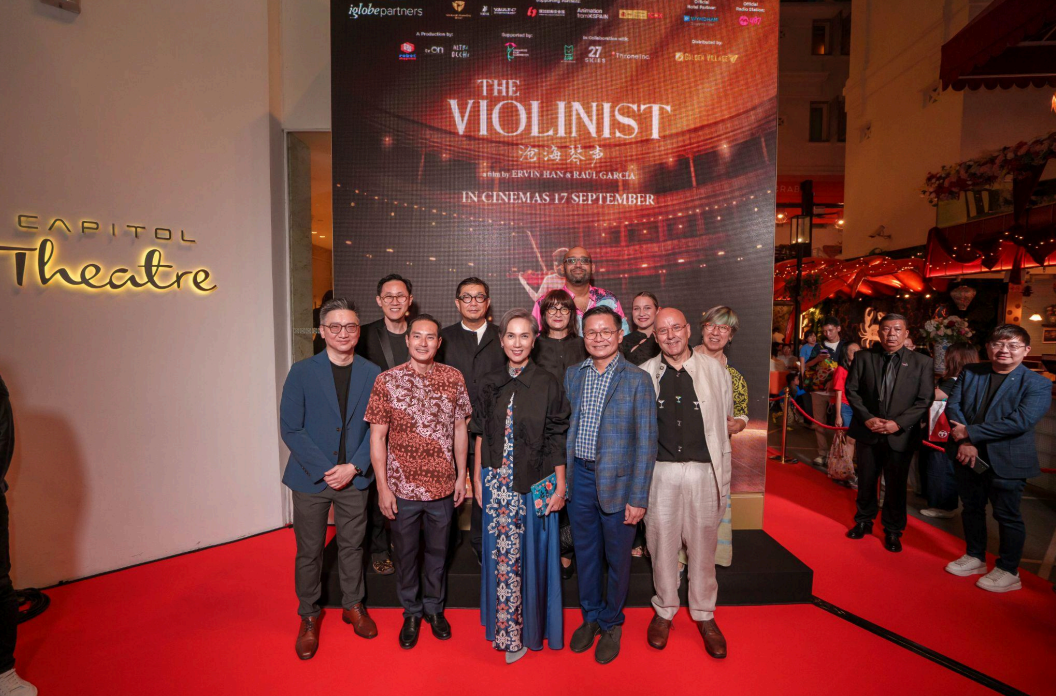
He also hopes the attention can translate into greater collaboration across the region, with more regional films travelling to festivals and finding releases outside their home markets. And then there is another audience Han is particularly interested in reaching: young Singaporeans. He wants The Violinist to remain in cinemas for as long as possible and is also working with educational institutions, partly because of his own experience of learning history at school. “History was one of my worst secondary school subjects,” he says. “Would a film like this have stirred my interest?”
For him, that question goes beyond whether the film can make history lessons more entertaining. The point is to restore an emotional connection to stories that risk disappearing as generations pass. “History is not about dates or events. It’s about the way we connect through family and the country’s stories,” Han says.
That may be the most personal ambition behind The Violinist. The film was born from an interest in a particular period and a particular place, but Han sees it as part of a larger act of preservation, opening a door into stories that younger Singaporeans may never otherwise encounter. “Singapore is 61. It’s barely a generation. It’s about 100 years since all this happened, practically a lifetime, but Singapore has changed so drastically,” he says. “It feels almost as if the Singapore we know has always existed.”
The film, he hopes, can disrupt that assumption. It can show that the Singapore of today is only one moment in a much longer, messier history, and that the stories of previous generations remain embedded in the country even when their physical surroundings have disappeared. “I hope the film opens up this vault,” he says. “Maybe we know ourselves a bit more. We know our family and can talk about what they went through.”
He has already seen some of that happen in cinemas. Children have asked their parents questions during or after screenings, questions as basic as, “Why are the people shooting at him?” and “Why is this happening?” “But that’s a start,” Han says.
Perhaps that is why he remains less interested in whether The Violinist perfectly captures every historical detail or whether every visual experiment lands than in whether it creates a reason for people to look again at the history around them.
For all the international recognition, the film ultimately comes back to something much more intimate: belonging to a place, and trying to understand how that belonging is formed. Han says that feeling is difficult to articulate through a simple definition of national identity. It is something people experience collectively, whether in cinemas, during National Day celebrations, through family stories, and in simply the recognition of places that feel familiar even after they have changed.
To Ervin, the idea of national identity may be something that emerges only when all those fragments are placed together. “Put it all together, and it’s what it means to be Singaporean.” It is a fitting thought for a film that took years to assemble its own fragments, of history and memory, music and images, war and romance, old Singapore and new Singapore.
Han wrote the ending of The Violinist in 2017. Seven or nine years later, after financing crises, production changes, COVID, international collaboration and the long road to Annecy, he says the destination never really changed. “It’s the film I always wanted to make from start to finish,” he says. “And finally, it’s been made.”
The Violinist is now playing in cinemas such as Golden Village in both English dubs and Mandarin dubs.

