
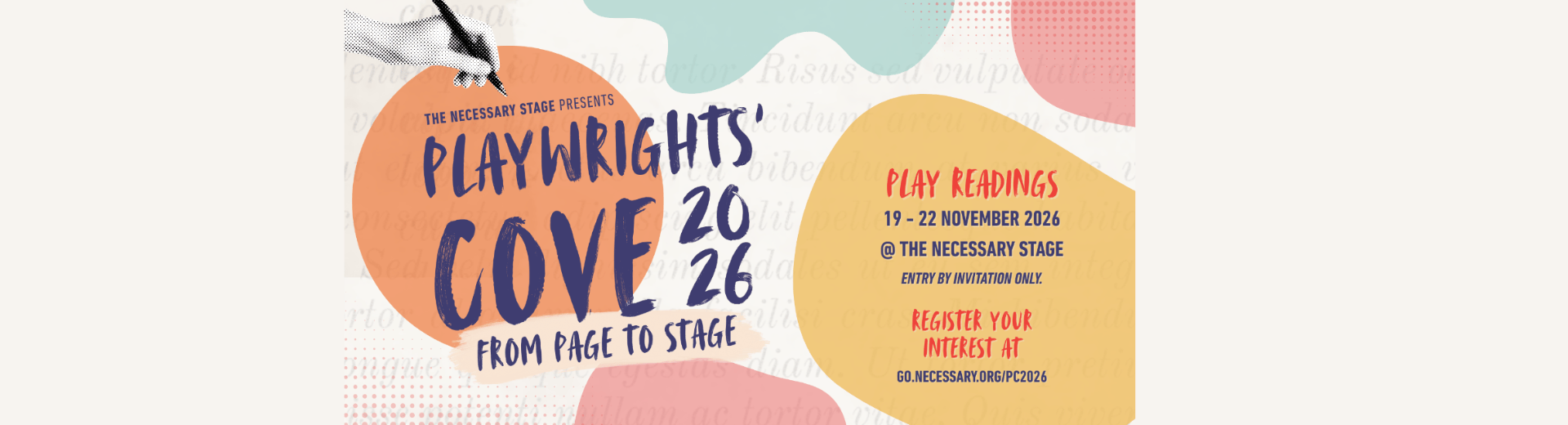
What happens when a writer accustomed to the intimacy of the page has to make a story live, breathe and speak in front of an audience? That question is what sits in the centre of Playwrights’ Cove 2026: From Page to Stage, The Necessary Stage’s annual playwriting programme, which this year brings four literary artists into the theatre-making process. Ahmad Syarif, Daryl Qilin Yam, Noonherd and Rachelyn Gordon have spent months working with The Necessary Stage’s Artistic Director and acclaimed playwright Haresh Sharma, transforming existing and new prose and poetry into scripts.
The programme culminates in four intimate, invite-only play readings from 19 to 22 November, where the writers’ works will be brought to life by Singapore-based directors and theatre practitioners. Each reading will be followed by a dialogue with the artists, facilitated by Sharma. Rather than simply teaching the mechanics of playwriting, From Page to Stage asks its participants to reconsider how stories behave when they leave the page. Character, dialogue, structure and narrative become tools not just for telling a story, but for allowing an audience to encounter it in real time.
For Daryl Qilin Yam, whose writing spans novels, short stories, editing and arts organising, the experience has been both an artistic challenge and a personal adventure. “I’ve always been a student at heart, always up for new adventures, and a writer who’s always led with his heart,” he says. “Learning the basics of playwriting under one of the most important and pivotal theatre-makers we have, in such a supportive and well-structured environment as well, has been both a privilege, an honour, and a truly rare exercise in dreaming.”
Yam brings Passersby to the programme, a story that unfolds almost entirely through conversations across a single pivotal day. At its centre is O, a man who appears to have every reason to stay where he is, a good flat, a current partner and the return of an acclaimed exhibition he curated for the Singapore Pavilion at the Venice Biennale. Yet he is contemplating a job in Hong Kong and, more significantly, the possibility of ending his relationship. As the day unfolds, O must also contend with his best friend’s deteriorating condition and the ghosts of relationships past. The play becomes an exploration of the things people carry with them even when they believe they are ready to leave.
If Passersby looks at the emotional weight of change, Ahmad Syarif’s Meander approaches it through grief, family and the sea. The story follows Hadi, whose father, a ship technician, dies in a machinery accident offshore. A year later, Hadi has withdrawn from school, struggling to find a way through grief. His understanding of water, how it moves and behaves, does little to help him understand how he should move forward himself.
An unexpected opportunity arrives when Hadi is accepted onto an OceanX expedition to Cabo Verde, a place his high-achieving classmate Alexa had hoped to go. But the expedition comes with financial and emotional complications. Hadi’s mother, Salmah, is the family’s sole breadwinner, running a jamu business beneath their block, while the sea that shaped her late husband’s life is also the sea she fears will take her son away.
For Syarif, whose literary practice is closely tied to ocean imaginaries and the relationship between people and their environments, the process of adapting his writing has been unexpectedly introspective. “Before my writing speaks for my characters, it often speaks about me,” he says. “The choices I make on the page made obvious my inclinations and assumptions, and my own ways of thinking and feeling, so this process has become as much as a self-discovery process as it is an artistic one.”
That sense of discovery extends into Noonherd’s for the love of god, which brings together love, faith, old relationships and unfinished business. Aruna has built a life around hard work, food and prayer, until her ex, Indu, unexpectedly returns. Indu is preparing to marry a man in London, but before she can do so, she needs Aruna to sign their divorce papers. The pair have one week to deal with the past, and decide whether the feelings between them have truly disappeared.
Written in English and Tamil, the play explores what remains between two people after a relationship has ended, while leaving room for humour, intimacy and the possibility of rekindling something that was thought to be over.
For Noonherd, a Tamil prose and poetry writer whose work explores divinity, hybridity and kinship, entering theatre has opened up another way of thinking about form. “Having a safe yet challenging environment to learn playwriting has been a massive privilege,” she says. “I’ve grown as a writer to consider how different mediums, genres, and artforms can coexist in the liminal space that is a play, and am excited to experiment and create more.”
The final work, Rosie and the Mamak Shop by children’s author Rachelyn Gordon, shifts the focus to a neighbourhood and the relationships that grow around it. Adapted from Gordon’s picture book, the play centres on Rosie and Uncle Hassan, and their shared affection for the beloved mamak shop that forms part of their everyday lives. But change is coming, and the story asks whether Rosie, Uncle Hassan and the shop they love can adapt without losing what makes the place special.
Recommended for audiences aged six and above, the work brings a distinctly family-oriented perspective to this year’s programme, while continuing the larger concerns that run through the four works: friendship, relationships, belonging and the difficulty of navigating change.
For Gordon, who is a creative writing teacher, children’s author and mother, one of the biggest lessons from the programme has been the discipline required to make writing work on stage. “The one thing I am taking away and trying to drill into myself from Playwrights’ Cove 2026 and Haresh’s mentorship is that good writing is clear, crisp, concise, and full of character,” she says.
Together, the four works demonstrate just how differently literary instincts can translate into theatre. A story about a man contemplating departure becomes a sequence of urgent conversations. A meditation on grief finds its shape through the physical and emotional pull of the ocean. A complicated romance becomes a collision between two former lovers. And a children’s picture book expands into a story about community, affection and adapting to change.
The readings will be directed by Yvan Karlsson, Irfan Kasban, A Yagnya and Deonn Yang, with performers including Fadhil Daud, Luke Kwek, Sindhura Kalidas, Wayne Lim, Chew Shaw En, Izzul Irfan, Moli Mohter, Salif Hardie, Indumathi Tamilselvan, Maya Nanthekumar, Norisham Osman, Tan Rui Shan, Vanessa Toh and Zulfiqar Izzudin.
The format remains deliberately intimate. These are works-in-progress rather than fully staged productions, giving audiences the opportunity to encounter the writing at a moment when it is still developing and to hear directly from the creators afterwards.
For The Necessary Stage, which has presented more than 130 original plays in Singapore and overseas since its founding in 1987, the programme is part of a broader commitment to nurturing new voices and local content. Under Sharma’s mentorship, Playwrights’ Cove provides emerging writers with a space to experiment, test ideas and discover what their work might become in another medium.
The four readings take place at The Necessary Stage’s studio at 180 Paya Lebar Road from Thursday 19 to Sunday 22 November 2026, with evening sessions from Thursday to Saturday and a Sunday afternoon performance. Entry is by invitation, with members of the public able to register their interest through The Necessary Stage.
From Page to Stage is all about finding a new language for literature. These four writers arrive with stories shaped by prose, poetry, memory and observation; the challenge now is to let those stories take on voices, bodies and silences of their own. The page may be where a story begins, but theatre is where it gets to meet its audience.
Playwrights’ Cove 2026: From Page to Stage runs from 19th to 22nd November 2026 at 180 Paya Lebar Road. Entry is by invitation, with members of the public able to register their interest through The Necessary Stage here

