
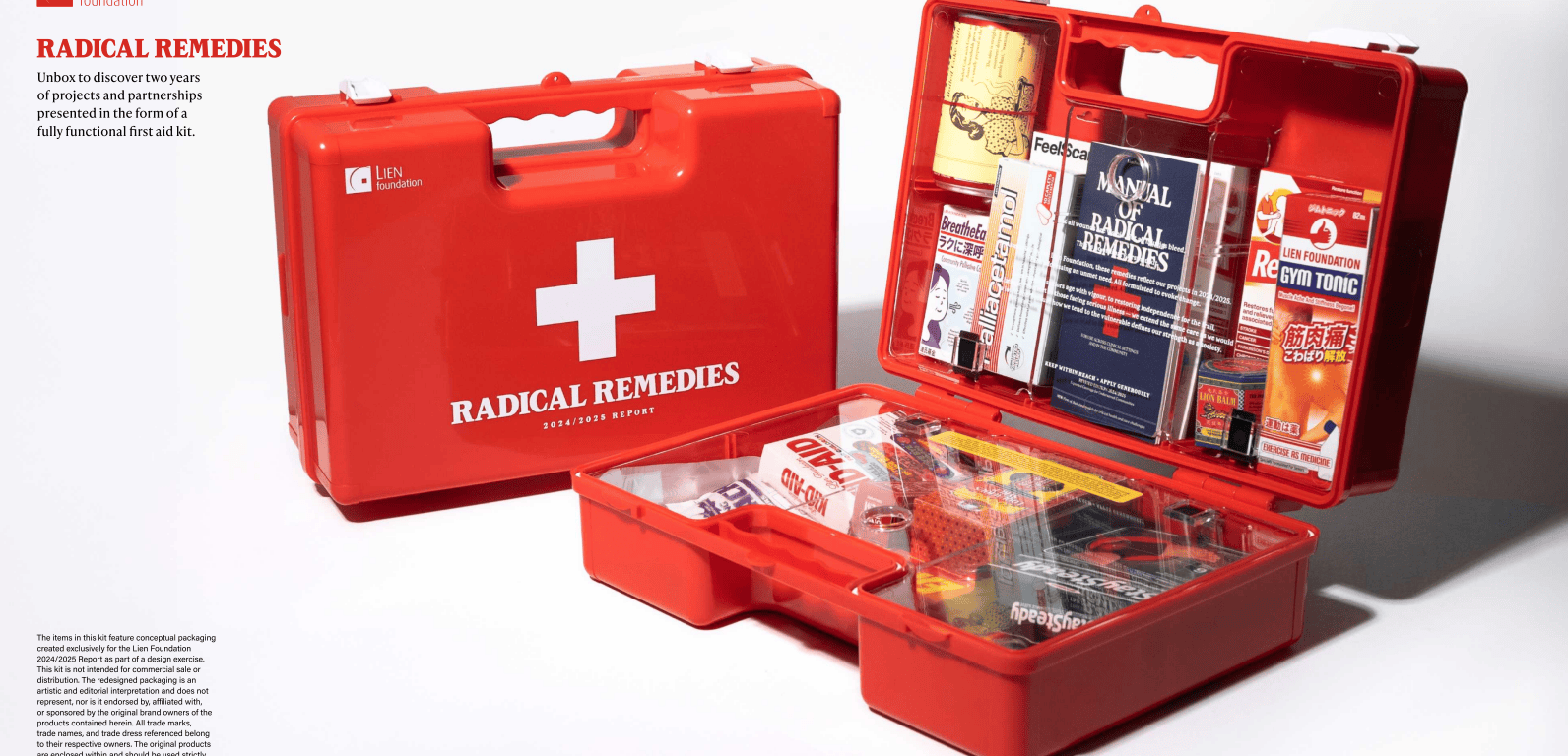
With its 2024/2025 biennial report, Lien Foundation turns a familiar first-aid kit into an unconventional portrait of radical philanthropy. In collaboration with Kinetic Singapore, the project explores how creativity can make difficult social issues more accessible, challenge established ideas of care and inspire new ways of thinking about impact.
Annual reports are not usually objects people look forward to opening, let alone keeping within reach. But Lien Foundation’s latest biennial report is designed to do just that. Radical Remedies, created in collaboration with independent creative agency Kinetic Singapore, takes the form of a physical first-aid kit. Inside are 14 creatively reimagined remedies and a bonus item, each representing initiatives from the Foundation’s work across health and social care.

It is an unexpected format for an institution whose work addresses some of society’s most difficult issues, including ageing, dementia, caregiving and end-of-life care. Yet the first-aid kit is more than a clever packaging idea. It is a tangible expression of the Foundation’s belief that philanthropy should be willing to challenge convention, tackle root problems and find practical ways to create change.
For Mr Lee Poh Wah, CEO of Lien Foundation, that willingness to think differently is central to the organisation’s purpose. “Philanthropy is about finding capable, caring people, and giving them the resources, space and courage to do great work. At its core, our role is resource allocation and talent management to seize unique opportunities in our markets. Radical means daring to be different and tackling root problems, which often calls for practical remedies rather than grand gestures. We muster the courage to reimagine our role, play moral compass and barrier breaker. Our priorities and scale have changed over the years, but we cling to one constant: aim to add value not only financially, but strategically, intellectually and emotionally, walking alongside partners for the long haul.”

That philosophy has shaped not only the Foundation’s programmes, but also the way it communicates its work. Lien Foundation’s biennial reports have long departed from the conventions of institutional reporting. From George’s Anatomy to How to Fight Like a Legend, each edition has used an unconventional form to communicate the Foundation’s values and work.
For Lee, this is not simply a matter of making an annual report more interesting. “An annual report is more than a report card. It is organization’s portrait, a storytelling vehicle and a marketing tool. It is also fertile, largely untilled ground for great design. When we think differently about our reports, we think differently about ourselves.
“We treat each report as a crafted object or exhibition that embodies our values, style and outlook. Playful design lets readers experience the message, not just read it. Each report should inform, surprise and delight, and is also a platform to honour our existing partners and inspire new ones.”

The response to these reports has also revealed something about the potential of creative communication.
“Some unintended consequences:
- Every edition, someone tells us it is the first report they have read cover to cover.
- Some readers collect our reports for their design. Some requested for extra copies as gifts to friends. Others were motivated to collaborate with us after reading one.
- There were a few individuals (here and overseas) who wanted to purchase our reports
- This year’s kit became an unexpected instrument of storytelling across ages and professions. Children seem particularly fond of it, and our partners were chuffed to have something that explains their day job to their young ones.”
The latest report builds on that legacy, but its concept emerged from the nature of the Foundation’s work itself.

For Gian Jonathan and Astri Nursalim, Partners at Kinetic Singapore, the first-aid kit was a way to bring the Foundation’s diverse portfolio together through a familiar, practical object. “Our initial reaction was equal parts excitement and responsibility. Lien Foundation has a long-standing reputation for pushing boundaries, so the brief was never going to be about producing a standard summary of two years of work. It was about making people feel the urgency, care and purpose behind every initiative.
“When reviewing their complex, wide-ranging projects across palliative care, rehabilitation, eldercare, and child and maternal health, a common thread emerged: every project was a direct intervention designed to treat an acute pain point in society. Drawing a parallel with a first aid kit felt like the most natural way to represent immediate, practical relief.
“What’s more, the contents of a first aid kit are inherently active. You do not open a kit to admire it; you open it to fix a problem. By pairing Lien Foundation programmes with specific medical remedies, the kit stopped being just a novelty box and became a practical guide to how their work directly treats social needs.”

Lee sees the concept as a fitting expression of the Foundation’s approach. “The concept came from Kinetic, who gave the report a form that is instantly legible, meaningful and a little unexpected. Each project is reframed as a remedy, and the report becomes a practical box you will inspect, keep and use. The metaphor also organises content, tone and audience engagement in a single stroke. It says something about us too. We bring a craftsman’s mindset and a constructivist approach to tackle hard problems with partners, improving continuously and breaking the chains of conformity.”
The kit brings together 46 projects across different areas of health and social care, translating them into 14 remedies and a bonus item. Rather than grouping the initiatives into conventional institutional categories, Kinetic sought to connect each project to a medical item that reflected its purpose. “Rather than sorting projects into standard institutional buckets like eldercare or palliative care, we tied each initiative to the medical item that best reflects what it actually does on the ground. Paracetamol, for example, was a natural fit for palliative care, since both are fundamentally about pain relief.
“The goal was to make what can often be heavy reading more digestible, tangible and memorable. But making information accessible does not mean dumbing it down. The remedies give people a warm, human-scale way in; once you open the items, you discover essential details, real-world impact and human stories behind the projects.”

The project’s witty names and familiar packaging invite people to engage with subjects that can otherwise be difficult to discuss. But the creative team was conscious that humour had to serve the work, rather than diminish it. “Lien Foundation has never shied away from difficult topics, whether it’s talking about care for the terminally ill or senior mental health. For Radical Remedies, we opted for a playful touch designed to get people to lean in and explore tough conversations on their own terms<” say Gian and Astri.
“While the presentation may be witty and surprising, we were mindful not to slide into the facetious. Navigating that line meant ensuring the playfulness never came at the expense of the people behind the stories nor the seriousness of the issues. This set an even higher bar during our brainstorming, pushing us to stress-test every idea and drop any that drifted into pure parody or made light of someone’s struggle.”

For Lee, making difficult issues engaging is not separate from the Foundation’s work. It is part of what allows that work to have an impact. “We work on issues that are gnarly, often unpalatable and sometimes unthinkable. Our impact depends largely on how willing society is to engage with them. If we don’t make these topics relevant and interesting, our programmes cannot inform or influence behaviour. Attention is a scarce resource, and we strive to earn it. Serious ideas do not need solemn packaging. Creativity can turn abstract issues into something tangible, human and memorable. Woven into programmes and spaces, design turns services into experiences with empathy, beauty and joy. In our view, creativity is part of the intervention, not an alternative to it.”
For Kinetic, the challenge was also to create something that felt genuinely new, rather than simply another instalment in a series of unconventional reports. “The pressure was certainly real, but Lien Foundation’s legacy is not simply quirky design; it is radical relevance. Living up to their standard meant starting from a place of genuine purpose rather than trying to out-gimmick past reports. The format of Radical Remedies wasn’t chosen to be clever for its own sake. It emerged organically because the first aid kit is something everyone is familiar with, thus helping make complex care and social issues more accessible and relatable.”

The physical experience of the kit was an important part of that thinking. “We wanted something that felt less like an academic study and more like an invitation. Making Radical Remedies a physical first aid kit was about creating a sense of touch and participation. When people unlatch the box, pick up a remedy and unfold its contents, they are actively engaging rather than passively consuming. This ‘high-touch’ approach also mirrors Lien Foundation’s work; after all, care and support are deeply physical, human experiences.
“And unlike usual reports that are put aside once read, the fully functioning kit is meant to be kept within reach for use as needed, remaining a visible, constant reminder of the foundation’s work long after the initial launch.”
The connection between the report and the Foundation’s work runs deeper than the metaphor of a remedy. Both involve taking familiar things and rethinking how they might serve people better. Kinetic’s approach to design reflects this broader ambition. “As a design studio, we do take pride in making things look good, but we don’t see aesthetics as an end in itself. Good design has to serve a purpose, like in the projects you highlighted, whether it’s improving a space or an experience or even the way a message is presented.”

For Lee, initiatives such as Hack Kopitiam and Oasis@Outram demonstrate how design can change the experience of care itself. “Hack Kopitiam meets seniors where they are, in places where they already feel a sense of belonging and connects them to the social care system. Services reach people more meaningfully when they sit close to what people believe and value. We give seniors choice, responsibility and a sense of achievement, and treat them as active participants rather than passive recipients of care. That guards against learned helplessness.
“Oasis@Outram is a de-medicalized day hospice designed for relationships. It is counterintuitive that a place for the dying can be joyful, engaging and uplifting, for both patients and families alike. Design that dignifies and enlivens can change how the end of life is experienced, and what it means. Many isolated seniors in the community are, frankly, dying to be delighted.

“There are ongoing attempts to strengthen the soul of the care system built around clinical task, to humanize the experience of seniors and the seriously ill. The future of healthcare is inherently social because medical issues have profound social consequences.”
These projects illustrate how design can go beyond appearance to influence how people experience services, spaces and relationships. They also reflect the Foundation’s wider interest in challenging the assumptions that shape care.
For Lee, the challenge is not always a lack of possible solutions. It can also be the difficulty of changing attitudes and expectations. “Partly, yes. Culture, norms and attitudes change slowly, and they shift in earnest when the issue is reframed, a positive alternative is on offer, and the community and government take collective ownership. Society can imagine differently. Over two decades, public sentiment on palliative care and dementia has clearly improved. But the ‘stretchiness’ of imagination has to be sustained, and part of our job is to keep stoking a healthy discontent. Alongside programmes, we work with partners on awareness campaigns such as ‘A Singapore Dementia Story’ and Rehab is Your Best Koyok campaign etc.”
The Foundation’s approach is not limited to changing perceptions. It also involves rethinking how impact is measured.
Philanthropy is often evaluated through quantifiable measures, but Lee believes that the complexity of social change calls for a broader understanding of success. “We work in complex, nonlinear systems, shaped by many players and forces that interact in unpredictable ways. As such, we favour a contribution over attribution mindset, and don’t get blinded by logic models and KPIs. That frees us to try many approaches, do our best and accept what we cannot control. Effectiveness is also socially constructed: it looks different depending on who is looking and what lens they are wearing.
“Beyond quantifiable measures, we look for signs of a healthy ecosystem. Are our partners growing in competence, confidence and innovation? Are awareness and attitudes improving among professionals and the public? Is our work being adopted by others? Ultimately, we believe success is felt.”
That emphasis on learning, partnership and long-term change also informs the Foundation’s willingness to take risks.

For Kinetic, the significance of Radical Remedies extends beyond the report itself. “In a way, Radical Remedies is a physical manifestation of Lien Foundation’s radical approach to philanthropy: a daring to do things differently to create impact. It points to a broader shift in how social issues can be approached: less risk-averse and top-down, more open and collaborative. We would love to see this ethos being adopted to address the myriad challenges we face today, and the doubtless more that tomorrow will bring.”
Lee believes that risk-taking is not simply an option for philanthropy, but one of its defining strengths. “Abandon the instinct to treat risk as something to avoid. Philanthropy’s strength is not generosity or moral clarity but its capacity to absorb risk in the service of public value creation. Risk is always present like oxygen, natural and necessary for living and growing. Taking risks is an inherent part of being human and a gateway to opportunities. In an age of AI and automation, not taking sufficient risks is itself the bigger risk, and a recipe for mediocrity. By reimagining risks, time horizons and incentives, philanthropy can create value that neither government nor markets can produce on their own.”

For Lien Foundation, Radical Remedies is therefore both a reflection of its work and an invitation to think differently about what philanthropy can be.
The kit may be designed to offer remedies for specific social needs, but its wider message is that meaningful change often begins by questioning familiar assumptions. Sometimes, the most radical intervention is not simply to provide more of what already exists, but to imagine a different way of doing things, and give people the courage and resources to make it happen.
Read Radical Remedies in full here. Find out more about Lien Foundation here

