
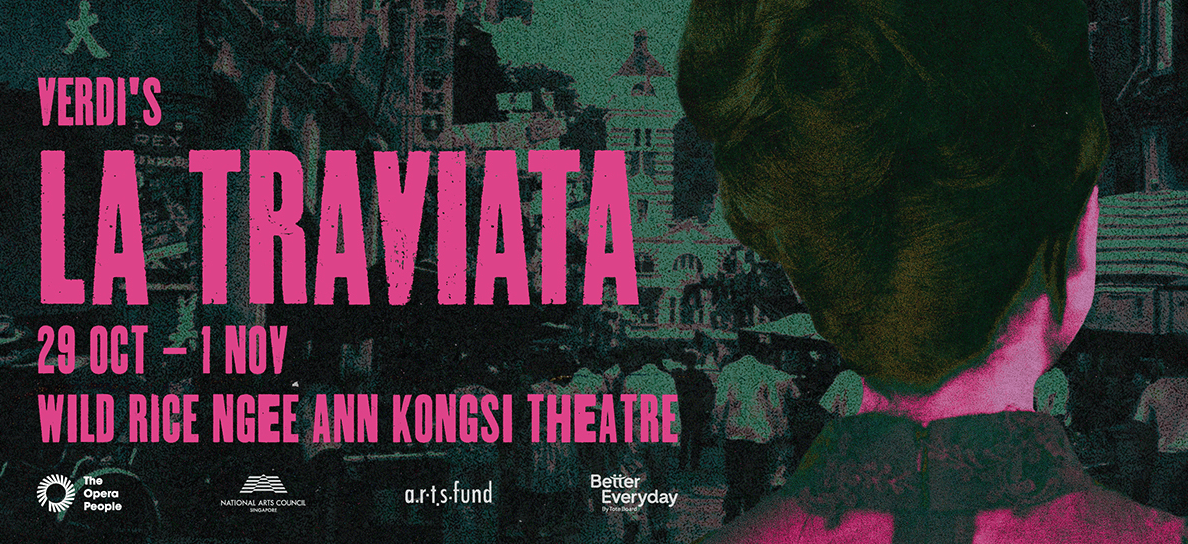
The Opera People’s Singapore-set production of Verdi’s beloved opera is a colourful, engaging theatrical experience that preserves the emotional force of the original while giving it distinct local flavour.
Duration: 150 minutes, with two 15 minute intermissions, Performance attended 29 October 2026
Opera always provides good melodrama. Give it romance, social disapproval, a family feud, a public humiliation and an impending tragedy, and you have all the ingredients for an evening of theatrical indulgence. Giuseppe Verdi’s La Traviata has been doing precisely that since its premiere in 1853, and The Opera People’s latest production makes a convincing case for why the opera continues to resonate, even when transplanted to a different time and place.
Directed by Tan Shou Chen, with musical direction by Lien Boon Hua, this production relocates the familiar tale of Violetta Valéry and Alfredo Germont to Singapore in 1961, on the eve of independence. It is an intriguing choice of setting, particularly given the historical significance of the Women’s Charter, passed that same year. As the production’s accompanying notes explain, the legislation marked an important moment in the struggle for women’s rights, even as questions of marriage, respectability and social acceptance remained deeply contested.
The parallels with Violetta are apparent. A celebrated hostess, she inhabits a world happy to enjoy her company but unwilling to accept her as a respectable partner or future wife. Her relationship with Alfredo is consequently threatened not simply by personal differences, but by the expectations of a society that measures women according to their reputations and pasts. The director’s personal reflections on the women in his own family, whose lives existed in the often-unacknowledged margins of marriage and social respectability, add another layer of poignancy to this reinterpretation.

That said, the Singaporean setting does not radically alter the opera’s narrative, and perhaps that is for the best. This remains La Traviata as Verdi imagined it, with the familiar dramatic progression and emotional turning points intact. There are occasional moments when the relocation feels more cosmetic than practical: Violetta and Alfredo’s retreat to a country house, for instance, carries a slightly different implication in a geographically compact Singapore. Nevertheless, the production does not strain to localise every aspect of the story. Instead, its Singaporeanness emerges more naturally through its visual language, costumes and social atmosphere.
The staging is particularly effective in making the most of Wild Rice’s relatively intimate theatrical space. Set designer TK Hay keeps things simple, with a striking central image: a suspended, off-white cheongsam, printed with a subtle floral pattern. Its two-dimensional construction creates the illusion of a three-dimensional garment, as though an invisible figure were wearing it. Slightly tilted to one side, it has an almost coquettish quality, while also suggesting the presence of Violetta herself and the identity she inhabits as a courtesan. Its reduced prominence during the country-house scenes is a subtle visual reminder of her attempt to leave that world behind.
The rest of the set is similarly restrained. A movable staircase, curtains and a handful of carefully placed pieces of furniture are enough to establish the different locations, whether a desk for the second act or a bed beneath a starry backdrop for the final scenes. Adrian Tan’s lighting deserves particular credit for helping these transitions along, moving convincingly between the brightness and bustle of a party and the more intimate, sombre moments that follow. The production demonstrates that a limited stage need not mean limited theatrical possibilities.
Costume designer Johanna Pan also contributes considerably to the production’s visual appeal. The costumes are varied and colourful, evoking a particular Singaporean social landscape through everything from sarong kebayas to more elaborate, lacy two-piece ensembles and evening dresses. Violetta, in particular, is consistently dressed to stand apart. She is unmistakably the centre of attention, and the contrast between her presence and that of the other partygoers reinforces her position within this social world. She may occasionally cough, but she never quite loses the poise and authority with which she carries herself.

One of the production’s most enjoyable features is its treatment of the party scenes. Yvan Karlsson’s movement direction and choreography, working alongside Tan’s direction, bring a playful theatricality to the gatherings. The courtship rituals and deliberately silly dances are entertaining to watch, with the first party feeling relatively innocent and the later gathering taking on a more sensual character. There is a pleasing sense of the performers playing with one another, almost inviting the audience into the game. The laughter and audible enjoyment around the theatre suggest that this approach works.
It is also in these scenes that the production’s melodramatic sensibility becomes particularly apparent. Rather than distancing the audience from the story, the staging embraces its theatricality, allowing us to enjoy the spectacle before gradually drawing us into its more painful consequences.
Renata Hann Sungwon makes for a compelling Violetta, bringing both the character’s social confidence and emotional vulnerability into focus. She has a commanding physical presence, and it is easy to understand why she would be the centre of attention in any room. When she meets Alfredo, played by Jonathan Charles Tay, there is a convincing sense of attraction beneath her initial resistance. Their exchanges and individual vocal moments convey the excitement of discovering a love that might offer something beyond the superficial pleasures of Violetta’s usual life.
One particularly affecting moment comes with Violetta’s famous Sempre libera. The number is often remembered for its vocal demands and dazzling coloratura, but here it also becomes an expression of her internal conflict. Her face and physicality reveal a woman attempting to convince herself that she remains committed to her independence, even as her feelings begin to pull her elsewhere. Watching someone so accustomed to carrying herself with pride gradually surrender to the possibility of love gives the scene its emotional charge.
The arrival of Giorgio Germont, Alfredo’s father, introduces a different kind of tension. Played by David Charles Tay, Germont is not an overwhelmingly forceful antagonist. Instead, there is something quietly threatening about his approach, with an understated authority that makes his demands all the more uncomfortable. His voice and expression shift as the confrontation develops, revealing the anger and conviction beneath his outward composure. Against him, Violetta’s fear and desperation are palpable. Their encounter is one of the production’s more affecting dramatic exchanges, particularly because her eventual sacrifice is made in the knowledge that she is unlikely to receive the recognition or understanding she deserves.
The second party scene delivers one of the evening’s most striking theatrical moments. When Alfredo storms in and throws money at Violetta, the flurry of notes falling around her as she lies on the floor creates a particularly arresting image. It is a sudden and brutal departure from the playful atmosphere established earlier. The tension in the room is immediate, especially as the other characters react to Alfredo’s public humiliation of Violetta. It is a reminder of just how quickly the pleasures of this social world can turn cruel.
By the final act, the production has stripped away much of the earlier glamour. Violetta’s world has narrowed to her sickbed, and the emotional focus rests almost entirely on her. Sungwon’s final vocal passages rise with an intensity that makes it difficult not to want to call out a resounding bravo. There is a particular poignancy in hearing her voice continue to soar even as Violetta’s physical circumstances deteriorate. The contrast between the vitality of the music and the inevitability of her fate is, as ever, devastating.

Musically, the production is well served by Lien Boon Hua’s direction and the Wayfarer Sinfonietta. Working with Jonathan Lyness’s reduced orchestration, the ensemble offers a scaled-down but still satisfying musical experience. The sound retains a sense of fullness within the theatre, supporting the singers without making the production feel diminished by its smaller forces. Given the emotional and musical demands of La Traviata, the intermissions between the acts also feel welcome. There is a great deal for both performers and audience to absorb, and the pauses offer some room to breathe before the next wave of drama arrives.
Ultimately, The Opera People’s La Traviata is a thoroughly enjoyable production that understands the enduring appeal of Verdi’s work. Its Singaporean setting is most evident in its aesthetics and historical framing rather than in a fundamental reworking of the narrative, but that is not necessarily a shortcoming. If anything, it demonstrates how readily this familiar tragedy can inhabit a different cultural landscape without losing its emotional core.
There is also something rather fitting about presenting La Traviata as a kind of period television drama. Its heightened emotions, romantic declarations and sudden reversals are precisely what make it so entertaining, even as its underlying questions about gender, class and respectability remain serious. The production gives us plenty to enjoy, plenty to gasp at and, ultimately, plenty to feel. Violetta may belong to another century, but the question of who gets to love freely, and who is deemed worthy of acceptance, is hardly a thing of the past.
Photo Credit: The Opera People
La Traviata plays from 29th October to 1st November 2026 at Wild Rice @ Funan. Tickets available from SISTIC
Production Credits
| La Traviata by Giuseppe Verdi (1813-1901) Director Tan Shou Chen Music Director Lien Boon Hua Set Designer TK Hay Costume Designer Johanna Pan Lighting Designer Adrian Tan Movement Director / Choreographer Yvan Karlsson Hair & Makeup Ashley Lim, Bobbie Ng Rehearsal Pianist Lim Chee Yap Reduced Orchestration Jonathan Lyness Production Manager Mirabel Neo Stage Manager Keira Lee Assistant Stage Manager Cristabel Ng Cast Violetta Valery Renata Hann Sungwon (29 Oct & 31 Oct), Anna Migallos (30 Oct & 1 Nov) Alfredo Germont Jonathan Charles Tay (29 Oct & 31 Oct), David Charles Tay (30 Oct & 1 Nov) Giorgio Germont David Charles Tay Flora Bervoix Cherie Tse Annina Daniela Leska Gastone Jonathan Macpherson Barone Douphol Edward Kim Marchese d’Obigny Dennis Lau Dottore Grenvil Shawn Liew Giuseppe Ted Ngoo Domestico/Commissionario Y. Kwan Ensemble Akiko Otao, Lin Renyue, Alison Wong, Azura Farid Wayfarer Sinfonietta Cheryl Lim, Flute Stephanie Tan, Clarinet Ruihan Kee, Bassoon Alan Kartik, Horn Danny Teong, Trumpet Julia Tan, Timpani Yang Shuxiang, Violin I Megan Low, Violin II Jeremy Chiew, Viola Theophilius Tan, Cello Robert Choi, Cello Julian Li, Bass |

