
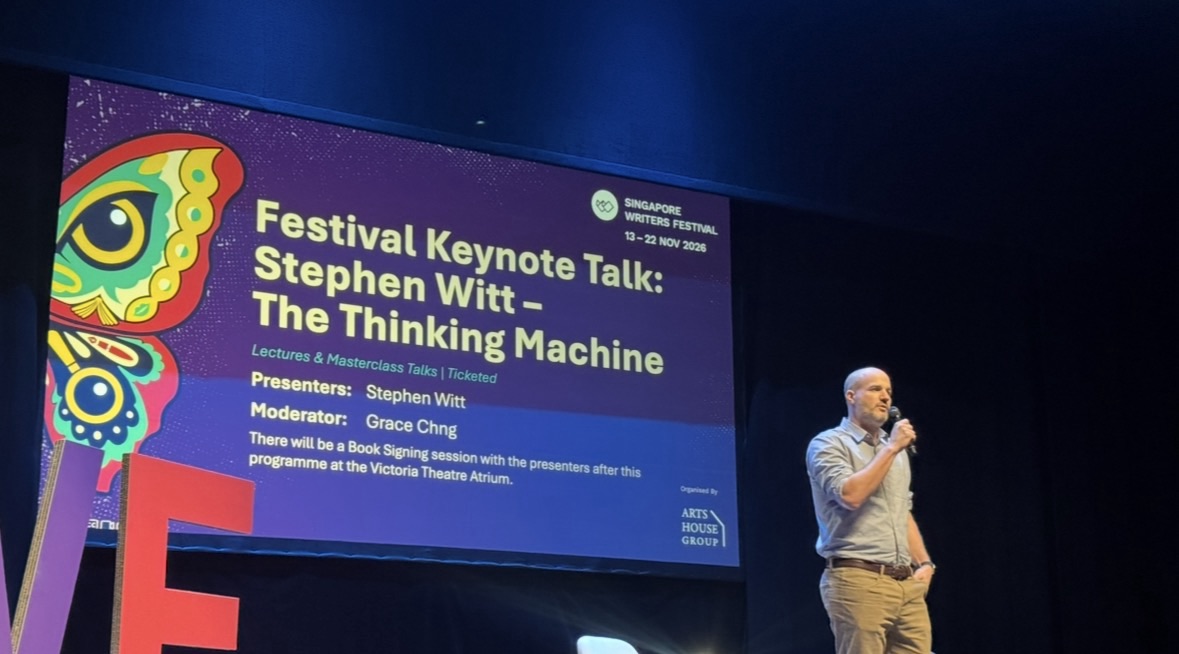

The Singapore Writers Festival 2026 opening keynote features writer Stephen Witt on Jensen Huang, human hubris, and the ‘what were you thinking’ machine
When the Singapore Writers Festival booked American journalist Stephen Witt to deliver its opening keynote, the subject was the extraordinary rise of Nvidia and its co-founder Jensen Huang, whom Witt had spent years researching for his biography, The Thinking Machine: Jensen Huang, Nvidia, and the World’s Most Coveted Microchip. Nobody could have anticipated quite how dramatically that subject would dominate the headlines just as the festival opened.
On the eve of the festival’s opening, on 12 November, Huang’s departure as Nvidia’s chief executive was announced amid a rapidly unfolding scandal involving allegations of extramarital relationships, questions surrounding Megaspeed, a Singapore-based data centre company, and concerns about possible links to the movement of advanced Nvidia equipment to China. Huang had already acknowledged being unfaithful to his wife and apologised to his family. Witt, meanwhile, had just published a first-person essay in The New York Times, titled “I Wrote Jensen Huang’s Biography. Here’s What Led to His Downfall.”
The biographer was no longer simply discussing the making of one of the world’s most powerful technology companies. The subject of his book had become the protagonist of a spectacular real-life drama. It was, in every sense, the elephant in the room. And Witt did not avoid it.
Instead, he took the audience through a story that was at once a technology chronicle, a political thriller and, as he repeatedly suggested, a Shakespearean tragedy. Drawing on years of reporting and his unusually close access to Huang, he offered something more revealing than a blow-by-blow account of the latest headlines: a portrait of a man whose extraordinary abilities, ambition and self-belief may ultimately have become the sources of his undoing.
“I think his irrational confidence in himself had taken over, and that he had become hubristic,” Witt observed.
It was a striking opening to the 2026 Singapore Writers Festival, whose theme, “Hidden in Plain Sight”, seemed almost uncannily suited to the evening. The festival, which runs from November 13 to 22, is also the final edition under the stewardship of festival director Yong Shu Hoong. There was something fitting about his closing year beginning with a keynote that asked an audience to look beyond the familiar narrative of technological triumph and examine the human contradictions beneath it.
One of the most compelling aspects of Witt’s account was the gap between the different versions of Huang that he had encountered.
There was the visionary founder, the brilliant engineer, the demanding boss, the devoted family man and the political operator. Each persona had its purpose. The problem, Witt suggested, was that Huang had become so accomplished at inhabiting these roles that he had eventually lost control of them.
He described a management style that could be extraordinarily intimidating. In one anecdote, Huang publicly berated an engineer for an extended period after a chip had failed. The episode recalled the punishing atmosphere of the film Whiplash, in which an obsessive instructor drives a young musician towards excellence through relentless humiliation.
Witt compared Huang’s approach to that of famously demanding sports coaches such as Alex Ferguson and Bill Belichick. In highly competitive, male-dominated environments, he suggested, this sort of behaviour can be tolerated, and even rewarded, when it produces results.
But there was a more unsettling dimension to it. Huang had cultivated the character of the formidable boss, the person who could command a room and demand extraordinary performance from those around him. Over time, Witt felt, the character had begun to take over the man.
“These characters that he played were taking over his identity,” he said. “And he no longer had any control over which one arrived or was present.”
It was a particularly revealing observation from a biographer. The question was no longer simply whether Huang was a difficult boss, or whether his behaviour was justified by Nvidia’s success. It was whether the performance of power had become inseparable from his sense of self.
Witt also spoke of the family-man image Huang had carefully cultivated. Huang often praised his wife, Lori, and spoke of the sacrifices she had made while he built Nvidia. Their children, Madison and Spencer, initially pursued interests outside the company before eventually joining it. To those around him, the family appeared close-knit and loving.
Witt said he had heard rumours of infidelity while researching the book but had been unable to verify them. People who had known Huang for years described a warm family life and an apparently devoted marriage. His wife, a notably private person, did not agree to speak to him.
The contrast between that image and the allegations now surrounding Huang was part of what made the story so startling. It was not merely a case of a powerful businessman behaving badly. It was the unravelling of an identity that had been presented, and apparently believed by many, as central to who he was.
Witt’s larger point was about what happens when success becomes a form of insulation. Huang had spent decades making extraordinary decisions, taking enormous risks and repeatedly being vindicated. His technical brilliance was real; so was his capacity to build and lead a company that would become central to the AI revolution. But when success is repeated on such a scale, Witt suggested, a person may begin to believe that the usual rules no longer apply.
For a Singapore audience, the story had an especially immediate dimension. Witt’s reporting had taken him into the complicated network of companies and business relationships surrounding the alleged diversion of Nvidia equipment. At the centre of this part of the story was Megaspeed, a Singapore-based data centre company, and Alice Huang, also known as Huang Le, who had held a senior position there.
Witt described Singapore as an important part of the route through which Nvidia equipment was allegedly moved, with Malaysia also featuring in the account. He discussed the possibility that large quantities of advanced chips and servers had been channelled through intermediaries towards China, despite American export restrictions. He also alleged that Huang’s personal relationship with Alice Huang created a serious conflict of interest.
These are serious allegations. US media reports have described American intelligence concerns about Alice Huang, while China has rejected allegations that she was involved in espionage. Singapore’s Ministry of Home Affairs, in a statement issued on 12 November, clarified that Alice Huang was not investigated by Singapore for espionage. Singapore’s investigations into Megaspeed concerned suspected domestic offences relating to potentially inaccurate declarations. Authorities said there was insufficient evidence to establish that she had committed offences relating to those declarations, although she was issued a stern warning for providing information she knew to be inaccurate during the investigation. The wider investigation into Megaspeed and other individuals remains ongoing.
The Singapore connection was therefore not incidental to the evening. It brought the story of Nvidia out of the abstract world of Silicon Valley valuations and into the region’s own commercial and geopolitical landscape. The movement of advanced chips is not simply a matter of corporate logistics. It sits within the wider contest between the United States and China over who will control the infrastructure of artificial intelligence.
Witt also described Huang’s increasingly close relationship with Donald Trump. Huang had not previously been known as a political figure, but he became an important advocate for allowing Nvidia to sell certain products into the Chinese market. His argument, as Witt presented it, was partly commercial: if Nvidia could not serve Chinese customers, local competitors would have every incentive to develop alternatives that could eventually challenge the company elsewhere.
In the ensuing question-and-answer session, an audience member asked whether the timing of the revelations suggested a political manoeuvre. Witt offered a pointed interpretation, arguing that China hawks within the Trump administration had become hostile to Huang because they considered him too accommodating towards Beijing and resented his influence over the president. He identified Marco Rubio as a key figure in this account.
It was a provocative explanation, though one that should be understood as Witt’s opinion and interpretation of events rather than an established account of the motives behind them. What it revealed, at the very least, was how thoroughly Huang’s business interests had become entangled with the politics of the US-China technology rivalry.
The scandal was no longer only about a founder’s private life. It had become a story about corporate governance, national security, export controls and the extraordinary influence wielded by the people who build the technologies on which governments increasingly depend.
Yet Witt was careful not to allow the scandal to erase Huang’s achievements. Indeed, some of the most interesting moments of the evening came when he returned to the qualities that had made Huang such an exceptional business leader. He described a man with an extraordinary grasp of Nvidia’s technology and operations, someone capable of discussing a graphics processor down to its individual components, while also understanding manufacturing costs, supply chains and the people in Taiwan who might be able to produce a part more efficiently.
“Usually those functions are separated in four or five people,” Witt said, describing the extraordinary range of abilities Huang had brought to the chief executive role.
Huang, he suggested, had effectively taught himself how to be a CEO. His office was filled with books, and he was an insatiable learner. Witt recounted an encounter in which Huang challenged an executive who disagreed with him over pricing to name three books on the subject. When the executive could not do so, Huang proceeded to list three from memory and instructed him to read them before continuing the discussion.
It was a small story, but an illuminating one. Huang’s intensity was not confined to his dealings with people. It was also directed at himself. He had the curiosity, discipline and capacity for learning to master fields beyond his original training.
His foresight was equally remarkable. Witt described how Nvidia began investing in the chips and computing infrastructure needed for robotics years before there was a substantial market for them. The company was prepared to absorb losses and build capabilities in anticipation of a future that had not yet arrived.
“It wasn’t some kind of accident that Nvidia became the most valuable company in the world,” Witt said.
He was equally emphatic about Huang’s business instincts: “God, he was a good businessman. God, he was good.”
This was an important counterweight to the portrait of hubris. Witt was not suggesting that Huang’s success had been a fraud, or that the achievements of Nvidia could be dismissed because of the scandal. The tragedy, if that is the right word, was that the same person could be both an extraordinary visionary and a deeply flawed human being.
The discussion of Nvidia’s future made the consequences of his departure even clearer. Asked how the company might function without its founder, Witt compared the challenge to Apple after Steve Jobs. But he suggested that Nvidia’s structure made the transition particularly difficult. Huang had accumulated so much authority and responsibility that the company would need more than a replacement chief executive. It would have to build out a much fuller executive team, with stronger operational structures and checks on the concentration of power.
A company with a vast global supply chain, he pointed out, did not even have a chief operating officer. The board now faced the task of finding leaders who could collectively perform functions that Huang had effectively held in one pair of hands.
The question of succession was not just about who might occupy the corner office. It was about whether Nvidia could remain the company Huang had built without the person around whom so much of its identity and decision-making had been organised.
Witt also looked ahead to the technology itself. He remained bullish about Nvidia’s position in robotics and physical AI, while suggesting that the company’s software advantage — particularly its CUDA ecosystem, which has helped developers build applications for Nvidia hardware — could face new challenges. AI coding tools may make it easier to adapt software for competing chips, potentially weakening one of Nvidia’s most important competitive advantages.
There was a final irony here. The artificial intelligence systems Huang had helped make possible might themselves help erode the technological moat that had protected his company.
The Q&A gave the audience a chance to test Witt’s portrait from several different, albeit conspiratorial, angles. Could Huang work for another technology titan, perhaps Elon Musk? Witt’s answer was delivered with comic relish: the two men, he suggested, would last about a week before their egos collided. He doubted that Huang, accustomed to being in control, could comfortably work for someone else.
Could Huang return to another leadership role? Witt was less certain. He speculated that, after spending so much of his life building Nvidia, Huang might have to reconsider what he wanted from the rest of his life. It was an intriguing possibility, though one that remains impossible to know.
Another audience member asked whether Huang’s behaviour should be forgiven if the relationships were consensual. Witt acknowledged the distinction between consensual relationships and predatory conduct, but argued that the board’s concerns, in his reading, went beyond the relationships themselves. He suggested that the alleged concealment and repeated dishonesty to the most trusted of members had become central to the question of whether Huang could even still be trusted.
After all, a board might decide to tolerate a leader’s private indiscretions; it might find it much harder to tolerate a breakdown of trust at the top of a company whose decisions carry enormous financial and geopolitical consequences.
And then there was the question about Huang’s wife and children. Witt admitted that he had been unable to speak to Lori Huang despite repeated attempts. Friends who had known the couple long before Nvidia’s extraordinary success described a loving home and a devoted family. It was a poignant moment because it brought the discussion back to the limits of what even a determined biographer can know. The people closest to a subject may remain beyond the reach of the story.
For all the revelations and speculation, there were still private lives, unanswered questions and unknowable motives.It would be easy to leave the evening with the image of a fallen tech titan: the leather-jacketed billionaire, once celebrated as one of the great architects of the AI age, suddenly at the centre of a scandal that seemed to encompass sex, espionage, corporate power and international politics.
But the most memorable thing about Witt’s keynote was that he did not allow the audience to settle for that image. He showed us a man who could be brilliant and overbearing, strategic and impulsive, devoted to his work and apparently unable to recognise the limits of his own power. He showed us how a company’s greatest asset, a founder whose abilities seemed to encompass several executive roles, could become an institutional vulnerability. And he reminded us that behind the immense machinery of the technology industry are human beings, with all their contradictions.
The scandal feels enormous now because we are living through it. Nvidia is a giant in the technology world; Huang was one of its most recognisable figures. The implications reach far beyond one company or one individual. But history has a way of putting even the largest figures into perspective. Markets move on. Companies reorganise. Political alliances shift. Another technology arrives, another founder captures the public imagination, and the headlines turn elsewhere.
The scandal, too, will eventually become an episode in a much longer human story. That does not make it unimportant. If anything, it is what makes the biographer’s work so valuable. News tells us what has happened, and the news cycle moves quickly towards what happens next. A writer such as Witt takes the time to examine the patterns, contradictions and consequences that may otherwise be obscured by the immediate spectacle. He asks not only how a man built an empire, but what the building of that empire did to him, and what his story might reveal about the nature of power.
There was something especially apt about hearing this at the first keynote talk of the Singapore Writers Festival. The festival’s theme, “Hidden in Plain Sight”, is an invitation to look again at what we think we already understand. In this case, the familiar story of a technology visionary became something older and more recognisable: a tale of ambition, desire, self-invention, hubris and human fallibility.
It was also a fitting moment in Yong Shu Hoong’s final year as festival director. His tenure has included an emphasis on conversations that reach beyond the literary world into ideas, research and the forces shaping contemporary life. This keynote brought those ambitions together. It showed how a writers’ festival can engage directly with the present, not merely by inviting an author to talk about a book, but by giving an audience the tools to think more critically about a story unfolding around them.
For audience members, the privilege was in being in that room at precisely this moment. The headlines were still breaking, the implications were still unfolding, and here was the person who had spent years trying to understand Jensen Huang, drawing together the strands of a story that was suddenly much bigger than any one biography. Witt was able to take us beyond the spectacle of a tech titan’s fall and into the complicated human story beneath it. It was a reminder of why writers matter, and why a festival such as this matters: because even when the world seems to be moving too quickly for anyone to make sense of it, a good writer can help us pause, look closer and see what was there all along.
Nvidia will move on. The technology will keep advancing. The headlines will eventually give way to the next great disruption. But sitting there, listening to Witt, one was reminded that the stories worth telling are rarely just about the powerful people who make the news. They are about the human beings behind the power, and what their stories in turn reveal about us.
Singapore Writers Festival 2026: Hidden In Plain Sight runs from 13th to 22nd November 2026. Tickets and more information available here.

