
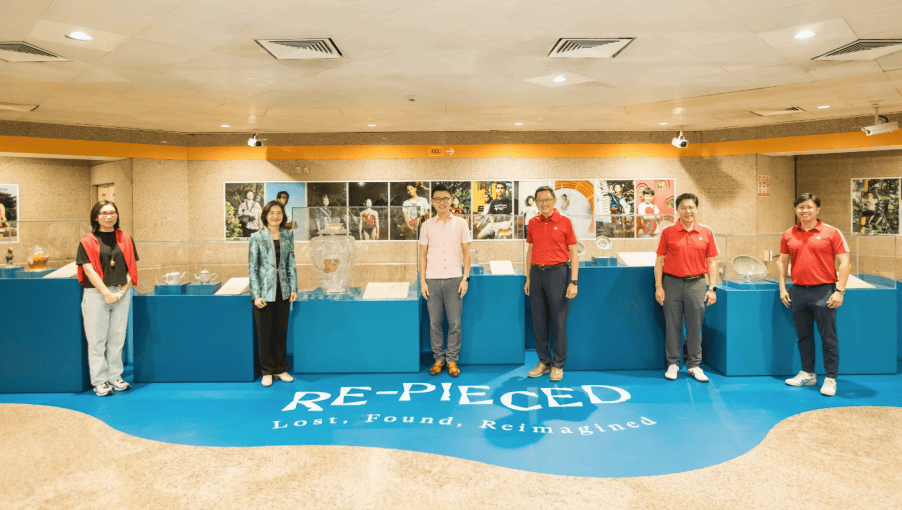
A new heritage exhibition brings centuries-old shipwreck discoveries to life, offering commuters a fascinating glimpse into Singapore’s history as an international trading hub.
The daily commute may not typically be associated with a journey through history, but a new exhibition at Marina Bay MRT Station is offering commuters an unexpected opportunity to travel back several centuries – and beneath the waters surrounding Singapore.
Titled Re-Pieced: Lost, Found, Reimagined, the exhibition by the National Heritage Board (NHB), in collaboration with SMRT Trains, brings the stories of two historic shipwrecks to the public through 10 specially recreated artefacts. Making their debut at the exhibition, the objects offer a glimpse into Singapore’s rich maritime and archaeological heritage.
Located at the paid concourse of Marina Bay MRT Station on the North-South Line, the free exhibition opened on 13 November 2026 and will run until the end of 2027.
At the heart of Re-Pieced: Lost, Found, Reimagined is an intriguing idea: what if fragments of centuries-old objects could be pieced together to reveal what they once looked like?
Many archaeological discoveries from shipwrecks survive only as fragments, making it difficult for the public to imagine their original forms. To bridge this gap, NHB has harnessed technology to recreate 10 objects using a combination of 3D scanning, digital sculpting and full-colour resin 3D printing.
The process begins with high-resolution scans that capture the geometry and textures of recovered artefacts. Researchers then use historical knowledge, consultation and images of similar objects to digitally reconstruct missing sections. The resulting models are optimised and printed in full colour, preserving details that offer a closer representation of the original pieces.
The exhibition features highlights such as a celadon bowl decorated with a rare pair of phoenixes, a large Chinese stoneware jar, intricately decorated blue-and-white ceramics, a white teapot with an unusual intertwined handle and even a porcelain parrot figurine.
Beyond their visual appeal, these objects offer fascinating clues about the people, goods and trading networks that once passed through Singapore’s waters.
The recreated artefacts draw inspiration from two historic shipwrecks discovered in Singapore’s waters: the Temasek wreck, dating to the mid-14th century, and the Shah Muncher wreck, dating to the 18th century.
Together, they provide evidence of Singapore’s longstanding position as an internationally connected maritime trading hub, long before the establishment of the British port in 1819.
The Temasek wreck carried approximately three-and-a-half tonnes of ceramics, including an unusually large quantity of blue-and-white wares compared with other shipwrecks from the same period. Among the recreated pieces is a blue-and-white bowl featuring lotus bouquets, chrysanthemums and lotus panels. Another is a shallow plate decorated with a phoenix against a backdrop of peonies and chrysanthemums – motifs commonly found in Chinese visual culture.
Also worth looking out for is a Longquan celadon dish featuring two stylised phoenixes impressed into its centre. Phoenixes traditionally symbolised peace and moral character, adding another layer of meaning to what might otherwise appear to be a simple decorative vessel.
The Shah Muncher, meanwhile, tells a different story of maritime commerce in the 18th century. The merchant vessel was travelling from Canton to Bombay, carrying a varied cargo that included ceramics, zinc ingots, glass bottles, glass beads and agate medallions.
Its discoveries reveal evidence of private commercial activity in the Singapore Strait before 1819. Among the recreated objects are an octagonal vase with moulded floral motifs, a blue-and-white glazed teapot and a porcelain parrot, a charming reminder of how decorative objects and artistic tastes travelled across continents.
Perhaps one of the most intriguing displays is a reconstruction of four fragments from large stoneware jars. These vessels may have been used to transport liquids and other organic cargo. Plum pits were found in one of them, while similar historical shipwrecks suggest that such containers could also have held sugared fruits, ginger, rhubarb and spices such as star anise and cinnamon.
For NHB, the exhibition is about more than simply reconstructing beautiful historical objects. It is also an opportunity to make archaeology more accessible and encourage the public to look beyond the fragments themselves.
Ms Georgina Koh, Director, Heritage Policy & Research, NHB, said: “Archaeological finds from our shipwrecks reveal how Singapore was connected to the wider region long before modern times. Re-Pieced: Lost, Found, Reimagined, brings together technology and heritage, using tools such as 3D scanning and its applications, to make sense of the objects we uncover which are often broken or incomplete – as well as the stories behind them. We hope visitors to the exhibition will be intrigued by how much history a seemingly ordinary archaeological sherd can hold, and the stories, some never known before, that can be unearthed from deeper research and understanding. Outreach efforts, such as Re-Pieced, build on NHB’s commitment to foster greater awareness and appreciation of archaeology, complementing displays of archaeological artefacts at NHB’s museums and heritage institutions.”
The initiative also builds on an earlier collaboration between NHB and SMRT Trains. Last year, the two organisations presented Unearthing Stories of Us: Archaeological Display at Bras Basah MRT Station, marking NHB’s first effort to bring archaeological artefacts directly into an MRT station.
Mr Alvin Kek, Group Chief Commuter Engagement & Service Excellence Officer, SMRT, said: “Most commuters step into a station with a destination in mind. But MRT stations can be more than just functional platforms and concourses to get you from place to place. By working with partners like NHB, we hope to bring a little extra to the daily commute, whether it’s a new discovery, or even learning about a piece of Singapore’s history. With this collaboration, we hope to invite commuters to pause and journey much further, across centuries and beneath the waters around Singapore, all within our SMRT network.”
For those keen to delve deeper after visiting the MRT exhibition, Singapore’s archaeological discoveries can also be explored at several of NHB’s museums and heritage institutions.
Head to the Hinrich Foundation Trade Gallery at the Asian Civilisations Museum to discover more about Singapore’s historical trading connections, or visit the newly refreshed Singapore History Gallery at the National Museum of Singapore for a broader look at the nation’s past.
ArCH Square also offers another opportunity to explore Singapore’s archaeological collection, with free admission for Singaporeans and Permanent Residents.
Whether you’re a history enthusiast, a curious commuter or simply someone looking for an interesting way to spend a few minutes between train connections, Re-Pieced: Lost, Found, Reimagined offers a refreshing reminder that Singapore’s story stretches much further back than we might imagine.
Visitor information
- Exhibition: Re-Pieced: Lost, Found, Reimagined
- Venue: Marina Bay MRT Station, North-South Line (paid concourse)
- Dates: 13 November 2026 to end-2027
- Admission: Free to view

