
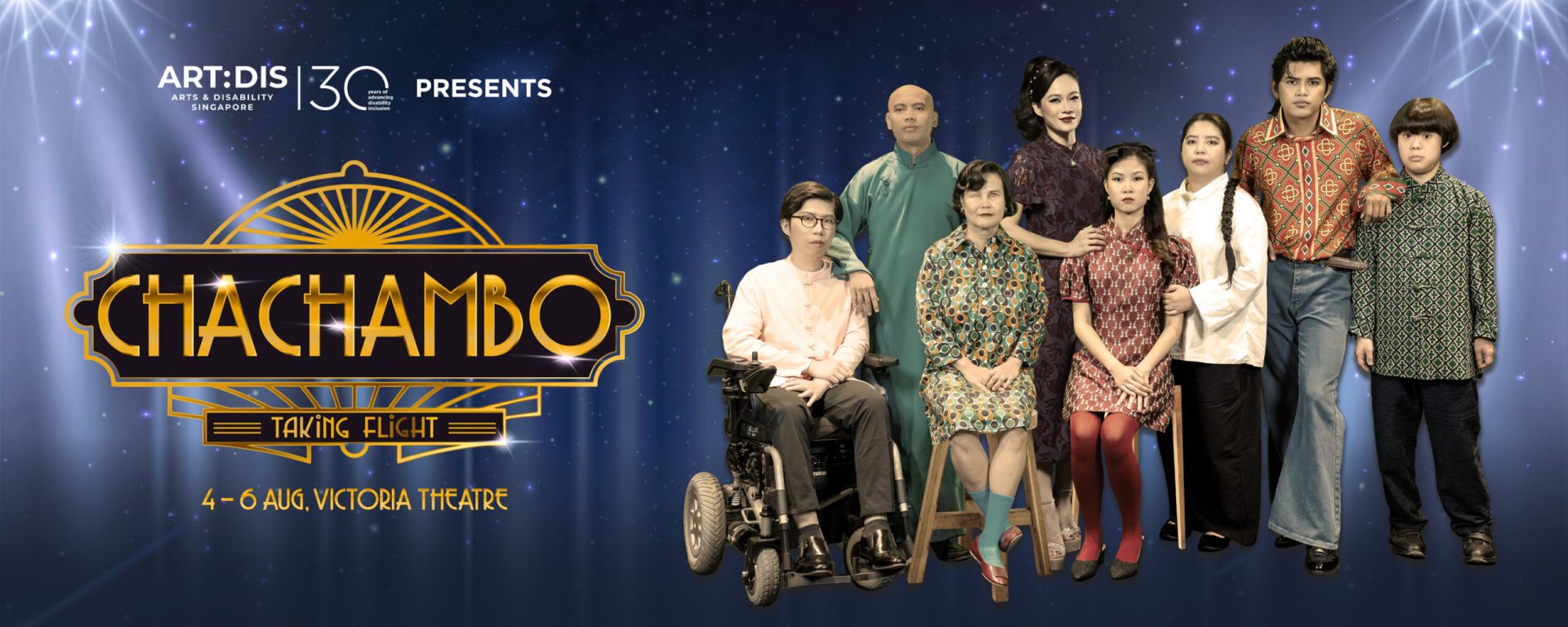

Filled with riveting drama, nostalgic songs and catchy dance numbers, be transported to the swinging ’60s of Singapore with Chachambo: Taking Flight. An original musical theatre production written and performed by an inclusive and intergenerational cast, Chachambo marks one of the biggest undertakings by non-profit organisation ART:DIS, which seeks to create learning and livelihood opportunities for persons with disabilities in the arts.
This is by no means a charity or pity party however, as all of these performers are trained professionals, seeking to turn art into a livelihood, each one possessing genuine skill and talent that goes into their performance, all going into an epic tale spanning decades as Ming Zhu, a visually-impaired girl, struggles to return an entertainment club to the glory days of the past.
Directed by Peter Sau, with other creatives such as costume designer Max Tan, multimedia designer Brian Gothong Tan and music director Dr Philip Tan, Chachambo promises a feast for the senses, and a sense of catharsis as we watch Ming Zhu’s story play out. But for now, we got a chance to speak to playwright and performer Claire Teo, and found out more about her process of writing the script, her place in Singapore as an artist with a disability, and how she hopes Chachambo begins important conversations. Read the interview in full below:

Bakchormeeboy: What made you decide to write Chachambo, and what was your inspiration? Considering you’re so young, are the songs all songs that you’re familiar with?
Claire: I honestly don’t have a grand answer to this other than I wanted to rise to the challenge of writing a script for persons with disabilities.
As for the songs, most of them I grew up listening to and I love very much. I’ve always connected more to the oldies and enjoyed singing them. There is a kind of poetic language to mandarin songs. They used a lot of sensorial images like in 不了情 by 顾媚 the lyrics go 忘不了雨中的散步, 也忘不了那風裏的擁抱. These convey so much feelings and sensations in such few words.
Bakchormeeboy: In the process of writing the script, besides Ming Zhu being visually-impaired, were there any other characters that were written with specific disabilities?
Claire: I didn’t plan for any of the other characters to be disabled, but I had to take into consideration the actors disability in order to write the story. I had to be aware of each person’s strengths and what they were able to bring out. For example, Luo Mang is a largely non-speaking autistic person but she is a very good violinist and dancer. So I had to find a way for her to be in the story in a way that made sense for her not to speak that much. But nowhere in the story did it say she was autistic.

Bakchormeeboy: Over the course of rehearsals, did these characters evolve to incorporate traits or characteristics of the actors playing them?
Claire: Of course because every character that we play, whether is it this production or another, somehow a part of our lives and a part of our personality will bleed into the character. Honestly, characters are by and large all the same. But it is the actor who is different so if someone else were to pick up Ming Zhu, I’m sure her characterisation will change because the actor playing her would have brought her own interpretation and lived experiences to the rehearsal and imbue Ming Zhu with it.
Bakchormeeboy: Not only are you the playwright, but you’re also playing the main role in Chachambo. How difficult has it been to juggle both these roles?
Claire: Very difficult because first as the playwright, I have my own interpretations of the scenes and characters. But once I hand it over to my Director Peter, he also has his own interpretation of things. As a lead actor, I have to respect that. So after the last script draft was done, I handed it over to Peter and placed my trust in him. When I transited into my role as an actor, I had to let go of a lot of previous notions I had of my character in order to take in suggestions and be open to Peter’s direction.

Bakchormeeboy: There are plenty of artists struggling to be recognised professionally. Is it even more difficult for an artist with disability, especially when it comes to opportunities on stage and to develop themselves?
Claire: Definitely. Right now, we either get charity opportunities where we are paid very little or opportunities are just very scarce period. There are organisations like ART:DIS that provides us a lot of opportunities to professionalise and many paid commissioned works, but this is not enough.
Many of us would like to branch out into the mainstream but we face roadblocks in education and employment. And then when we do not have the right training or exposure, the mainstream do not believe we have the skills or calibre to stand on stage. So it becomes a perpetual cycle where we are entrenched even deeper into stereotypes where PwDs are only capable of doing ‘charity’ shows.
I hope society can start doing things differently because the arts is really a place for exploration and experimentation. It is a space for discovering new things instead of doing the same thing over and over again to only get the same results. Why not collaborate with an artist with disabilities and see the possibilities it opens up?

Bakchormeeboy: Is it important that media continue to refer to you as “visually impaired”, or would there eventually be a point where you hope to be recognised quite simply, for your artistry?
Claire: I hope that one day, I can just be an artist. I just want to do my art but because society is not there yet, as we have to fight for so many opportunities, I believe the label is important. Many articles highlight my disability because this is advocacy for the disabled community. If I can be the voice for the community, even though I don’t really want to be and feel like I have the right to be either, then the label is important because it tells organisations that “Yes, PwDs are worth it” and it tells my fellow disabled peers that “Yes, you are worth it and you should step up to speak for yourself.”

Bakchormeeboy: Where in Singapore do you feel are the biggest areas of discrimination against those with disabilities?
Claire: Sometimes, I feel we discriminate ourselves because stigmas are so deeply rooted and it feels impossible to perceive ourselves as being more than what society has pigeonhole us into. Areas of employment and education aside, I think as a disabled community we should talk about self-worth first so that we can change mind-sets from within.
You know when I first started out, I did a lot of gigs and was always given less renumeration than everyone else because people told me it’ll be good exposure for myself and my community. At that time, these reasons felt valid but when the time came for bills to be paid, it no longer made sense to me.
When I think deeper as well… If I keep doing gigs with little compensation, then my community would also have to work and receive less also because I set the example right? This is why I try my best to advocate for myself because I can then tell my community, “Hey, I’m getting paid well. So this is what you’re supposed to get as well because this is your worth.”
One of the things about disability is the way showcasing it can be seen as “inspirational”. How do you feel companies and audiences can check themselves that their mode of thinking doesn’t fall into this zone?
It’s not wrong to view an individual as inspirational if they indeed have qualities people aspire to have. But how we check ourselves is in the notion of what’s next. The reason I don’t like being called an inspiration is because does that mean nothing needs to be done for the community already? Does that mean there is nowhere else we can grow? No, that’s not true. A lot of role models have even bigger aspirations and want to achieve them, but are unable to because society thinks they have achieved enough or sufficient work has been done for the community already.

Bakchormeeboy: There are many sides to the disability debate, especially in terms of representation. What is your goal with Chachambo, and how do you hope audiences will receive it or have a changed perception of people with disability?
Claire: I don’t want to dictate how people receive the work because I believe Chachambo will speak for itself. It contains so much heart that audiences can relate to and go back with different messages.
But of course with this show, I want perceptions of artists with disabilities to start to shift so that we can move forward. In a way, this production is really our audition into the mainstream stage so I hope people come with an open mind and appreciate the work for what it is.
Photo Credit: ART:DIS
Chachambo: Taking Flight plays from 4th to 6th August 2023 at Victoria Theatre. Tickets available from BookMyShow
 Bakchormeeboy