
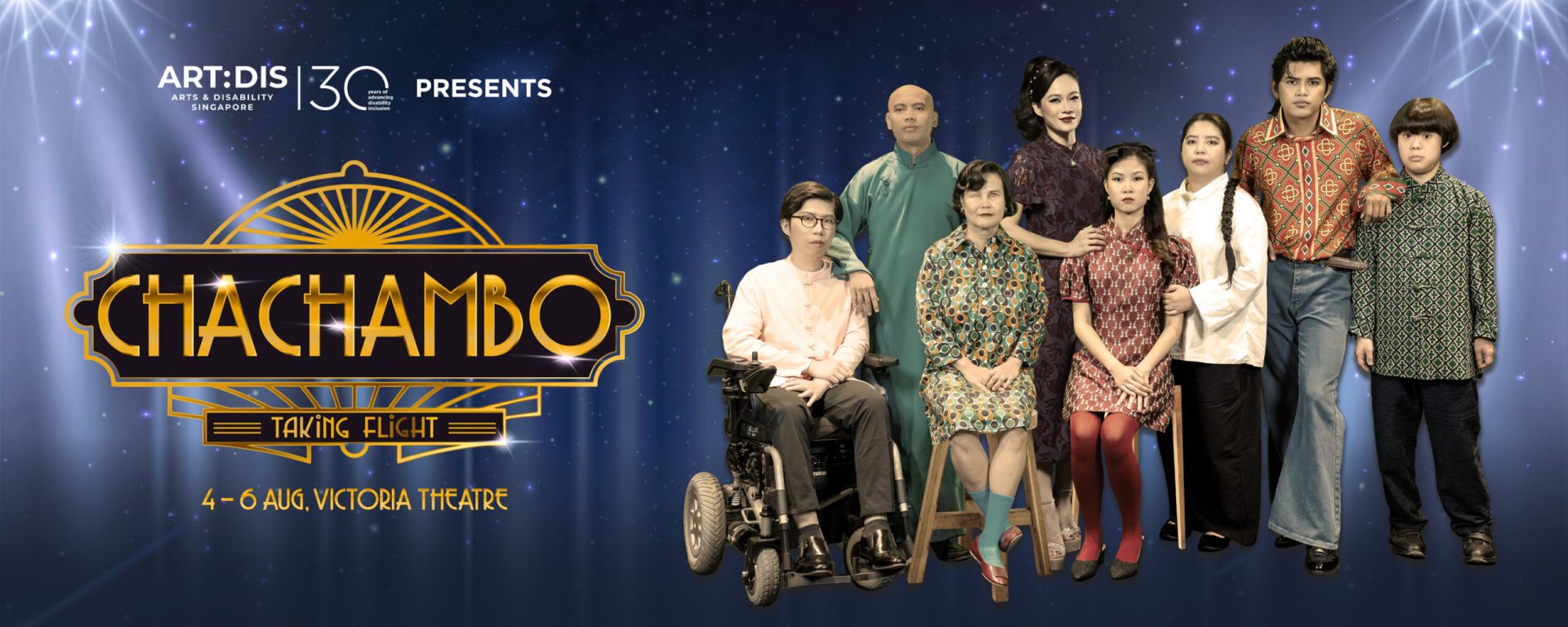

The draw of nostalgia has always been powerful, as we reminisce over the heyday of Singapore’s past, when lives were slower and simpler, and people were happier. Thinking back to yesteryear, we can only imagine the heady dancing that went on at entertainment clubs like New World, Great World and Gay World, where people could fully be themselves without judgment.
But under our rose-tinted lenses, was it really all that perfect in the past? For a disabled person living under more conservative and traditional beliefs, with few people understanding accessibility needs, it might well have been a struggle. And so it is that ART:DIS, a non- profit organisation dedicated to creating learning and livelihood opportunities for persons with disabilities in the arts, is set to bring one such story to life, with their original musical Chachambo: Taking Flight.
Written by Claire Teo, and directed by Peter Sau (also Head – Performing Arts and Artistic Development at ART:DIS), Chachambo is an epic production that charts decades of an entertainment club in Singapore, as told through a visually-impaired girl going through her own share of trials and tribulations trying. to return it to its former glory.

With such high expectations and a bold mission, we spoke to director Peter Sau and costume designer Max Tan to find out more about the behind-the-scenes process that went into producing such a work, the considerations they had for accessibility, and their own experiences and thoughts on the disabled community in Singapore.
“Honestly, when I first read the script, I thought Claire was very ambitious to have it span so many decades, and with all these period scenes paying tribute to that era. I probably stepped into these amusement parks and entertainment clubs once when I was younger, and to me they always felt so alien to Singapore,” says Peter. “But being inside, being free, observing people, it’s a place where you can learn what human interaction is like, and really be yourself. Naturally, the songs are classics, and very nostalgic as well, but the challenge then comes about as to how we tell a story that is relevant not just to people with disabilities, but the general public as well.”

Presented in conjunction with ART:DIS’s 30th anniversary and forwarding their ethos of advancing disability inclusion, Chachambo: Taking Flight is Singapore’s first full-length theatre production written and performed by an inclusive and intergenerational cast. As a result, careful consideration has gone into sending the right message across, along with providing them with the right training to ensure they shine onstage.
“When I look at the cast, I need to think of their strengths, whether it’s at playing an instrument or dancing. Take Claire and (Wan) Wai Yee for example, who are singers and excel at conveying their emotion through song and voice, and that informs their resulting performance,” says Peter. “We adapt the performance according to what your cast can do, and you then put in place all the mentorship and training it takes to turn potential into excellence. And it’s not an easy play, it’s a challenging play because it needs them to face all these obstacles for them to rise up. This is bringing together people of different skillsets and putting them all together in a single show, and putting them front and centre to do a full production.”

Costume designer Max got involved in part because he has a personal stake in the matter, having grown up with a sister on the spectrum. “My sister was diagnosed as autistic, and has selective mutism, so only speaks to immediate family members,” he says. “All things considered, I think she was pretty lucky that she was given a chance to go to a mainstream school, and we gave her quite a lot of freedom and independence, to the extent we gave her an EZ-link card and just let her find her way around without worrying about her all the time. These days, she works at TOUCH Ubi Hostel, and she’d actually learnt lifeskills like cooking, so that she could be more independent.”
“This is in contrast to some of my cousins with Down syndrome, where they would live their lives heading to school and home again, more or less locked up in the house. Part of it comes from how their parents almost blame themselves for how they were born like that, even if it’s not their fault, but it’s important to move past the shame and think more of solutions or even opportunities to open up the possibilities of what they can do,” adds Max. “Sure, routine is important, but I always feel so much more can be done for them, and in a similar vein, we’re putting our artists through a challenge that gives them new memories, and new skills through the process.”

As a costume designer creating clothes for people with specific needs, Max has many specifications he has to take note of when preparing for his cast, while also ensuring these costumes are both functional and fashionable. “We actually do have a specific niche in fashion where we design for people with mobility challenges, but oftentimes the features that end up getting designed stick out like. a sore thumb and draw attention to the issue, like a massive zip,” says Max. “Design sensitivity then has to come in, where we deliberately hide these zips, or do something more subtle, like lower the neckline for a high neck collar so it’s less stuffy, rather than announcing that it’s specifically made for people with disabilities.”
“One of the costumes I’m quite proud of is for one of the backup dancers, and while the scene seemed to suggest requiring a full gown to match the era, it was a very constricting material, so what we did is to change the material to jersey and accessorise that instead,” he adds. “Comfort really is the key, even if stage costumes are actually quite gross due to performing in them. So I try my best to strike a balance between matching all these eras, and using materials that are more comfortable, like cotton for t-shirts, while still styling them accordingly. They aren’t used to wearing these costumes, but I’m already prepared for all the complaints, and with all the hard work that went into it, I hope I don’t cry when I see them perform onstage in them.”

To push that narrative further, Max fully believes that Chachambo and ART:DIS as a whole is doing important work in empowering artists with disabilities. “I remember how when I was helping my sister find a job, and I was just 20, trying to find out which organisations I could go to for help or advice,” he says. “It was so unhelpful when they would just tell me to send her to go to a fast food restaurant to work as a waitress when she can’t speak to others, and it almost felt like we had to beg them to give us proper help and see her needs.”
“I know one show won’t change anything, but hopefully it’s a starting point that leads to more conversations at least, or even for audience members to treat it as good fun entertainment, to celebrate each individual’s personal achievements in the show and how they come together, not from a pity perspective, but to think – did they do a good job in the role?” he adds. “It’s not about positioning them as ‘superhuman’, because they’re not, but also not meant to make it seem like doing something an ordinary person does is incredible. It’s about just taking that first step to recognising that these are legitimate artists with skills who are performing onstage.”

Chachambo, being a show that would appeal both to able audiences and audiences with various disabilities, also has the task of catering its accessibility to a wider range of people. “We’ve employed a form of integrated access, where we operate on the understanding that not everyone will be experiencing the performance in the same way,” says Peter. “We have specially designed captions for the deaf, and creative narration and audio description for the visually-impaired, and even onstage, you’ll see tactile sign language that enhances all the senses.”
“This whole pity and charity lens is so old-fashioned, and we’re very deliberately ensuring no one is onstage trying to evoke your pity. Even right down to the choreography, rather than making it ‘easier’ for them to perform by simplifying steps, we instead ask them to show us what they’re capable, and work with them to design movements that take them a little more out of their comfort zone, and push them to become better versions of themselves,” says Peter. “It has to be a collaborative effort, not a dictatorial one, which is why we have to change our approach to making sure they also feel good about what they put out there onstage, as an equal partnership where we’re giving them an opportunity to perform at their best.”

This means having an understanding of all these different needs for both audience and performer, or at least the empathy and humility to be willing to listen to what they have to say. “Sometimes I bring my sister to watch a theatre show, and halfway through she would tell me she would want to leave and go home. Not because it’s a bad show, but because the show is much too overwhelming, from bright lights or loud sounds,” says Max.
“Accessibility should not just be done for the sake of ticking a box, but should. be creatively done and well-integrated into the show. It’s a shared experience, and in the production stage, is about recognising how we can co-exist better. I remember what Kuo Pao Kum asked me when I was training – what is theatre for? And for me, I still ask myself that every so often, thinking about how it is a means for us to relook at the world around us,” says Peter.

Naturally, having such a process also makes it such that the rehearsals for Chachambo stretched longer than a typical theatre show, with about four and a half months instead of the usual one to two months. “There are many stages to achieving the final product, starting with laying the foundations and building the chemistry so that everyone is on the same page when it comes to achieving a common goal,” says Peter. “The keyword is trust, and that allows us to be more honest with each other in feedback and push each other. And if it ever gets too much, that trust also comes into play where they have to come forward and tell me. We do not treat each other as amateurs, but experts in our own ways. We want to promote a culture of getting to the point, of having clear communication and being real with each other.”

“At this stage, they’re all good and are on the verge of peaking. The ones they always have to keep in mind are that they are proving themselves not to their family and friends, but the members of the public who come in wanting to see what they’re capable of, since that’s what ART:DIS stands for,” he adds. “So beyond not forgetting lines, we want excellence, and sometimes in the rehearsal room, they end up more direct and brutal than I expect. But because we know it’s all in good faith, they understand where it comes from, and we still end up going for a meal together after the rehearsal. It reminds me of my time in drama school, where everyone had something to prove, and that’s when we really bring our best in order to ensure the final product is indeed, worth being proud of.”
“I think about how Claire would complain to me about how she couldn’t feel her waist in her costume, and for an able actress, that would be a smaller issue,” adds Max. “But this was something I had to address, because being visually-impaired, her perception. of the world comes from the tactile and her ability to feel. Without that, she would not be comfortable and secure enough to perform, where her ability to sense is determined by factors from putting her hand against the ground or feeling the air against her. And I appreciate that honesty we have with each other, and how we can tell each other what is possible or what our needs are.”

While both Max and Peter are realistic enough in seeing that the show isn’t going to be a cultural zeitgeist, the two do hope it’s a milestone and inspiration for others to see theatre and performance in a new light, with new possibilities. “Sometimes it’s just about trying to see things from each other’s perspectives, or even just being more understanding,” says Peter. “We have some senior citizens who help out, and they’re actually some of the least judgmental people around, and take the initiative to step up when we’re shorthanded, or just be a friend to the cast and creatives when they need someone to just be there. When you put the disabled and non-disabled people together, it broadens the mind and sets the right tone, and perhaps it develops this common understanding between them.”
“Looking back at the show’s content, narratively, there is only one disabled character, the visually-impaired girl. But we see how everyone is reacting to her, from her non-disabled mother trying to discipline and force her to somehow become non-disabled, as if trying to forge this success story to absolve her own ‘guilt’ for giving birth to her,” concludes Peter. “But you know, there are about 10% of our population who are disabled. And so much of that is swept under the carpet, locking them away at home for fear of being seen and heard.”

“If we can put on a show with this many disabled actors onstage, doesn’t it help with visibility and representation to show they exist? On the flipside, we’re even dedicating a show that will comprise fully of disabled audience members, in the hopes that they come out to Victoria Theatre and see that this is what’s outside, to give them the confidence that they can live and exist in this world with everyone else. So here we are, trying to bring back the conversation to how there’s nothing ‘special’ about disability, to normalise it respectfully, and create that space for exchange, in the hopes that more people learn to condition themselves that yes, we can live together without fear, without pity, and recognise them for who they are and their abilities beyond being defined by their disability.”
Photo Credit: ART:DIS
Chachambo: Taking Flight plays from 4th to 6th August 2023 at Victoria Theatre. Tickets available from BookMyShow
 Bakchormeeboy