
As the daughter of legendary Indian classical dance artists K.P. Bhaskar and Santha Bhaskar, Meenakshy Bhaskar has a lot to live up to when she took over Bhaskar’s Arts Academy as Artistic Director. In her first year, she found herself fully helming the projects her mother had been working on, dealing with collaborators and stakeholders, and most of all, learning the ropes of what it means to head a company.
“It’s been a chaotic time, with so many productions from Yantra Mantra at the 2022 Singapore International Festival of Arts, to the Butterfly Lovers,” says Meena. “It’s really been about getting back on track after COVID, getting back into a schedule and raising out visibility, to let the community know that we’re back and we’re here. That can be difficult as well, with every other arts group doing the same thing, and all of us fighting for eyes and audiences. But we make do somehow, and I always go back to what my parents wanted in the first place – to create more opportunities for the arts landscape.”
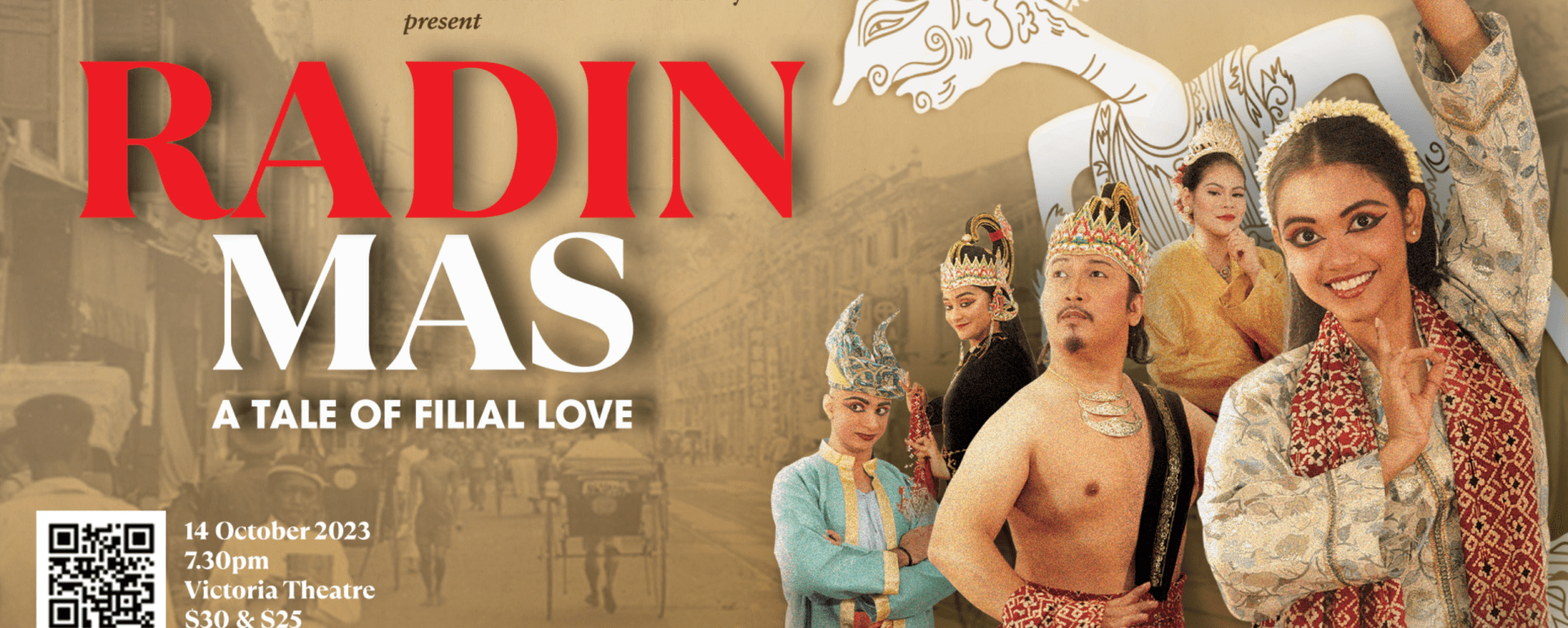
But one year on, and Meena seems to have found her footing, as Bhaskar’s Arts Academy prepares for a brand new cross-cultural production – Radin Mas, in collaboration with Sri Warisan Som Said Performing Arts, playing for one night only at the Victoria Theatre this Saturday. “My mother and Som Said go back a long way, where she would see my mother as an ‘elder’ figure whenever she watched a show, and the two of them treated each other with a lot of respect,” says Meena, on the history between the two companies. “They maintained that friendship for a long time, and even when they were too busy to hang out, they would always express a desire to spend more time catching up with each other, celebrating and reminiscing over all the times they worked together.”
This, however, marks the first time the two companies are doing a full on collaboration, where bharatanatyam dance and Malay dance are integrated into the traditional tale of Radin Mas. “After my mother passed, I would think about all these people who said ‘oh we used to talk about wanting to work together’, and I ended up coming up with a list of all these people. I wanted to put it out there into the universe, and I believe that when the time is right, these collaborations will happen,” says Meena. “When I called up Sri Warisan to ask about collaborating, Kak Som immediately said of course, before even asking about the dates!”
“To bring both art forms and cultures together is really about taking that mutual respect to the stage. It’s about being kind to each other, which helps people get more in sync, and it becomes easy to work together,” she adds. “So in the beginning, we threw out some ideas and Sri Warisan suggested Radin Mas, which is a story they’ve adapted before as a musical and a dance drama. It made sense to me, and we sat down and crafted a vision together. We do share a similar work ethic, and both come prepared, making the process quite easy and efficient, even if we don’t have a lot of time spent together.”
That sense of collaboration extends even to the dancers, who find chemistry even coming from different backgrounds and trainings. “There’s an easy camaraderie developed, and they get along with each other quite well, and a lot of mutual respect for each other because of their respective technical mastery. In fact, it reminds me a lot of my time growing up as well, when I would watch Sri Warisan’s work and be similarly impressed,” says Meena. “They’re very had workers as well, and are all well-trained, with similar values in loyalty and respect for their teachers.”
On how the dance form comes into play during Radin Mas, Meena explains the innate emotive power of bharatanatyam. “Bharatanatyam lends itself to introspection, and is rooted in expressive pieces where the dancer is responding with emotion and passion, or even anger if let’s say she discovers her husband cheating or others are taking behind her back. Most of all, it has a lot of freedom in playing any character,” says Meena. “This feels quite relevant in Radin Mas, which I see primarily as a tale of jealousy gone wrong, a love story that comes under threat, and most of all that it’s a local, Singaporean story.”
The story follows Princess Radin Mas Ayu, the daughter of a secret marriage between Prince Pengeran and a commoner. The prince’s brother, the Sultan, orders the murder of the family as a result, leaving only Radin Mas and her father as the sole survivors. Escaping to Singapore, her new stepmother threatens the death of her father unless she marries Tengku Bagus, her stepmother’s nephew. Even after a rescue, a final attempt made by Tengku Bagus to kill Pengeran ends in tragedy, as Radin Mas takes the fatal keris attack instead.

Playing Radin Mas is Biju Gowripriya, who has been learning Bharatanatyam at Nrityalaya Aesthetics Society since the age of six, under the tutelage of Guru Ambujah Thiru. Successfully joining Bhaskar’s Arts Academy’s Junior Company in 2019, she has since been part of various company productions. “We needed someone who could look 14, the age Radin Mas is supposed to be, and Kak Som ended up choosing her from three dancers I shortlisted. It’s Gowri’s first major role in a full blown production, and so far, she’s been doing her best and taking on the challenge with gusto,” says Meena. “I do believe that every one of our dancers have the potential to succeed given the right landscape, and if we treat them right, they’ll all blossom into beautiful plants with their very strong rpoots to the arts, so long as the community gives them the opportunity.”
All this comes to life onstage with a set that comprises an ingenious bamboo structure that will be adapted with each scene, from village huts, to fervent flames. “I’m really quite excited about the project – we wanted to showcase a kampung but not build an actual set, with some elements of palm trees. It’s the first time we’re using a movable set onstage, so we’re not being too ambitious about it, and at the end of the day, the dance and story always remain at the forefront,” says Meena. “We’re even doing things like having the dalam recited in Tamil, and I think we’ve gained so much knowledge and insight during the rehearsal process, ready for the diversity of the audience we’ll be seeing in the space during that one night.”
Bhaskar’s Arts Academy has never shied away from such cultural collaborations, constantly evolving the art form with their experiments and explorations. But how then do they ensure the tenets of bharatanatyam are adhered to? “There will always be naysayers that believe it should remain as ‘pure’ as possible, but my own mother was always the kind of person who was never afraid to try. Learning dance isn’t just about learning the choreography, but whether one knows the essence, and when you close your eyes, can you imagine the kinds of movements you can potentially perform with the art form, and then invite that into performance?” says Meena.
“I am always willing to grow, and remain surprised. Like for our opening court scene, I initially wanted our girls to focus on a more high energy, upbeat piece. But on the Sri Warisan side, they instead brought out a more melancholic and poignant track they wanted, and I just went wow, it’s perfect. Working together, we had to find a way to blend the two together, and with enough open discussion, eventually come to a happy medium that’s just culturally in tune with each other.”
Much like other traditional art forms, bharatanatyam has a limited audience, with younger generations growing further from being able to appreciate it, prioritising more social media-friendly alternatives or more mainstream activities they’d gladly save up money for. “Today’s children are really constantly on social media, which feed them what becomes the basis for their understanding of culture. We do have a lot of organisations doing good work to keep tradition alive, but the pervasiveness of media really makes it much harder to put out there,” says Meena. “What’s also concerning is that we do have so many dancers trained, but not everyone chooses to continue the journey, perhaps because there just aren’t as many opportunities out there.”
“I do think we all need more support – Temasek Foundation for example, has given us a grant because they recognise our value in bringing communities together to promote living in harmony and multi-cultural society,” she adds. “Whether or not we do receive money though, we will always do the work. I know there are some groups that are resentful of the older arts groups getting support, but I think considering how in my parents’ time, they managed to survive on their own without funding and getting community support, they’ve proven the company’s value and staying power. But we absolutely hope that we can identify more people out there who would like to support the arts, especially with the sheer number of shows we produce, the job opportunities we create, and the visibility of the culture. It’s just that I’m not good at self-promoting, and so busy with the artistic side of things, which is why we often rely on others to help us out.”
There is absolutely no denying that the training Bhaskar’s Arts Academy offers is high quality, equipping its dancers with the skills, experience confidence to succeed as performers. But more than that, it offers them a community, and a sense of belonging. “As a child, I performed in many shows, and a lot of the time it would have been as a stand-in when performers were unavailable, and that’s what gives me that professional experience from a young age. We do have high expectations of our dancers as well, and because of the intensive training, they build up their stamina, and know how to take care of themselves,” says Meena. “All of them take up that responsibility, because they understand how important their role is and how it could jeopardise a production if they’re absent, along with how there’s a stringent attendance rate because we submit our training to the National Arts Council.”
“But also, many of the teachers have literally seen their students grow up since they were maybe five or six years old, and they have this incredibly close relationship where they are comfortable sharing anything with each other,” she adds. “Teachers are so integral to making students feel confident and comfortable with what they’re doing, checking in if they need extra practice or any kind of support. That’s also why we have such a strong foundation, because we’re not just inculcating them with the arts and confidence, but also a community and sense of belonging. Even if they don’t continue with dance when they’re adults, they forge these honest friendships that they can always come back to, and when they meet up with their teachers or fellow students, there’s so much love they have for the art form built up from the camaraderie they had over training, and the realisation of how much they’ve gained from that.”
Ultimately, everything ties back to friendships and relationships, and Meena hopes that this will be represented beautifully onstage this Saturday. “I hope the production sparks questions and reflections on how many creative possibilities still exist out there, especially with dance,” she concludes. “And all these collaborations, well it starts from being friends with the people behind these groups, and building up their rapport over the years, through conversation, supporting each other and being there. We may disagree artistically at times, but always, the respect is there, and I believe that is what makes works like Radin Mas work so well.”
Radin Mas plays for one night only on 14th October 2023 at Victoria Theatre. Tickets available here
 Bakchormeeboy