
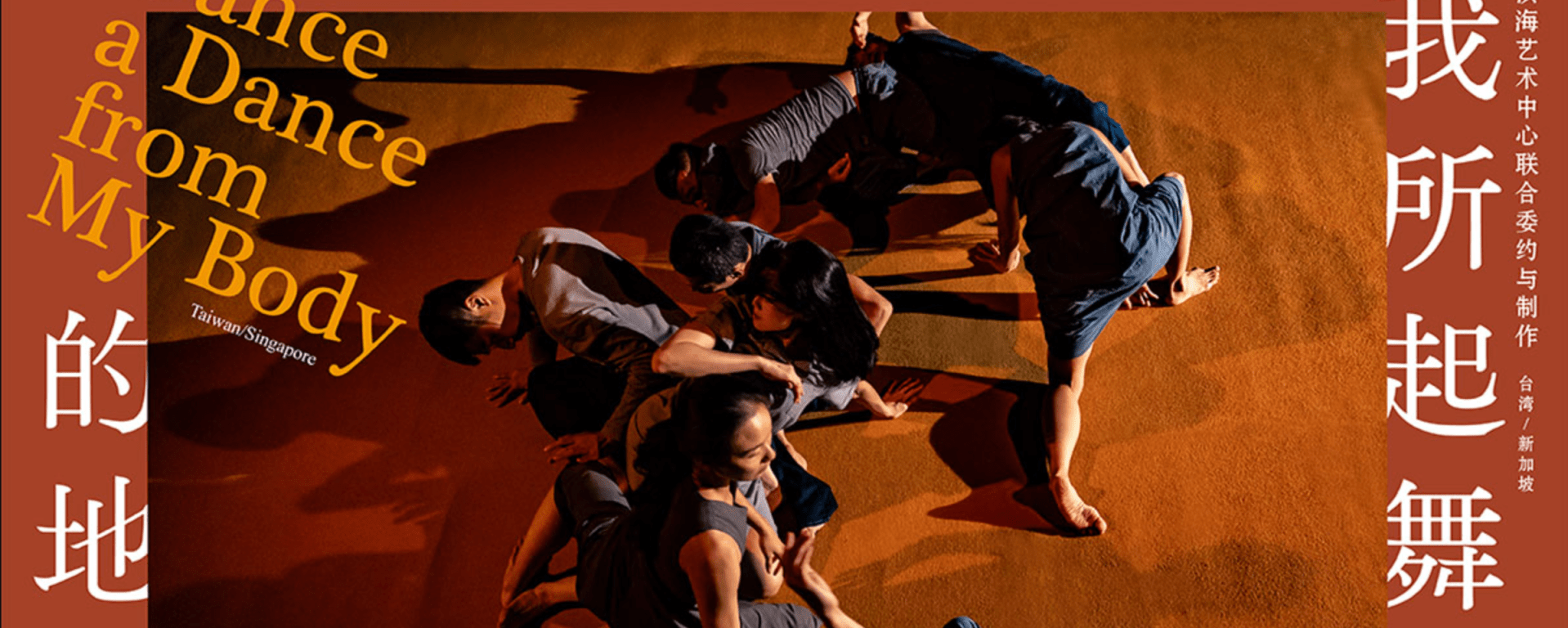
The beauty of diversity in motion.
There is always something exciting about an artistic collaboration between two distinct groups of people, be they from different companies, mediums or even places of origin, as they discover points of connection and difference. In the case of Esplanade – Theatres on the Bay and National Kaohsiung Center for the Arts Weiwuying co-production Dance a Dance From My Body, the two arts centres have called upon choreographer Chou Shu-yi to devise a new work together with dancers from both Taiwan and Singapore, as they explore their national and individual identities as Asian Chinese dancers.
Playing last week as part of the 2024 Huayi – Chinese Festival of Arts, the Esplanade Theatre Studio featured mustard-coloured flooring, standing out against the otherwise black space, perhaps reflecting the verve and vibrance of the dancers involved, while somewhat reflective cloth hangs above. Designed by Lee Chi-wai, onstage are 8 pairs of chairs back-to-back, arranged in a semi-circle, each with a different coloured cloth laid over them. There are no dancers to be seen, as we await the performance to begin.
But as it turns out, the dancers are in fact already here, sitting in plain sight among the audience members. Brushing past the seats and making their way down to the performance space, it feels like a gathering, as they begin to play with each other, getting to know each other. In that sense, what Dance a Dance from My Body feels like is a form of cultural exchange, a process-driven approach that seems to chart the dancers finding unexpected links and divergences in their shared Chinese ancestry and lived experiences.
To that end, the performance utilises a variety of approaches in their little experiment, as they engage in various points of convergence – we hear snippets of news from Singapore and Taiwan, childhood songs they grew up with, and they count in English, Mandarin and Taiwanese Hokkien, moving to the beat of their own drum, each one an individual with their own pace and style of doing things. Strangers at first, caught up in their own languages, they initially seem disparate, all with their own unique identities.
While there are times it does feel like an early draft of a work, with so much focus on the process and art of experimentation that still could use further distillation and editing for a smoother flow, or where some of the chaos when everyone is moving at the same time can be reined in, what Dance a Dance From My Body results in is a reminder that connection isn’t always easy, and an invitation to share and learn from each other. This most prominently comes to light when the dancers take turns telling us about themselves, self-introductions seemingly free form as they cover topics ranging from their biological information, to key memories in childhood, to their relationship with dance. At the same time, another dancer is doing a live translation of whatever is being said into another language, often a truncated, simplified version that while unable to fully capture fully what is being said, shows an attempt at connecting, where the act of translation is an act of reaching out and processing what is being said.
When each sharing is over, the translator pauses, and ponders over a question in his or her head, asking it to the speaker, perhaps to show how they are willing to still probe further and get to know them even better. Meanwhile, the rest of the ensemble does their own thing, leaping and playing with each other, from throwing balls back and forth in an attempt to build stronger chemistry, to lining up at the back of the stage, facing the wall and stretching out. This cycle repeats until all of the dancers have shared their stories, and we gain insight into each of them, no longer blank slates but their own personalities. This concept of individual versus ensemble continues on through the rest of the performance, as the dancers play with the idea of literally how we identify, by throwing cloths onto each other, obscuring their face and torso. When artists Tung Ka Wai and Cheng Chih-chung perform, the former with a few bones less than others, and the latter wheelchair-bound due to his polio, they show the beauty of diversity in bodies and the uniqueness in their movement vocabulary.
Yet, once the showcase of diversity is over, Dance a Dance From My Body ultimately sees the dancers as a single unit, connected by their shared passion for dance and intimately linked to each other – literally, as they come together, no longer defined by the clothes on their body as they strip down and stand in a line, holding each other’s hands, resulting in their identities become less defined, more intertwined. There is a willingness and a discipline to bring themselves all up to the same level, where even Chih-chung leaves his wheelchair and travels across the dancers’ backs, all united despite their differences, finding a niche in what they are able to do, and a cohesion when performing together as one.
Thus, Dance a Dance from My Body is a showcase of dance as personal expression, as much as it is a discipline, welcoming to all bodies to participate and how community can be formed. Chou Shu-yi has essentially crafted a production that feels like an orientation in motion, as we get to know these dancers as individuals and how they’ve managed to come together as a single cohesive team in spite of their differences, and further that message as more iterations of this continue in future. In its final scenes, we witness the dancers left in darkness, obscured at first, until a single white light in their hands illuminates their faces, and we see them all smiling as one – banding together against all odds, and finding hope and comfort in the presence of each other.
Dance a Dance From My Body played from 23rd to 24th February 2024 at the Esplanade Theatre Studio. More information available here
Huayi – Chinese Festival of Arts ran from 16th to 25th February 2024 at the Esplanade. More information and full programme available here
Production Credits:
| Choreographer Chou Shu-yi (Taiwan) Set & Lighting Designer Lee Chi-wai (Hong Kong) Music Designer Wang Yu-jun (Taiwan) Performers Chiew Peishan, Chua Chiok Woon, Hong Guofeng, Ng Zu You, Tung Ka Wai (Singapore) Cheng Chih-chung, Liang Chun-wen, Yang Ya-chun, Yu Yen-fang (Taiwan) Producer Lee Pee Hua (Esplanade – Theatres on the Bay), Lo Shih-ju (National Kaohsiung Center for the Arts – Weiwuying) Production Stage Manager Shining Goh Sound Engineer Yong Rong Zhao |
 Bakchormeeboy