
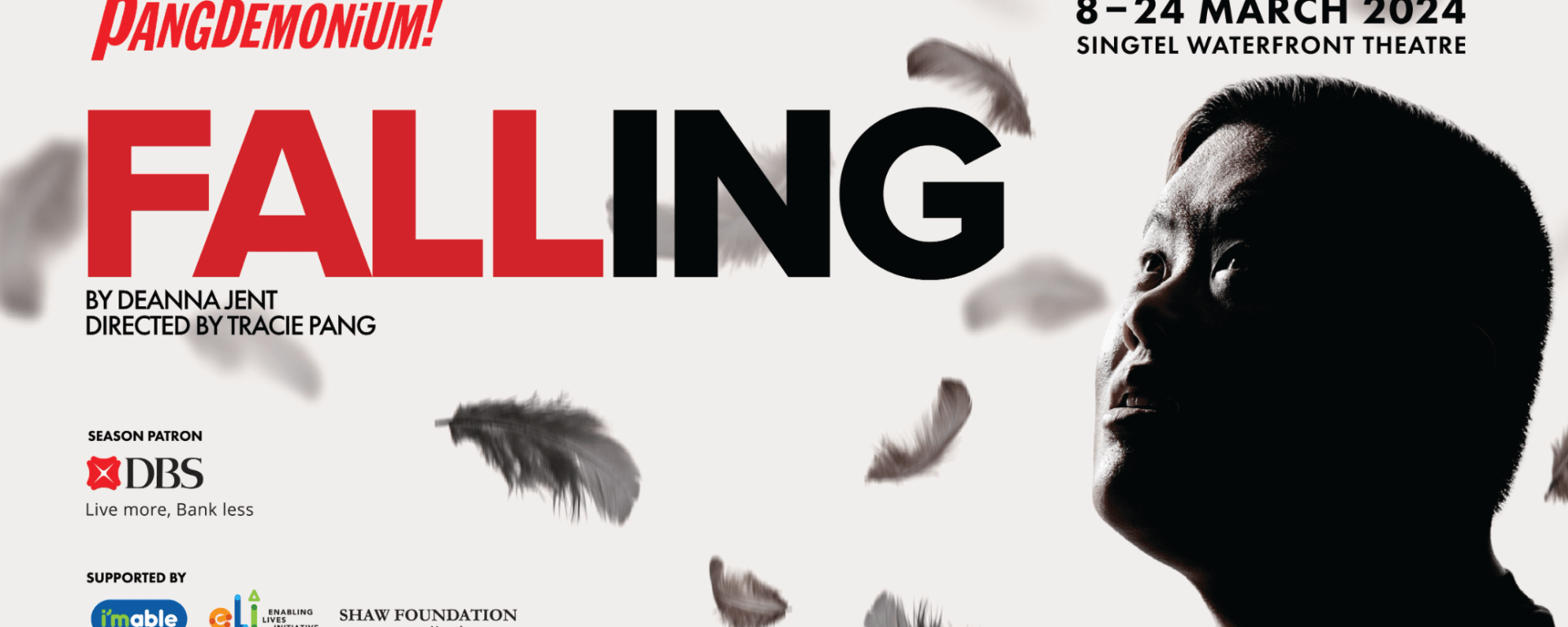
Maybe it’s because of good genetics, but Andrew Marko is the kind of man you look at and looks eternally youthful. Even in his 30s, there’s something about his demeanour that still suggests a child-like sense of wonder and innocence, while carrying the hidden weight of experiences he’s willing to put onstage. All that makes him the perfect candidate to return to the role where he got his first big break eight whole years ago – as the teenage Josh, in Pangdemonium!’s production of Falling.
Falling, written by American playwright Deanna Jent, returns to the local stage next week, where Tracie Pang will once again helm the play as director. Playing to sold-out houses in their 2016 run, and finally gets its much-requested revival, for a brand new audience to watch. The play follows the life of an ordinary family trying to raise two teenagers – an angsty 16-year old daughter, and Josh, their 18-year old autistic son, examining the ups and downs of what it means to be a caregiver and living with autism in the family.

While Andrew seems the same on the outside, the last eight years have changed him considerably, with a plethora of work and life experiences that have allowed him to grow as a person, finding himself at a very different stage of life than where he was back then – including literally shaving his head some time back. “My hair’s gone through many styles over the years, and it’s one thing I always take pride in,” says Andrew. “When we were starting rehearsals, I wanted to leave that behind and not feel too self-conscious or bothered by my hair and looks, so I wanted to shave it off and start from a clean slate. In a way, it feels like the shedding of the self, and starting from zero again, where I can fully focus on the character.”
“In a way, it also feels like a new phase for myself, where I’m finally finding my footing again – 2024 I think is me feeling very comfortable with where I am and who I am, and I am now confident about making decisions about the future,” he adds. “Like how even thinking about ‘rejections’ from auditions – I no longer think of it as them not liking me, but simply about the production finding the best fit for the role, and that we have to roll with the punches and go with the flow rather than get hung up on such things.”

Clearly though, Pangdemonium! has maintained their faith in Andrew over the years, who has appeared in multiple major productions since Falling, most recently in End of the Rainbow (2022) and Into The Woods (2023). “This play means so much to me, because Josh really was my first major role after only doing theatre for a few months. Landing it got me so many opportunities after that, and I will forever be thankful to Pangdemonium for taking that chance on me to shine, and they really are the only ones I don’t get nervous auditioning for,” says Andrew. “It’s been so nice to see them grow and change as a company, and at the back of your head, you always think ‘wow surely they’d have run out of heartfelt shows and stories to tell by now’, but there really is an endless well of plays that keep coming up, and I’m always impressed how they manage it year after year.”

Taking on the character of Josh again invites a degree of criticism from those who believe that actors should be ‘authentic’ in their roles and have the lived experience to properly play them, especially for Andrew who does not identify as being on the spectrum and playing a character with autism. “It’s easy to make assumptions and misconstrue the notion that here’s a guy who’s not autistic yet playing an autistic character, and probably has no idea what he’s doing. Those are the same fears we had the first time we did it back in 2016,” says Andrew. “But we ultimately decided that for the sake of safety of both the performer and other actors, it was still the right call, since there are some more violent scenes that require specific fight choreography that an actor with severe autism might not be able to do 30 times in a week.”
“These days, I think we’re less worried about it, but there’s still a small nagging voice at the back of my head that someone will end up blowing it all up, but the team has been very supportive, and it won’t affect my performance, and I can go onstage confidently,” he adds. “We do our research too – this time around, we spent a day at the Rainbow Centre, observing classes and especially the caregivers, and how they feel or react throughout the day. There’s a lot that hasn’t changed – there are still not enough facilities available for adults with autism, and even those that exist require you to tick certain boxes on a checklist to ‘qualify’ as severely autistic. So seeing the way these caregivers work, you realise they have so much patience, and that they really know how to stay calm in the most difficult of situations, and I think we can aspire to be similarly empathetic and kind.”

While Andrew and director Tracie remain the same as the 2016 production, the remainder of the cast has completely changed, where Josh’s mother, father, grandmother and sister are now played by Karen Tan, Dwayne Lau, Lok Meng Chue and Rebecca Ashley Dass respectively, alongside now being performed at the Esplanade’s Singtel Waterfront Theatre. “These are all amazing actors I’ve had the luxury of working with before, and I love and trust them all very much,” says Andrew. “They do have a very different working style compared to the previous cast,but especially for Karen and Dwayne, they have very similar acting styles with each other, making them a good pair. Most importantly, they’re able to handle the crux of the show where you have to feel for them.”
“Also, the new space now utilises a thrust stage, where there’s audience around you, so we have to be more conscious and mindful every time we turn around,” he adds. “But as much as things change, the needs, the wants , the fears and the sensibilities still stay the same, and stepping into this world again brings all those things back. It’s not often that actors get to revisit a role like this, and it’s really an honour that I’ve been asked back to do this again.”

Coming back to his acting ability, Andrew emphasises how he’s also making a conscious effort to become more technically competent at his craft, and not rely on his natural talent alone. “Over the years, I’m learning to be more refined with my choices and justifying why I perform in a certain way, compared to how I was really just closing my eyes and just ‘feeling’ the role, with a lot less thought put into it,” says Andrew. “Somebody told me that means I’m naturally very good at acting, but I didn’t want to just be this ‘feeling feeling’ actor – I knew I was lacking the technical aspects, and needed to be more conscious in my acting.”
“So this time around, I’m really thinking a lot about how Josh’s mood – something I learnt from a caregiver who had an autistic daughter who was prone to violent outbursts was that autistic people tend to read and emulate your energy, and I am more conscious about picking up on the energy of the room to shape the way he thinks and does things,” he adds. “It’s also important to ensure that you don’t completely lose yourself in the role, and I always try to keep one foot in the play, another in reality – often what helps the decompression process is music. That differs a lot from period to period, whether it’s going through a Motown phase or Japanese city pop, or jazz, but either way, it’s an important way for me to return to reality, while I’ve also been trying to cycle to rehearsals when I can, just to clear my mind and be ready for the day ahead.”

On the topic of how difficult it can be to maintain relationships when the going gets tough, Andrew thinks back to his own low points, at his worst, and appreciates the people who’ve stuck with him through thick and thin. “I know I’ve been difficult to love at many points in life, and for me, I’m always so grateful to my mother who has shown unconditional love and care to me throughout my whole life, along with my friends who’ve stuck with me,” he says. “One thing I’ve heard is that hate is not the opposite of love; indifference is. Someone getting angry or frustrated isn’t someone devoid of love. When that happens, it helps to take a deep breath and learn to be patient, and not just react immediately, and show love instead.”

Reflecting on all his experiences, Andrew concludes by thinking on where he is now, and what’s next. “As an actor, it’s important to see things from so many perspectives, to keep an open mind in order to understand the full range of humanity to put onstage. I do think I’ve been through a lot, and although I still have a long way to go before I really feel like I’ve seen it all, I think that I’ve slowly grasped this ability to really emphasise all the little moments and learn to give words more weight,” he says. “Everything we say or do onstage has meaning, and it is the experiences we go through that add even more to that. I’m still just Andrew Marko, just trying his best, as a constant work in progress.”
“Right now, I just hope that audiences come in ready to receive what the play has to say, about the importance of patience and kindness, and being able to translate that to everything else in their lives, and gain a sense of catharsis from watching it and empathising,” he concludes. “If you can see that these characters persevere and go on, then so can you, and still remain kind in the journey ahead.”
Photo Credit (except top photo): CRISPI
Falling plays from 8th to 24th March 2024 at the Singtel Waterfront Theatre. Tickets available from SISTIC
 Bakchormeeboy