
Theatremaker Sim Yan Ying ‘YY’ may only be in her 20s, but she’s already able to list a slew of artistic achievements to her name across both Singapore and New York, starting from humble devised works, to experiments online, to working with major theatre companies such as T:>works and W!ld Rice. Now, fresh from a rejuvenating break, YY returns to the Esplanade to complete her run with their TRIP programme, intended to give early career directors an opportunity to platform and showcase their work.
While in 2023, YY was tasked to choose from a pool of scripts, eventually choosing and directing Joel Tan’s No Particular Order, in this new work for TRIP, YY has now been given free rein to choose a project to present for this ‘graduating’ production. With this in mind, she’s gone back to her roots – devising and collaborating to create something altogether new, with pass·ages, in association with playwright Jean Tay, choreographer Dapheny Chen and her cast.
“I first pitched this idea when applying for TRIP when I was 26 years old, but even a few years later, I’m already feeling the physical changes in my body – how even sitting cross-legged and then standing up, it starts to ache,” muses Sim Yan Ying ‘YY’, as she reflects on the origin of pass·ages. “”I’ve always been curious about what it means to age at different stages in life, and I felt it come back stronger than ever when I returned to dance after a 12 year hiatus, and how so many dancers have such a short runway for their career, where they’re defined to be in their ‘prime’ in their early 20s, and have no choice but to pivot to choreography and education by the time they hit their 30s.”

“I also think about how when my grandmother passed away, in the months leading up to it, my mom and aunts and uncles were all caring for her in those final stages of her life – a kind of role reversal from parent to child,” she continues. “And it made me see how my own mother was growing older as well, and I wondered about how one day, if I’m lucky enough to live to that point, I’ll end up doing the same for her. There’s this humbling feeling of inevitability of age – a friend in her 30s talked about the biological clock counting down her ability to have a child, while a friend in her 50s shared about the gradual process of menopause and all the hormonal, physical and psychological changes she was experiencing.”
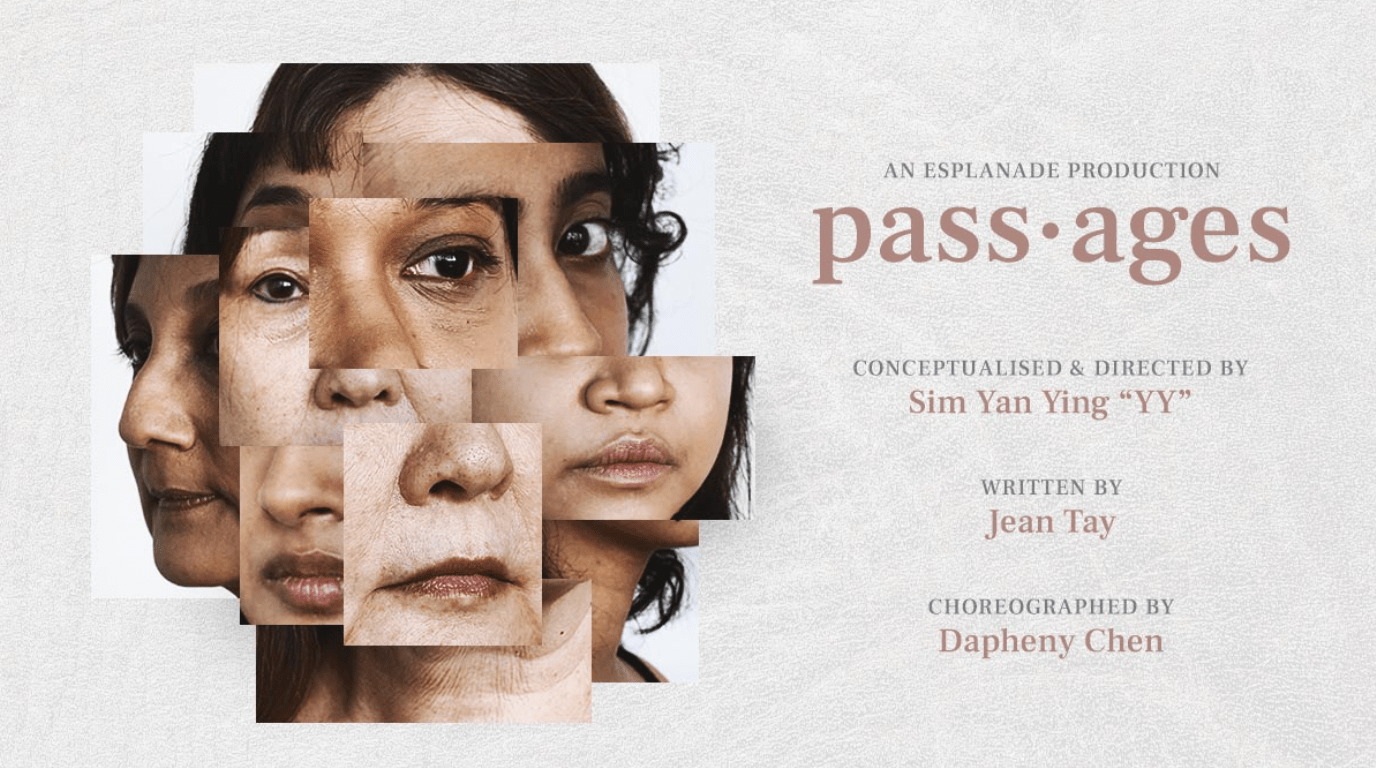
It is all these reflections that led to the creation of pass·ages, which focuses on the journeys of four women at different stages of their life, each one exploring the evolving landscape of ageing. “We’re all carrying this pressure where we’re running against time, where you’re not hitting certain milestones you think you should be hitting by certain ages – ageing is happening all the time, not just when you’re older, and the work is about interrogating the complexities at various stages of one’s life,” says YY. “Like what some of my dance classmates say – if you keep fretting about growing old, you end up ageing faster than if you live life with vitality and zest, doing the things you want to do. You learn to pivot and listen to what your body is saying, and lean into the possibilities it offers, rather than holding onto your youth forever, in order to find other creative means of expression, and a wealth of other possibilities you never considered before.”

Inspired by contributions from performers Dana Lam, Nirmala Seshadri, Suhaili Safari and Shanice Stanislaus, the interdisciplinary production confronts the complex realities and anxieties of growing old(er) as a woman, and encourages audience members to re-examine our relationship with ageing. “I started chatting with playwright Jean Tay around the middle of last year, and just talked about the ideas we wanted to explore, ideating characters and deciding we would cast four women at different stages in life,” says YY. “We roped in choreographer Dapheny Chen in September, and explored what she could add to the growing tapestry of ideas and movement, and we started the first phase of workshops in October, and got our performers in to really explore the possibilities of their characters beyond the broad strokes we had at the moment.”
“And then we ended up doing workshops led by each of the performers – Shanice taught everyone clowning, Nirmala did a crash course in bharatanatyam, Dana led a Shiatsu massage session, and Suhaili did a neutral mask 101 workshop. We continued to do research, finding moments that seemed exciting and that we wanted to further develop, and really go about finding the ensemble’s chemistry and energy, especially considering how all four performers come from different backgrounds, demographics and artistic training,” she continues. “But they all gelled really well, mostly because of the care present in the space. By the time we reached Phase 2, we were ready to workshop specific scenes, and developed more specific blocking and movements to shape the piece. Now we’ve been in Phase 3 since March, and it’s in full force as we build the show towards our final presentation.”

Despite having so many voices involved, as the director, YY sees herself as an overall facilitator and curator, pulling the voices together to produce a cohesive work at the end of the day. “I love this process of springboarding people and hearing what people have to say, whether it’s the cast, playwright, choreographer, designers or dramaturg. It’s about pooling all these ideas that everyone has to offer, and recognising them as creators in their own right,” says YY. “There’s a need for patience and investment and tenacity in building these sorts of works, with so many moving parts, compared to how it’s more clear cut to stage an already written work, and it’s a process I’m willing to engage with.”
“My philosophy has always been to bring out the best of these performers, and it was important to set the expectations first,” she adds. “We don’t impose any specific forms or cultures on them, and explore where their talents lie – there was a lot of movement exploration to understand each individual’s bodies and movements, and the qualities they gravitated towards, where their comfort zones were, and when it was ok to push or challenge those zones. Dapheny is particularly sensitive to that, and she helped generate this movement vocabulary, as we found both common ground while leaning into their strengths, eventually drawing out the best of their abilities.”

In terms of the narrative itself, while the four stories do overlap at points, each woman is going through their own individual journey of ageing, and featuring in each other’s narratives at different points. There is the elderly Ching, who struggles to reclaim her personhood and dignity in the face of dementia; Shivani, a mature dancer determined to stake her claim to the stage; Ogy, a woman in a desperate race against her biological clock; and teenage Millie, who is coping with the five stages of grief in her own peculiar way. “A lot of the work is movement-based, and it does take some degree of interpretation to see how it all comes together. But I believe that there are different points of entry and accessibility for the audience, as long as they are willing to engage with it,” says YY. “There are plenty of naturalistic scenes as well of course, and my barometer is often my own relatives. As much as my hope for the work I create is that they are all experimental in terms of innovation and form and language, I don’t want to lose people like my aunts and uncles in the work, and instead open them up to the possibility of experience – no one wants to feel stupid in the audience.”
In that sense, it made perfect sense why No Particular Order last year was the script she chose – that it was deeply experimental and challenging in how it pushed the limits of language and how much audience members were willing to go with the flow of these short, micro-plays and make sense of the world as a whole. In pass·ages, there is instead more scaffolding, and allows space and place for audience members to grasp as the play progresses. It’s not easy, but YY has clearly chosen her desired career, and loves it every step of the way. “After No Particular Order, I realised that I’d been having four years of productivity, even during the COVID years, and that it was time to take a short break. I travelled, got back into dance, exercised more regularly, and even got a part-time job doing arts administration with T.H.E Dance Company, which was wonderful, especially the chance to get to know the dance community so much more,” says YY.

“That was my happy place, and then I got started on pass·ages, and was given a really nice long runway before presenting it, where I could engage with these themes and ideas fully, which is something not many productions get to do in Singapore, while also being an associate director for W!ld Rice’s G*d Is A Woman. I felt like I was able to recalibrate everything,” she adds. “All of it really made me realise that sometimes, it’s important to slow down and step back, and I really do have so much respect for artists who do other full-time and part-time jobs to sustain themselves, only coming out when they feel like their art has something they really want to say. It can be so nervewracking to have zero income months as a full-time artists, and I really do want the work I do to go beyond doing it for the sake of making it – I want it to feel important and necessary, and have more of that in the years to come.”
As for her future plans, YY isn’t planning on leaving Singapore, but still wants to spread her wings wide and take more opportunities. “I’m really lucky that since coming back to Singapore, I’ve gotten so many opportunities to try so many things, as both a writer and creator. Perhaps I’ll do a Masters overseas, check out the Europe scene, and still stay in contact with my New York artists and connections,” she says. “I think a lot about what keeps me going, and often, I think about the artists who’ve been in the scene for 30, 40 years or more, and I’m reminded of this Martha Graham quote:
“There is no place for arrogance in the arts, but neither is there room for doubt or a perpetual need for affirmation. If you come to me with doubts about a particular move in a piece, or if you come to me and ask if what you’ve written has truth and power in it, these are doubts I can handle and respect. But if you come to me and moan about whether or not you really have a place in the dance or the theatre or in film, I’ll be the first person to pack your bags and walk you to the door. You are either admitting that you lack the talent and the will, or you are just looking for some easy attention. I don’t have time for that. The world doesn’t have time for that. Believe in your worth and work with a will so that others will see it. That’s how it is done; that’s how it was always done.”
As a 28-year old still so early in her career, I know there’s a long road ahead, and as hard as it can be, it’s always the little things that keep you going.”

How then does she carry on, knowing how difficult things can be? “I do think to myself sometimes about getting a 9-5 full-time job where I can just go do pilates after work, watch Netflix and then call it a night, compared to the chaos and complexity and frustration that goes into art,” says YY. “It feels good to know that people have confidence in you to invite you onboard a project, but even during the process, there are so many ups and downs, where some rehearsals feel awful, and others make you feel like you nailed it and you’re on top of the world. Collaborating gives me the energy to carry on because there’s so much care, and so much to discover, and the environment makes everyone feel safe and seen.”
If anything, YY seems to be at peace with where she is in life, and happy to continue being a creator, a maker, and a collaborator with fellow artists, loving every experience that comes her way. “Ultimately, this is a work that’s about admitting how ageing is a physically and psychologically complex process, and it seeks to gently address the parts of ageing that we keep under wraps. In hearing from my collaborators, I hope it helps the audience to feel less alone in the process of growing older, and that beyond fixating on the loss of youth and agility, there are new things we gain as well,” YY concludes, about how she wants this to impact audiences. “I think about how we are always fully human at any age, and that we can find value and the same humanity in people in their 70s and 80s as much as people in their 20s, where we can afford not to treat them like babies, but that they’ve led and continue to lead a full life. Perhaps only then can we all aim to respect all people at whatever stage of life they happen to be in.”
Photo Credit: Esplanade – Theatres on the Bay
pass·ages plays from 12th to 14th April 2024, at the Esplanade Theatre Studio. Tickets available here Find out more about TRIP here
 Bakchormeeboy