
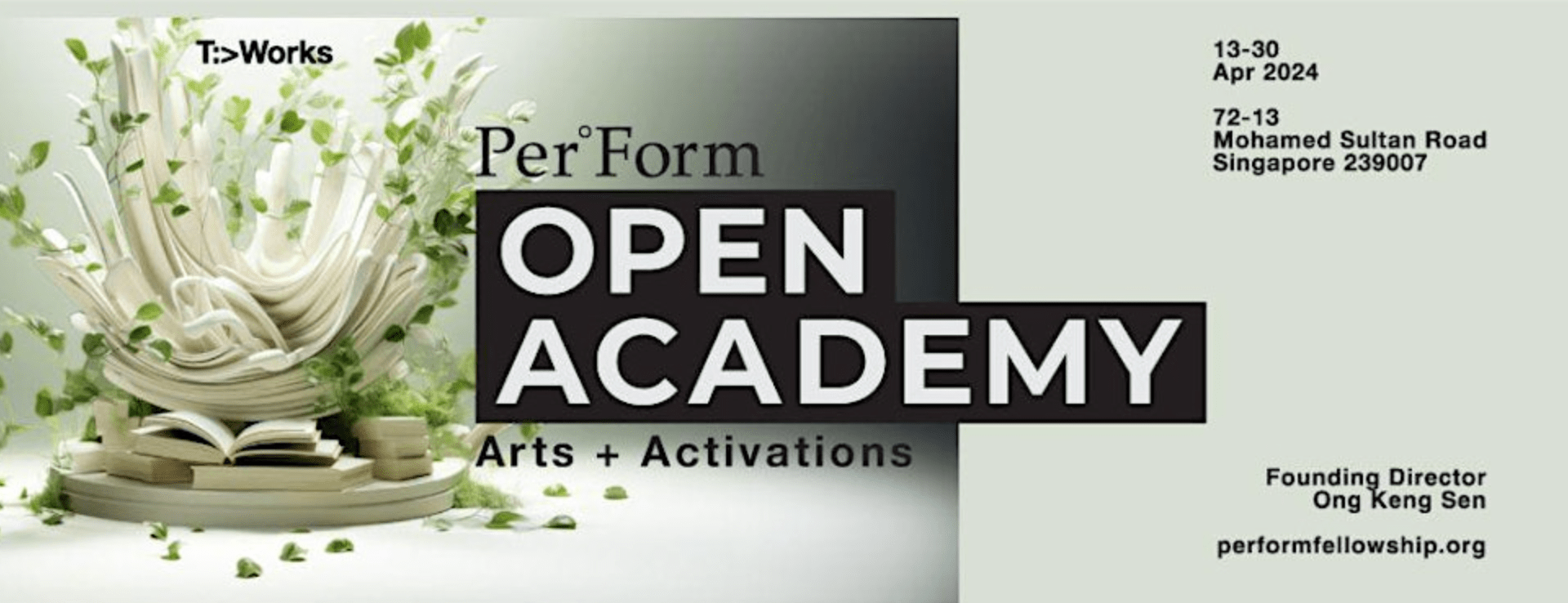

Last Wednesday, the second edition of T:>Works’ Per°Form Open Academy of Arts and Activations (POA) welcomed artist Hira Nabi to deliver an opening keynote, where the filmmaker presented a lecture performance at 72-13. Titled How to Love A Tree, the presentation showcased footage of green landscapes and misty mountains, while Hira spoke of forest time and the spectre of colonialism, drawing us into a dreamscape where we considered the temporality of all that is around us, and the very real prospect of extinction.
Outside, fashion designer Diamantina Arcoiris had set up an atelier in the foyer, filling it with material and footage of her work with the homeless and sex workers in the red light district of Bogotá. Showcasing haute couture, streetwear and blankets created by these vulnerable groups, Diamantina’s practice is one that prioritises care and social rehabilitation, upskilling as a means of recovery for these participants, and finding a means of expression and strength despite their marginalisation.

These are just two of the presentations that featured in this year’s edition of POA, which has expanded to a whopping three weeks worth of programming, from last year’s one. This year, as T:Works Artistic Director Ong Keng Sen puts it, is all about an ‘intense interweaving of art and socialisation of power’, where art is no longer simply a thing to be admired, but seems to form a key part of our social fabric, used as a means of driving thought and conversation and potentially even action that could bring about important change in the world. This year’s POA invites 15 Per°Form Fellows and intersectional practitioners from the Global South, each with their own practice, to present their strategies for activating contexts and communities.

As an ‘Open’ Academy, naturally, this isn’t an exclusive get-together, but rather, an invitation for members of the public to enter this space, and participate in this exchange of ideas and blossoming of conversations. “Open Academy is an opportunity for people to come out of their silos and participate in this project that traverses so many different disciplines,” says Ong Keng Sen, Artistic Director of T:>Works. “It is an experiment that brings together artists and cultural workers with audiences from other parallel industries. The promise we make is that we’re here to provide a platform for gatherings, whether it’s through our workshops or presentations, and a space for discussion between our fellows and the audience, in a single programme that cuts across spaces of transformative justice.”

The POA’s marketing materials this year focus on the idea of a sapling after all, and seems to champion growth through seeding the world and bringing like-minded individuals together to amplify their power. One of the key events that made a welcome return this year was the POA Marathon, which saw the Fellows present a whopping 15-hour series of showcases, sharing about their respective practices and demonstrations, considering disciplines as varied as sex work, climate change, female legacy and more, which audience members can come in and out of throughout the Marathon, granting a certain degree of freedom and choice.

“This year, there is a greater sense of intimate crossings, to cut through all these different silos and people working across visuals arts and arts education and more,” says Keng Sen. “We see different groups of audiences attending the different sessions, and while there will always exist some form of class divide, this is an opportunity for people beyond the usual crowd to just come to the space. We recognise that not everyone is ‘wired’ for the arts’ and what the POA does is to serve these people who are interested in these other disciplines, and find others and affinity with those who might be working in parallel communities or groups. It’s not networking per se, but about recognising that these tangential practices exist, and help them realise that they aren’t so alone in this and their endeavours.”
“I do believe that in Singapore as a whole, we do need greater exposure to social issues and practices from a younger age, and encourage them to ask much larger questions and how they can get involved more – we could never do Fridays For Future here for example,” says Keng Sen. “Singapore still needs to mature in terms of our consumption habits. An event does not need a mass crowd before it can be considered ‘worth’ supporting, and many of us are still devoted to the standard cookie cutter, institutionalised narrative of Singapore’s evolution from third world to first, rather than looking beyond that to consider how else we can expand the narrative and what we can think of that allows us to connect more deeply with the rest of the world.”

“It’s not so much about unlearning so much as just having more exposure – which is why POA is about the opportunity to interact, and provide that opportunities to experience things they don’t know much about to become a transformational space and a turning point, to speak with these diverse Fellows after their presentations, and simply immersing themselves in this atmosphere, and integrating these alternative perspectives and positions into what we already know, from the complexities of justice to issues of the homeless and marginalised, as we learn more and absorb other positions on issues we face.”
“That being said, each journey is different, and every individual has their own experience of shedding things and not just a cut and dried way of unlearning and organically morphing and evolving. Even if there is no structure for their practice in the public system, it is about realising that there are still ways to make change in small ways, whether it’s group meetings on Tuesdays or just a way to talk strategies of social justice, pooling their resources, that allows the birth of more such opportunities,” says Keng Sen. “With the Marathon, there really is opportunity to reap a bountiful harvest of experiences, and that is why we continue to hold the Commune/Banquet at the end as well, for them to process and make sense of all they’ve been through.”

On the other hand, even beyond the POA, T:>Works has also been expanding their scope by providing training and development for Artistic Directors in Singapore with the Artistic Directors Academy (ADA). Training up to 10 Artistic Directors over one year from April 2024 to March 2025, the ADA provides masterclass modules and mentoring for participants, resulting in a final public presentation in March 2025 about “the people cultures of a national theatre.” “The ADA isn’t formally teaching people dramaturgy or techniques, but more along the lines of generating conversation and discussion, for participants to learn how to draw connections – such as how we have two architects from Buenos Aires coming in to give a masterclass on urban development, and about social architecture that builds community,” says Keng Sen. “The idea comes down to training directors to adopt different ways of thinking and methodologies for work, and the ways in which art can intersect with public policy. The arts are inherently embedded into society, where even a play that touches the public and deals with social issues can have an impact.”
“The goal is that the participants of ADA will develop multiple perspectives towards creating a more liveable society, and working together with both artists and non-artists to connect with each other and the world, in turn establishing their practice, attitude, and lenses to take on as an artistic director,” adds Keng Sen. “In both POA and the ADA, in changing our own perspectives, it changes things in small ways. It doesn’t always have to be a mass movement – like say people can be lobbying for biodiversity instead of immediately calling for the preservation of Ubin’s marshes, or TRANS:MISSION using theatre to reach out to the public. As an Artistic Director, you already inherently should be interested in the idea of connecting people, be it as an ensemble or just bringing people together. That’s what we see for ourselves as T:>Works, moving past talking to large institutions, and moving on to connecting individuals and communities with each other. It creates a feedback loop for working in this way, and hopefully, helps shape the processes of the future.”

And just as the POA itself spawned and evolved from Keng Sen’s prior work such as The Flying Circus Project (1996–2013), as well as the Curator’s Academy (2018–22), even when this edition is over, it will continue to change and transform itself into new iterations as time goes by, shaping itself and those who attend it. “Change and transformation is the process by which we grow, and our focus continues to lie in the space of interactions between cultural receiver and cultural producer, and to see how all of these result in impacts on the larger world as our research and programming grows. The artist is just the catalyst, while the audience is there to reflect on the experience and their own understanding and context, and how it leads to action from this new production of knowledge,” concludes Keng Sen.
“The POA is still evolving, and after next year’s edition it might become something else altogether. We’re not necessarily here to completely change and transform the world, but sometimes about finding ways of amplifying good work that people are doing, to empower them and engage them in realising that they can go beyond passive viewers and consumers, into active agents of change.”
Per°Form Open Academy of Arts and Activations runs from 13th to 30th April 2024 at 72-13. Full programme and tickets available here
On 25th April, the Closing Keynote will be given by award-winning Uzbek filmmaker and artist Saodat Ismailova who has dominated major exhibitions in Europe in recent years. There will be numerous screenings as Saodat articulates her trajectories of ecology, tradition, living with the non-human, colonialism, and the female universe through the lens of her key film, The Haunted.
 Bakchormeeboy