
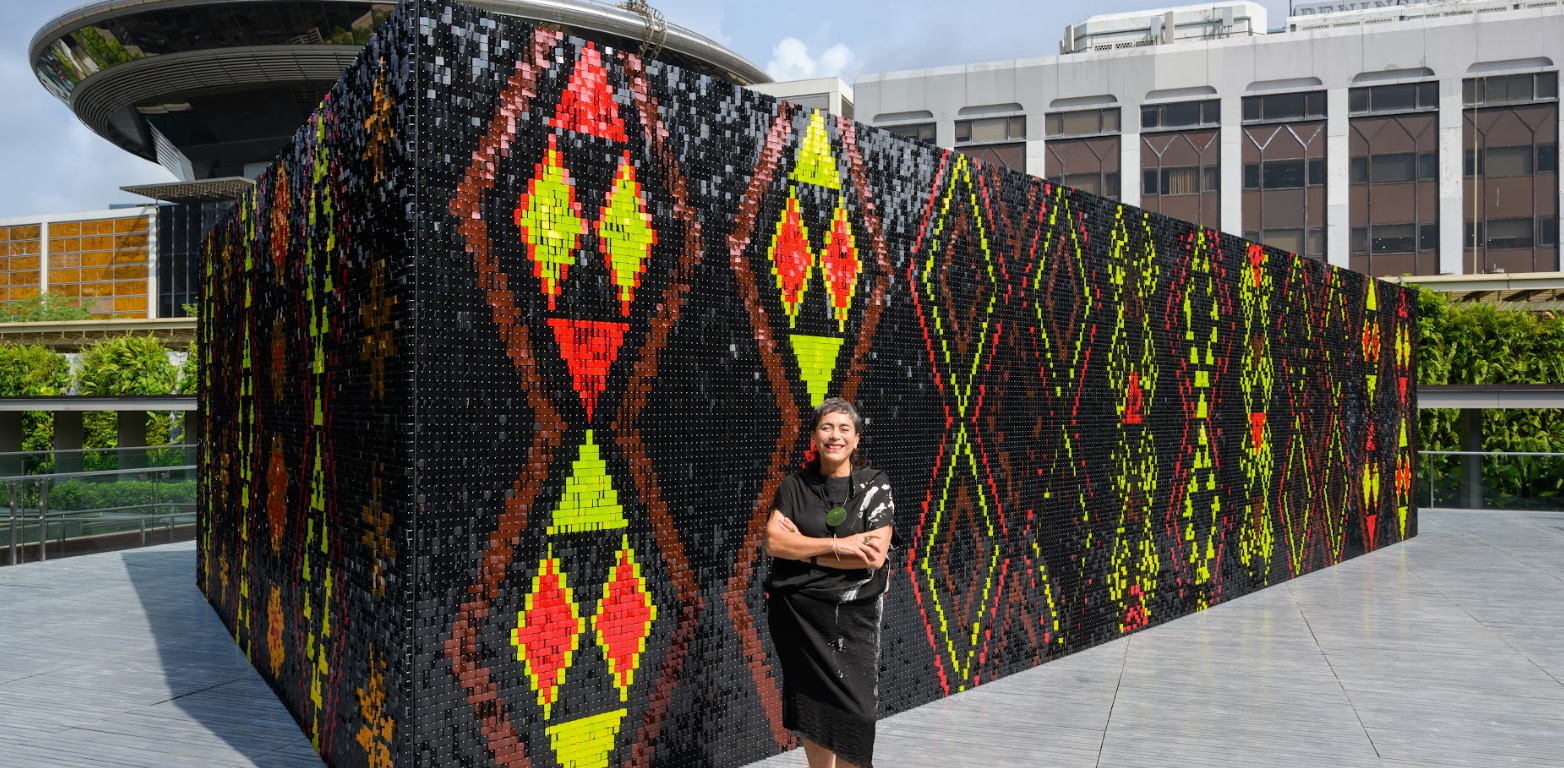
Humans are often more alike than we think, with surprising parallels taking place across cultures, arts and beliefs, even thousands of miles apart. Bringing that to light is Māori contemporary artist Lisa Reihana, whose new work GLISTEN, installed atop National Gallery Singapore, finds links between Southeast Asian Songket and Māori Tāniko weaving from Aotearoa New Zealand .
Taking the form of a large-scale outdoor kinetic installation, as part of the Gallery’s annual Ng Teng Fong Roof Garden Commission Series, GLISTEN presents a vibrant tapestry with intricate patterns that pay homage to the traditions and craft of Indigenous women weavers from Māori and Southeast Asian cultures, with the intertwining of art and nature. The three-sided sculpture reacts and responds playfully to its surrounding natural environment. With over 114,000 shimmer discs beautifully reflecting light, and with the accompanying soundscape of a wind chime, GLISTEN orchestrates a multi-sensory encounter with the artwork.
Inspiring a deeper appreciation of the respective cultures, while prompting thought about links between Southeast Asia and New Zealand, GLISTEN also hopes to deepen the understanding and expanding the representation of extraordinary textiles from both regions. We spoke to Lisa to find out more about the process of conceptualising and creating this work, alongside her own practice as a Māori contemporary artist. Read the interview in full below:

Bakchormeeboy: Could you share a bit about your research process that you went through, especially when it came to exploring songket weaving?
Lisa Reihana: My research includes that of Māori ancestral knowledge, materials, and costumes, and I worked closely with the Gallery’s curator Qinyi Lim, to research further into Southeast Asian weave patterns, referencing one of Malaysia’s early textile artists Grace Selvanayagam’s book, Songket: Malaysia’s Woven Treasure.
Bakchormeeboy: While you’re very well-versed in Maori history and heritage, could you share about something surprising you learnt, about either Maori or Southeast Asian culture, or the connections between them in the course of this project?
Lisa: This sculpture honours the traditions, labour and pivotal roles of both Songket and Tāniko’s women weavers as makers, communicators, knowledge bearers and mediators prior to the Asia Pacific region’s first contact with Western culture.
Through numerous studies and research, it has been established Southeast Asia and Oceania share connections as Polynesians have been proven to be genetically descended from Southeast Asia, hinting towards shared ancestry between the two regions.
Another similarity is that textiles and garments featuring Songket and Tāniko are worn on ceremonial occasions, so this work is to honour the beauty and craft of these incredible practices. Through this work, I want to honour the traditions, labour, and pivotal roles of the women weavers from Southeast Asia and Māori communities as makers, communicators, knowledge bearers, and mediators prior to the Asia Pacific region’s first contact with Western culture.

Bakchormeeboy: You’ve taken a keen interest in how digital technologies and virtual space as realms where innovation meets ancestral knowledge. With technology growing and changing at a rapid pace, especially with AI, how excited do you feel about how much potential this opens up for future projects?
Lisa: The digital realm and AI concerns me in relation to indigenous knowledge and copyright issues. Indigenous peoples should be first in line to access their culture, this is not always the case, and a complex subject! Some knowledge is sacred and remains under the stewardship of particular tribes,… but how to come to that conclusion, and who do you talk to to know? I’ve previously thought that sacred knowledge is so esoteric that even hearing about it might not lead to recognition – and therefore there is a degree of cultural safety. We should remain aware that some information might belong to others and support them in their journey first.
However, apart from raising these issues, I love the opportunity digital platforms offer to share information, support cultures and raise awareness or empathy. I hope that within the next decade access to artists and their communities will allow us to research and develop our stories on platforms that support the planet.

Bakchormeeboy: The Maori culture often pays homage or showcases a lot of respect for the land and nature. Do you feel that there is a way of reconciling that with digital art, especially considering how much energy consumption technology like AI takes up?
Lisa: I actually think I’m pretty old fashioned in the digital work that I do. So far I’ve avoided the fever surrounding block-chain intensive workflows. And it does concern me how resource intensive my life-style is, even while trying to lighten my footprint. Living in New Zealand also makes one very aware of the multiple issues facing us and our Pacific neighbours – sea level rise, nuclear proliferation and increased militarisation. Hopefully my art practice helps to elevate consciousness about these pressing issues… that is my role as an artist, the digital part is my communication tool of choice.

Bakchormeeboy: What was the process of working with National Gallery Singapore like, from the initial invitation to the freedom of ideation and installation?
Lisa: As part of the process, I was one artist invited to pitch a project for the Ng Teng Fong Rooftop Garden. I asked if I was expected to develop a video work, the answer was “No”, which provided the opportunity to work in a different capacity and draw upon my sculpture and public art practice.
In response to National Gallery Singapore’s invitation to propose for the Ng Teng Fong Roof Garden Commission Series, I was spurred by my longstanding research into Māori ancestral knowledge, materials, and costumes, and also extended my research into Songket weaving for this unique commission. Through GLISTEN, I wanted to deepen my understanding and expand the representation of these extraordinary textiles and cultural practices, and to honour the traditions, labour, and pivotal roles of the women weavers from Southeast Asia and Māori communities.
I have often worked with huge numbers of pixels when I’m producing large scale video works. However, this is the first time that I’ve worked with shimmer discs, and it takes 114,000 of them to make up GLISTEN. They still are reminiscent of my media practice. I think of GLISTEN as a three dimensional mural as an LED screen activated by the natural elements – the sun and the wind rather than power. Songket weaving features the addition of gold or silver threads that create a secondary pattern. The reflective quality of the shimmer discs made them an appropriate material, the perfect opportunity to shine. I chose square shimmer discs because they remind me of LED pixels, monitor resolution and square pixels when creating images using Photoshop or After FX.
It really is mesmerising to watch the play of wind and light across the work. The surfaces of the discs reflect sunlight and softly rattle in the wind. I love that visitors of all ages are drawn towards the work as it glimmers on the Ng Teng Fong Rooftop Garden.

Bakchormeeboy: How did you come to decide on the Maori pâtikitiki and kaokao patterns, and the Malay Pucuk Rebung Gigi Yu patterns for this work? How do the two specific styles come into conversation with each other?
Lisa: With GLISTEN, I wanted to deepen my understanding and, through this installation, expand the representation of extraordinary textiles and cultural practices of Māori and Southeast Asian communities.
Different stories are told through symbolic meanings behind the weaving patterns and motifs used. GLISTEN features Tāniko patterns, which is a traditional Māori style of finger weaving. Tāniko patterns are often woven around the borders of korowai (cloaks) and relay Māori stories, histories, and values. Māori weavers’ designs consisted of triangles, diamonds, diagonal bars and stepped patterns. These designs were usually worked in black, red, and white. The featured patterns include the pâtikitiki and kaokao patterns. The pâtikitiki pattern is usually represented as a repetitive diamond or geometric pattern. Pâtikitiki is the word for flounder, symbolising abundance, hospitality and providing for your people. The kaokao pattern refers to protection and resembles a repetitive ‘M’ shape and is said to represent the rib cage and arms of warriors (haka stance).
The artwork also features Songket which is a textile handwoven in silk or cotton and patterned with gold or silver threads, and I looked into Malaysian Songket weave patterns for GLISTEN. Songket is traditionally worn during ceremonial occasions including weddings and religious ceremonies where the colour and grandeur of Songket adds to the occasion, and in the early centuries, Songket was only worn by Malay royalty. The motifs featured in the patterns include the Pucuk Rebung Gigi Yu which fuses the Rebung (bamboo shoot) and shark motifs, the Teratai (lotus) which is associated with Malay culture and religions, and the mangosteen which symbolises the reflection of one’s feelings or one’s inner self as related to human spiritual state. The panels were placed onto frames outlining the three sides of GLISTEN, with one side featuring Tāniko weaving patterns, one side featuring Songket, and the third side showing a ‘handshake’ of both.
Bakchormeeboy: What are some of the challenges of being an artist in New Zealand?
Lisa: From my perspective, sometimes our youthfulness as a nation means it’s harder to appreciate what we have here, and the complexity of other nations’ histories. Equally our remoteness is both a positive and a negative. There are aspects unique to this part of the world… and I know other regions have incredible diversity of cultures we don’t see so much here. New Zealand’s smaller economy can make things tricky… it can curtail a “think big” attitude, and limits access to a range of materials and skills.

Bakchormeeboy: Representation and community are gaining more awareness and significance in the art world – what is it like to identify as a Maori artist specifically, and is there more joy or pressure to always represent your culture in all your works?
Lisa: Yes, I do from time to time feel the pressure to represent my people. The way I deal with these feelings is to ensure I work hard, know I have earned the belief, and do the very best I can… Some projects have good financial and human resources, and then I’m able to include others too, that pressure is shared across a team. Regardless, I love my job and always push myself to learn more and to share that knowledge.
Photo Credit: National Gallery Singapore
GLISTEN is displayed till 30th March 2025 at the Ng Teng Fong Roof Garden Gallery, Level 5, City Hall Wing, National Gallery Singapore. Admission is free. More information available here
 Bakchormeeboy